



 Chat with AI
Exam 8: Transport Across Membranes: Overcoming the Permeability Barrier

Exam 1: A Preview of the Cell66 Questions
Exam 2: The Chemistry of the Cell62 Questions
Exam 3: The Macromolecules of the Cell62 Questions
Exam 4: Cells and Organelles59 Questions
Exam 5: Bioenergetics: the Flow of Energy in the Cell62 Questions
Exam 6: Enzymes: the Catalysts of Life58 Questions
Exam 7: Membranes: Their Structure, function, and Chemistry61 Questions
Exam 8: Transport Across Membranes: Overcoming the Permeability Barrier59 Questions
Exam 9: Chemotrophic Energy Metabolism: Glycolysis and Fermentation60 Questions
Exam 10: Chemotrophic Energy Metabolism: Aerobic Respiration61 Questions
Exam 11: Phototrophic Energy Metabolism: Photosynthesis62 Questions
Exam 12: The Endomembrane System and Peroxisomes59 Questions
Exam 13: Signal Transduction Mechanisms: Ielectrical and Synaptic Signaling in Neurons60 Questions
Exam 14: Signal Transduction Mechanisms: Iimessengers and Receptors59 Questions
Exam 15: Cytoskeletal Systems74 Questions
Exam 16: Cellular Movement: Motility and Contractility62 Questions
Exam 17: Beyond the Cell: Cell Adhesions, cell Junctions, and Extracellular Structures60 Questions
Exam 18: The Structural Basis of Cellular Information: DNA, chromosomes, and the Nucleus59 Questions
Exam 19: The Cell Cycle, DNA Replication, and Mitosis60 Questions
Exam 20: Sexual Reproduction, meiosis, and Genetic Recombination59 Questions
Exam 21: Gene Expression: Ithe Genetic Code and Transcription59 Questions
Exam 22: Gene Expression: Iiprotein Synthesis and Sorting60 Questions
Exam 23: The Regulation of Gene Expression59 Questions
Exam 24: Cancer Cells60 Questions
Select questions type


In bacteria,the porins have the unique ability to transport
(Multiple Choice)
4.8/5  (88)
(88) The bacteriorhodopsin proton pump creates a proton gradient that is needed in the process of anoxygenic photosynthesis.The energy necessary to drive this pump is generated by
(Multiple Choice)
4.9/5 (80)
(80) Receptor-mediated endocytosis involves vesicles with a special coat protein known as ________.
(Short Answer)
5.0/5 (66)
(66) Which of the following is not a mechanism of active transport?
(Multiple Choice)
4.9/5 (67)
(67) Which of the following glucose transporters in humans has properties that facilitate glucose transport out of the cell in response to keeping blood sugar levels homeostatic?
(Multiple Choice)
4.7/5 (81)
(81) Transmembrane movement of a substance with a concentration gradient,with no involvement of membrane proteins,is called ________.
(Short Answer)
4.8/5 (75)
(75) The P-type ATPases associated with the movement of heavy metals are
(Multiple Choice)
4.9/5 (78)
(78) Which of the following measures is used to determine a substance's polarity?
(Multiple Choice)
4.9/5 (89)
(89) The graph below shows the rate of transport for each substance when the cells are placed in 0.10 mM solutions of A,B,and C.Based on these data and coupled with the data observed above,substance C is transported via ________.
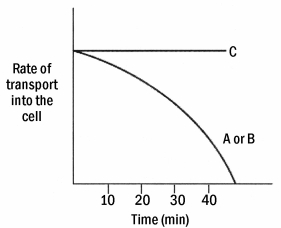
(Not Answered)
This question doesn't have any answer yet
While working with a novel cell line,you observe that movement of hydrophobic molecules,such as cholesterol and fatty acids,is impaired.You narrow the defect down to a P-type ATPase
(Multiple Choice)
4.8/5 (86)
(86) When transporting uncharged molecules across the membrane,which of the following is/are false?
(Multiple Choice)
4.8/5 (83)
(83) In the capillaries of the body tissues,CO₂ diffuses ________ and is converted to ________.
(Short Answer)
4.8/5 (77)
(77) Consider the glucose transporters (GLUT).In the case of GLUT1,glucose is transported into the cell for use by the cell.On the other hand,GLUT2 in liver cells allows for glucose to be released by the cells.Why would the body need GLUT systems with such variation?
(Essay)
4.7/5 (88)
(88) The type of transport ATPase that are reversibly phosphorylated as part of the transport mechanism are the ________ ATPases.
(Short Answer)
4.9/5 (83)
(83) You wish to dehydrate a piece of meat using solutions of varying salt concentrations.The best concentration to use would be
(Multiple Choice)
4.8/5 (75)
(75) The graph above shows the initial rate of transport for each substance when the cells are placed in solutions of different concentrations of A,B,and C.Based on these data,substance A is transported via
(Multiple Choice)
4.9/5 (86)
(86) In examining glucose transport into a cell,the immediate phosphorylation of glucose following its entry into the cell
(Multiple Choice)
5.0/5 (82)
(82) In the capillaries of the lungs,O₂ diffuses ________ and is bound to ________.
(Short Answer)
4.9/5 (61)
(61) Transmembrane movement of a substance with a concentration gradient utilizing a membrane protein is called ________.
(Short Answer)
4.9/5 (86)
(86) 
Filters
- Essay(0)
- Multiple Choice(0)
- Short Answer(0)
- True False(0)
- Matching(0)