



 Chat with AI
Exam 18: Markets for Factors of Production

Exam 1: What Is Economics212 Questions
Exam 2: The Economic Problem159 Questions
Exam 3: Demand and Supply197 Questions
Exam 4: Elasticity186 Questions
Exam 5: Efficiency and Equity119 Questions
Exam 6: Governments Actions in Markets130 Questions
Exam 7: Global Markets in Action138 Questions
Exam 8: Utility and Demand120 Questions
Exam 9: Possibilities, Preferences, and Choices124 Questions
Exam 10: Organizing Production111 Questions
Exam 11: Output and Costs142 Questions
Exam 12: Perfect Competition117 Questions
Exam 13: Monopoly118 Questions
Exam 14: Monopolistic Competition122 Questions
Exam 15: Oligopoly106 Questions
Exam 16: Externalities116 Questions
Exam 17: Public Goods and Common Resources98 Questions
Exam 18: Markets for Factors of Production128 Questions
Exam 19: Economic Inequality124 Questions
Exam 20: Measuring Gdp and Economic Growth133 Questions
Exam 21: Monitoring Jobs and Inflation121 Questions
Exam 22: Economic Growth98 Questions
Exam 23: Finance, Saving, and Investment141 Questions
Exam 24: Money, the Price Level, and Inflation126 Questions
Exam 25: The Exchange Rate and the Balance of Payments126 Questions
Exam 26: Aggregate Supply and Aggregate Demand136 Questions
Exam 27: Expenditure Multipliers171 Questions
Exam 28: The Business Cycle, Inflation, and Deflation110 Questions
Exam 29: Fiscal Policy97 Questions
Exam 30: Monetary Policy97 Questions
Exam 31: Macro Only: International Trade Policy126 Questions
Select questions type


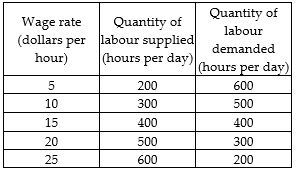 Table 18.3.1
-Refer to Table 18.3.1. Table 18.3.1 gives information about the labour market in Lantis, a community in which the labour market is perfectly competitive. If the price of the good that Lantis produces increases and the value of marginal product of labour changes by $10 an hour, the equilibrium wage rate ________ an hour and the quantity of labour employed ________.
Table 18.3.1
-Refer to Table 18.3.1. Table 18.3.1 gives information about the labour market in Lantis, a community in which the labour market is perfectly competitive. If the price of the good that Lantis produces increases and the value of marginal product of labour changes by $10 an hour, the equilibrium wage rate ________ an hour and the quantity of labour employed ________. (Multiple Choice)
4.8/5  (93)
(93) Use the figure below to answer the following questions.
 Figure 18.3.1
-Refer to Figure 18.3.1. This figure shows the value of marginal product of labour curve, the labour supply curve, and the marginal cost of labour curve. If this labour market is controlled by a monopsony, the wage rate is
Figure 18.3.1
-Refer to Figure 18.3.1. This figure shows the value of marginal product of labour curve, the labour supply curve, and the marginal cost of labour curve. If this labour market is controlled by a monopsony, the wage rate is (Multiple Choice)
4.8/5 (67)
(67) The present value of a future sum of money is the amount that, if invested today, will grow
(Multiple Choice)
4.8/5 (88)
(88) Use the figure below to answer the following questions.
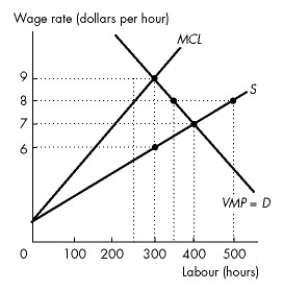 Figure 18.3.3
-Refer to Figure 18.3.3. Suppose the government passes a minimum wage law that prohibits anyone from hiring labour at less than $8 per hour. The monopsonist will hire
Figure 18.3.3
-Refer to Figure 18.3.3. Suppose the government passes a minimum wage law that prohibits anyone from hiring labour at less than $8 per hour. The monopsonist will hire (Multiple Choice)
4.9/5 (66)
(66) If the wage rate increases, the substitution effect gives a household the incentive to
(Multiple Choice)
4.8/5 (87)
(87) Use the table below to answer the following questions.
Table 18.2.1
 -Refer to Table 18.2.1. If the firm can sell all the output it wants for the price of $5 a unit, what is the value of marginal product of the 6th worker?
 (Multiple Choice)
4.8/5 (75)
(75) 
Filters
- Essay(0)
- Multiple Choice(0)
- Short Answer(0)
- True False(0)
- Matching(0)