



 Chat with AI
Exam 18: Markets for Factors of Production

Exam 1: What Is Economics212 Questions
Exam 2: The Economic Problem159 Questions
Exam 3: Demand and Supply197 Questions
Exam 4: Elasticity186 Questions
Exam 5: Efficiency and Equity119 Questions
Exam 6: Governments Actions in Markets130 Questions
Exam 7: Global Markets in Action138 Questions
Exam 8: Utility and Demand120 Questions
Exam 9: Possibilities, Preferences, and Choices124 Questions
Exam 10: Organizing Production111 Questions
Exam 11: Output and Costs142 Questions
Exam 12: Perfect Competition117 Questions
Exam 13: Monopoly118 Questions
Exam 14: Monopolistic Competition122 Questions
Exam 15: Oligopoly106 Questions
Exam 16: Externalities116 Questions
Exam 17: Public Goods and Common Resources98 Questions
Exam 18: Markets for Factors of Production128 Questions
Exam 19: Economic Inequality124 Questions
Exam 20: Measuring Gdp and Economic Growth133 Questions
Exam 21: Monitoring Jobs and Inflation121 Questions
Exam 22: Economic Growth98 Questions
Exam 23: Finance, Saving, and Investment141 Questions
Exam 24: Money, the Price Level, and Inflation126 Questions
Exam 25: The Exchange Rate and the Balance of Payments126 Questions
Exam 26: Aggregate Supply and Aggregate Demand136 Questions
Exam 27: Expenditure Multipliers171 Questions
Exam 28: The Business Cycle, Inflation, and Deflation110 Questions
Exam 29: Fiscal Policy97 Questions
Exam 30: Monetary Policy97 Questions
Exam 31: Macro Only: International Trade Policy126 Questions
Select questions type


Use the figure below to answer the following questions.
 Figure 18.3.1
-Refer to Figure 18.3.1. This figure shows the value of marginal product of labour curve, the labour supply curve, and the marginal cost of labour curve. If this labour market is competitive, the wage rate is
Figure 18.3.1
-Refer to Figure 18.3.1. This figure shows the value of marginal product of labour curve, the labour supply curve, and the marginal cost of labour curve. If this labour market is competitive, the wage rate is (Multiple Choice)
4.7/5  (77)
(77) If the price of a natural resource is expected to rise at a rate that exceeds the interest rate, demand ________ and supply ________.
(Multiple Choice)
4.9/5 (95)
(95) Use the table below to answer the following questions.
Table 18.2.1
 -Refer to Table 18.2.1. If the firm can sell all the output it wants for the price of $10 a unit, what is the profit-maximizing number of workers if the wage rate is $30?
 (Multiple Choice)
4.8/5 (83)
(83) Use the table below to answer the following questions.
Table 18.2.2
Wendy owns an apple orchard and she employs students
to pick the apples. In an hour they can pick the following amounts:
 -Refer to Table 18.2.2. If the price of apples is $0.50 per kilogram, the value of marginal product of the 5th student is
 (Multiple Choice)
4.8/5 (69)
(69) The Internet is ________ natural resource. Power generated by wind turbines is ________ natural resource.
(Multiple Choice)
4.8/5 (74)
(74) Use the information below to answer the following questions.
Fact 18.4.1
Water is a natural resource that is plentiful in Canada but not plentiful in Arizona and southern California. Suppose Canadians start to export bulk water to Arizona and southern California.
-Refer to Fact 18.4.1. The Hotelling Principle ________ apply to Canada's water because the Hotelling Principle ________.
(Multiple Choice)
4.9/5 (73)
(73) Use the information below to answer the following questions.
Fact 18.2.1
Wanda's is a fish store that hires students to pack the fish. The fish market is competitive. Originally the price is 50¢ a kilogram. The market for packers is competitive and their market wage rate is $7.50 an hour. Then the market price of fish falls to 33.33¢ a kilogram but the wage rate of fish packers remains at $7.50 an hour.
-Refer to Fact 18.2.1. As a result, students' marginal product ________ and students' value of marginal product ________.
(Multiple Choice)
4.8/5 (91)
(91) Suppose a profit-maximizing firm hires labour in a competitive labour market. If the value of marginal product of labour is less than the wage rate, the firm should
(Multiple Choice)
4.9/5 (84)
(84) If marginal product of a restaurant employee is 10 customers per hour, and the price of a meal is $15, the restaurant employee's value of marginal product is
(Multiple Choice)
4.7/5 (82)
(82) Which one of the following would unions be most likely to support?
(Multiple Choice)
4.9/5 (88)
(88) Use the figure below to answer the following questions.
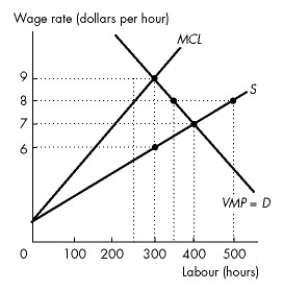 Figure 18.3.3
-Refer to Figure 18.3.3. For the monopsonist employer illustrated in this figure, the profit-maximizing wage rate is ________ and the quantity of labour hired is ________.
Figure 18.3.3
-Refer to Figure 18.3.3. For the monopsonist employer illustrated in this figure, the profit-maximizing wage rate is ________ and the quantity of labour hired is ________. (Multiple Choice)
4.8/5 (62)
(62) Suppose a profit-maximizing firm hires labour in a competitive labour market. If the value of marginal product of labour is greater than the wage rate, the firm should
(Multiple Choice)
4.8/5 (74)
(74) If the present value of the $1,000 to be received in one year is $800, the interest rate is
(Multiple Choice)
5.0/5 (83)
(83) A shift in a firm's demand curve for labour occurs when there is a change in the
(Multiple Choice)
4.7/5 (82)
(82) The present value of a future payment of money will be higher the
(Multiple Choice)
5.0/5 (86)
(86) If the value of marginal product of capital decreases as more capital is employed, then the
(Multiple Choice)
4.8/5 (88)
(88) Mr. Smith's firm competes in a perfectly competitive market. The firm is currently hiring 30 workers. The value of marginal product of the last worker is $7.00 per hour. The wage rate is $8.00 per hour. To increase profit, Mr. Smith should
(Multiple Choice)
5.0/5 (81)
(81) To increase the demand for union labour, unions do all of the following except
(Multiple Choice)
4.8/5 (82)
(82) 
Filters
- Essay(0)
- Multiple Choice(0)
- Short Answer(0)
- True False(0)
- Matching(0)