



 Chat with AI
Exam 18: Markets for Factors of Production

Exam 1: What Is Economics212 Questions
Exam 2: The Economic Problem159 Questions
Exam 3: Demand and Supply197 Questions
Exam 4: Elasticity186 Questions
Exam 5: Efficiency and Equity119 Questions
Exam 6: Governments Actions in Markets130 Questions
Exam 7: Global Markets in Action138 Questions
Exam 8: Utility and Demand120 Questions
Exam 9: Possibilities, Preferences, and Choices124 Questions
Exam 10: Organizing Production111 Questions
Exam 11: Output and Costs142 Questions
Exam 12: Perfect Competition117 Questions
Exam 13: Monopoly118 Questions
Exam 14: Monopolistic Competition122 Questions
Exam 15: Oligopoly106 Questions
Exam 16: Externalities116 Questions
Exam 17: Public Goods and Common Resources98 Questions
Exam 18: Markets for Factors of Production128 Questions
Exam 19: Economic Inequality124 Questions
Exam 20: Measuring Gdp and Economic Growth133 Questions
Exam 21: Monitoring Jobs and Inflation121 Questions
Exam 22: Economic Growth98 Questions
Exam 23: Finance, Saving, and Investment141 Questions
Exam 24: Money, the Price Level, and Inflation126 Questions
Exam 25: The Exchange Rate and the Balance of Payments126 Questions
Exam 26: Aggregate Supply and Aggregate Demand136 Questions
Exam 27: Expenditure Multipliers171 Questions
Exam 28: The Business Cycle, Inflation, and Deflation110 Questions
Exam 29: Fiscal Policy97 Questions
Exam 30: Monetary Policy97 Questions
Exam 31: Macro Only: International Trade Policy126 Questions
Select questions type


Consider the factors of production. The price in a(n)________ market is a rental rate.
(Multiple Choice)
4.7/5  (88)
(88) The present value of the $50 that will be received next year is $40. What is the interest rate?
(Multiple Choice)
4.9/5 (91)
(91) The supply of a nonrenewable natural resource is determined by all of the following factors except
(Multiple Choice)
4.9/5 (80)
(80) 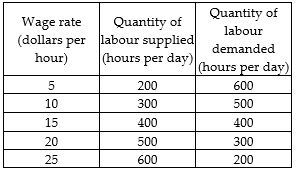 Table 18.3.1
-Refer to Table 18.3.1. Table 18.3.1 gives information about the labour market in Lantis, a community in which the labour market is perfectly competitive. The equilibrium wage rate is ________ an hour and the quantity of labour employed is ________ hours per day.
Table 18.3.1
-Refer to Table 18.3.1. Table 18.3.1 gives information about the labour market in Lantis, a community in which the labour market is perfectly competitive. The equilibrium wage rate is ________ an hour and the quantity of labour employed is ________ hours per day. (Multiple Choice)
4.9/5 (83)
(83) Use the information below to answer the following questions.
Fact 18.3.1 In Modern Rarity, Workers Form Union at Small Chain
In New York's low-income neighbourhoods, labour unions have virtually no presence. But after a year-long struggle, 95 workers at a chain of 10 sneaker stores have formed a union. After months of negotiations, the two sides signed a three-year contract that sets the wage rate at $7.25 an hour.
Source: The New York Times, February 5, 2006
-Refer to Fact 18.3.1. The winners from this contract are ________. The losers from this contract are ________.
(Multiple Choice)
4.9/5 (84)
(84) A firm can sell its output for $40 per unit. When it increases its labour force from 4 workers to 5 workers, its output increases from 15 to 17 units. The value of marginal product of the 5th worker is
(Multiple Choice)
4.9/5 (75)
(75) A profit-maximizing firm will continue to hire labour until the
(Multiple Choice)
4.9/5 (78)
(78) Use the information below to answer the following questions.
Fact 18.3.1 In Modern Rarity, Workers Form Union at Small Chain
In New York's low-income neighbourhoods, labour unions have virtually no presence. But after a year-long struggle, 95 workers at a chain of 10 sneaker stores have formed a union. After months of negotiations, the two sides signed a three-year contract that sets the wage rate at $7.25 an hour.
Source: The New York Times, February 5, 2006
-Refer to Fact 18.3.1. The union can try to increase the demand for labour by doing all of the following except
(Multiple Choice)
4.9/5 (74)
(74) Which of the following would unions be least likely to support?
(Multiple Choice)
4.8/5 (74)
(74) The value of marginal product of oil is the ________ influence on demand. The greater the quantity of oil used, the ________ is the value of marginal product of oil.
(Multiple Choice)
4.8/5 (87)
(87) Use the figure below to answer the following questions.
 Figure 18.3.1
-Refer to Figure 18.3.1. This figure shows the value of marginal product of labour curve, the labour supply curve, and the marginal cost of labour curve. If a union and the monopsonist in Figure 18.3.1 are equally strong, the outcome will be an hourly wage
Figure 18.3.1
-Refer to Figure 18.3.1. This figure shows the value of marginal product of labour curve, the labour supply curve, and the marginal cost of labour curve. If a union and the monopsonist in Figure 18.3.1 are equally strong, the outcome will be an hourly wage (Multiple Choice)
4.8/5 (68)
(68) Use the figure below to answer the following questions.
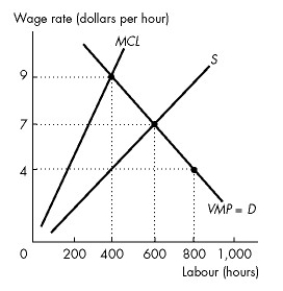 Figure 18.3.2
-Refer to Figure 18.3.2. If the labour market illustrated in this figure becomes competitive, the equilibrium wage rate is ________ and the quantity of labour hired is ________.
Figure 18.3.2
-Refer to Figure 18.3.2. If the labour market illustrated in this figure becomes competitive, the equilibrium wage rate is ________ and the quantity of labour hired is ________. (Multiple Choice)
4.8/5 (79)
(79) The demand for the services of labour ________ a derived demand and the demand for the services of land ________ a derived demand.
(Multiple Choice)
4.9/5 (96)
(96) Use the information below to answer the following questions.
Fact 18.2.1
Wanda's is a fish store that hires students to pack the fish. The fish market is competitive. Originally the price is 50¢ a kilogram. The market for packers is competitive and their market wage rate is $7.50 an hour. Then the market price of fish falls to 33.33¢ a kilogram but the wage rate of fish packers remains at $7.50 an hour.
-Refer to Fact 18.2.3. As a result,
(Multiple Choice)
4.9/5 (87)
(87) The demand for labour is a derived demand because it is derived from
(Multiple Choice)
4.7/5 (83)
(83) Use the table below to answer the following questions.
Table 18.2.2
Wendy owns an apple orchard and she employs students
to pick the apples. In an hour they can pick the following amounts:
 -Consider Table 18.2.2. If the price of apples is $0.50 per kilogram, and the wage rate for apple pickers is $7.50 per hour, then the number of pickers that Wendy will hire is
 (Multiple Choice)
4.8/5 (96)
(96) 
Filters
- Essay(0)
- Multiple Choice(0)
- Short Answer(0)
- True False(0)
- Matching(0)