



 Chat with AI
Exam 14: Monopolistic Competition

Exam 1: What Is Economics212 Questions
Exam 2: The Economic Problem159 Questions
Exam 3: Demand and Supply197 Questions
Exam 4: Elasticity186 Questions
Exam 5: Efficiency and Equity119 Questions
Exam 6: Governments Actions in Markets130 Questions
Exam 7: Global Markets in Action138 Questions
Exam 8: Utility and Demand120 Questions
Exam 9: Possibilities, Preferences, and Choices124 Questions
Exam 10: Organizing Production111 Questions
Exam 11: Output and Costs142 Questions
Exam 12: Perfect Competition117 Questions
Exam 13: Monopoly118 Questions
Exam 14: Monopolistic Competition122 Questions
Exam 15: Oligopoly106 Questions
Exam 16: Externalities116 Questions
Exam 17: Public Goods and Common Resources98 Questions
Exam 18: Markets for Factors of Production128 Questions
Exam 19: Economic Inequality124 Questions
Exam 20: Measuring Gdp and Economic Growth133 Questions
Exam 21: Monitoring Jobs and Inflation121 Questions
Exam 22: Economic Growth98 Questions
Exam 23: Finance, Saving, and Investment141 Questions
Exam 24: Money, the Price Level, and Inflation126 Questions
Exam 25: The Exchange Rate and the Balance of Payments126 Questions
Exam 26: Aggregate Supply and Aggregate Demand136 Questions
Exam 27: Expenditure Multipliers171 Questions
Exam 28: The Business Cycle, Inflation, and Deflation110 Questions
Exam 29: Fiscal Policy97 Questions
Exam 30: Monetary Policy97 Questions
Exam 31: Macro Only: International Trade Policy126 Questions
Select questions type


Use the figure below to answer the following questions.
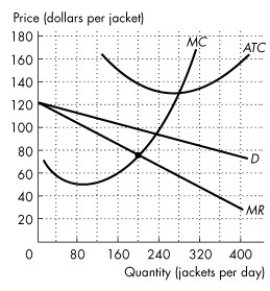 Figure 14.2.6
-Refer to Figure 14.2.6, which shows the demand curve, marginal revenue curve and cost curves faced by Gap. Gap maximizes its profit if it charges ________ per jacket.
Figure 14.2.6
-Refer to Figure 14.2.6, which shows the demand curve, marginal revenue curve and cost curves faced by Gap. Gap maximizes its profit if it charges ________ per jacket. (Multiple Choice)
4.8/5  (79)
(79) Use the figure below to answer the following questions.
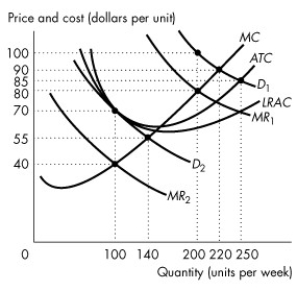 Figure 14.2.3
-Refer to Figure 14.2.3. Assume this firm faces demand curve D₂. When the firm produces the efficient quantity, it produces
Figure 14.2.3
-Refer to Figure 14.2.3. Assume this firm faces demand curve D₂. When the firm produces the efficient quantity, it produces (Multiple Choice)
4.7/5 (86)
(86) Use the figure below to answer the following questions.
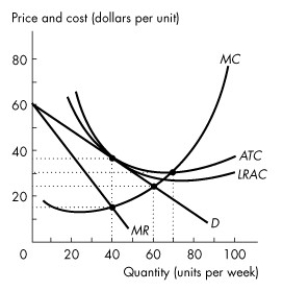 Figure 14.2.2
-Refer to Figure 14.2.2. To maximize economic profit, this firm in monopolistic competition will charge a price of
Figure 14.2.2
-Refer to Figure 14.2.2. To maximize economic profit, this firm in monopolistic competition will charge a price of (Multiple Choice)
4.8/5 (77)
(77) Choose the correct statement about firms in monopolistic competition.
(Multiple Choice)
4.7/5 (86)
(86) In the long run, all firms in an industry that is monopolistically competitive
(Multiple Choice)
4.9/5 (72)
(72) Consider a monopolistically competitive industry in long-run equilibrium. Suppose there is a large increase in wages that raises the costs for all firms. What happens within each firm in the short run?
(Multiple Choice)
4.7/5 (78)
(78) Use the figure below to answer the following questions.
Figure 14.2.3
-Refer to Figure 14.2.3. Assume this firm faces demand curve D₂. At the profit-maximizing output level, the firm
Figure 14.2.3
-Refer to Figure 14.2.3. Assume this firm faces demand curve D₂. At the profit-maximizing output level, the firm (Multiple Choice)
4.9/5 (80)
(80) Mrs. Smith's bakery shop is a firm in monopolistic competition. She is currently selling a box of bread for $16. The firm's marginal cost is $7 and marginal revenue is $7. To maximize economic profit Mrs. Smith
(Multiple Choice)
4.8/5 (73)
(73) Use the information below to answer the following questions.
Fact 14.3.2
Suppose that Tommy Hilfiger's marginal cost of a jacket is $100 (a constant marginal cost)and at one of the firm's shops, total fixed cost is $2,000 a day. The profit-maximizing number of jackets sold in this shop is 20 a day. Then the shops nearby start to advertise their jackets. The Tommy Hilfiger shop now spends $2,000 a day advertising its jackets, and its profit-maximizing number of jackets sold jumps to 50 a day.
-Refer to Fact 14.3.2. Tommy Hilfiger uses advertising as a signal because
(Multiple Choice)
4.9/5 (74)
(74) Use the information below to answer the following questions.
Fact 14.3.3
Suppose that Roots' marginal cost of a jacket is a constant $125.00 and the total fixed cost at one of its stores is $1,500 a day. This store sells 20 jackets a day, which is its profit-maximizing number of jackets. Then the stores nearby start to advertise their jackets. The Roots store now spends $2,000 a day advertising its jackets, and its profit-maximizing number of jackets sold jumps to 70 a day.
-Refer to Fact 14.3.3. After the advertising begins, the average total cost of a jacket sold in this store is
(Multiple Choice)
4.8/5 (80)
(80) Use the figure below to answer the following questions.
Figure 14.2.3
-Refer to Figure 14.2.3. Assume this firm faces demand curve D₂. If the firm produces the efficient quantity, it
Figure 14.2.3
-Refer to Figure 14.2.3. Assume this firm faces demand curve D₂. If the firm produces the efficient quantity, it (Multiple Choice)
4.8/5 (92)
(92) Use the figure below to answer the following questions.
Figure 14.2.3
-Refer to Figure 14.2.3. Assume this firm faces demand curve D₁. If this firm in monopolistic competition is maximizing profit,
Figure 14.2.3
-Refer to Figure 14.2.3. Assume this firm faces demand curve D₁. If this firm in monopolistic competition is maximizing profit, (Multiple Choice)
4.8/5 (75)
(75) Which of the following best explains why firms in monopolistic competition face a downward-sloping demand curve while perfectly competitive firms do not?
(Multiple Choice)
4.9/5 (70)
(70) Use the figure below to answer the following questions.
Figure 14.2.3
-Refer to Figure 14.2.3. Assume this firm faces demand curve D₁. If the firm produced the efficient quantity, it would produce
Figure 14.2.3
-Refer to Figure 14.2.3. Assume this firm faces demand curve D₁. If the firm produced the efficient quantity, it would produce (Multiple Choice)
4.9/5 (81)
(81) A monopolistically competitive firm has excess capacity because in the
(Multiple Choice)
4.9/5 (85)
(85) Consider a monopolistically competitive industry which is in long-run equilibrium. Which of the following is true?
(Multiple Choice)
4.7/5 (78)
(78) Use the figure below to answer the following questions.
Figure 14.2.3
-Refer to Figure 14.2.3. Assume this firm faces demand curve D₂. If this firm in monopolistic competition is maximizing economic profit,
Figure 14.2.3
-Refer to Figure 14.2.3. Assume this firm faces demand curve D₂. If this firm in monopolistic competition is maximizing economic profit, (Multiple Choice)
4.8/5 (84)
(84) 
Filters
- Essay(0)
- Multiple Choice(0)
- Short Answer(0)
- True False(0)
- Matching(0)