



 Chat with AI
Exam 14: Monopolistic Competition

Exam 1: What Is Economics212 Questions
Exam 2: The Economic Problem159 Questions
Exam 3: Demand and Supply197 Questions
Exam 4: Elasticity186 Questions
Exam 5: Efficiency and Equity119 Questions
Exam 6: Governments Actions in Markets130 Questions
Exam 7: Global Markets in Action138 Questions
Exam 8: Utility and Demand120 Questions
Exam 9: Possibilities, Preferences, and Choices124 Questions
Exam 10: Organizing Production111 Questions
Exam 11: Output and Costs142 Questions
Exam 12: Perfect Competition117 Questions
Exam 13: Monopoly118 Questions
Exam 14: Monopolistic Competition122 Questions
Exam 15: Oligopoly106 Questions
Exam 16: Externalities116 Questions
Exam 17: Public Goods and Common Resources98 Questions
Exam 18: Markets for Factors of Production128 Questions
Exam 19: Economic Inequality124 Questions
Exam 20: Measuring Gdp and Economic Growth133 Questions
Exam 21: Monitoring Jobs and Inflation121 Questions
Exam 22: Economic Growth98 Questions
Exam 23: Finance, Saving, and Investment141 Questions
Exam 24: Money, the Price Level, and Inflation126 Questions
Exam 25: The Exchange Rate and the Balance of Payments126 Questions
Exam 26: Aggregate Supply and Aggregate Demand136 Questions
Exam 27: Expenditure Multipliers171 Questions
Exam 28: The Business Cycle, Inflation, and Deflation110 Questions
Exam 29: Fiscal Policy97 Questions
Exam 30: Monetary Policy97 Questions
Exam 31: Macro Only: International Trade Policy126 Questions
Select questions type


Calvin is a custom picture framer. His total fixed cost is $110 a day, and his average variable cost is $1 a frame. He is maximizing his profit by selling 22 picture frames a day for $6 a frame. Few people know about Calvin's Framery. Calvin thinks that if he spends $10 a day on advertising, he can increase his market and sell 44 picture frames a day for $6 a frame. If Calvin's belief about the effect of advertising is correct, he
(Multiple Choice)
4.7/5  (82)
(82) Use the figure below to answer the following questions.
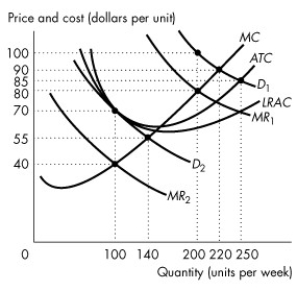 Figure 14.2.3
-Refer to Figure 14.2.3. Assume this firm faces demand curve D₂. To maximize economic profit, this firm in monopolistic competition will charge a price of ________ and produce an output of ________ units.
Figure 14.2.3
-Refer to Figure 14.2.3. Assume this firm faces demand curve D₂. To maximize economic profit, this firm in monopolistic competition will charge a price of ________ and produce an output of ________ units. (Multiple Choice)
4.9/5 (70)
(70) Use the figure below to answer the following questions.
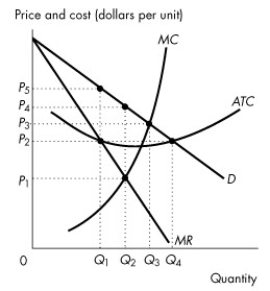 Figure 14.2.4
-Refer to Figure 14.2.4. The figure represents a monopolistically competitive firm in short-run equilibrium. What price does the firm charge?
Figure 14.2.4
-Refer to Figure 14.2.4. The figure represents a monopolistically competitive firm in short-run equilibrium. What price does the firm charge? (Multiple Choice)
4.9/5 (87)
(87) Use the figure below to answer the following questions.
Figure 14.2.3
-Refer to Figure 14.2.3. Assume this firm faces demand curve D₁. At the profit-maximizing output level, the firm
Figure 14.2.3
-Refer to Figure 14.2.3. Assume this firm faces demand curve D₁. At the profit-maximizing output level, the firm (Multiple Choice)
4.9/5 (70)
(70) The key feature of monopolistic competition that distinguishes it from perfect competition is
(Multiple Choice)
4.7/5 (83)
(83) Use the figure below to answer the following questions.
Figure 14.2.4
-Refer to Figure 14.2.4. The figure represents a monopolistically competitive firm in short-run equilibrium. What is the firm's level of output?
Figure 14.2.4
-Refer to Figure 14.2.4. The figure represents a monopolistically competitive firm in short-run equilibrium. What is the firm's level of output? (Multiple Choice)
4.9/5 (90)
(90) A monopolistically competitive firm is able to influence the price of what it sells because of
(Multiple Choice)
4.8/5 (83)
(83) Use the figure below to answer the following questions.
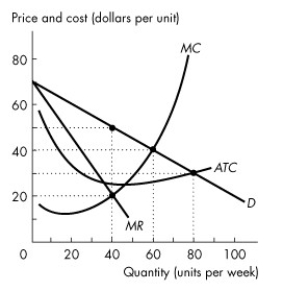 Figure 14.2.1
-Refer to Figure 14.2.1. If this firm is in monopolistic competition, then it will charge a price
Figure 14.2.1
-Refer to Figure 14.2.1. If this firm is in monopolistic competition, then it will charge a price (Multiple Choice)
4.8/5 (91)
(91) Which one of the following characteristics is not shared by single-price monopoly and monopolistic competition?
(Multiple Choice)
4.9/5 (89)
(89) Which of the following are true? The similarities between perfect competition and monopolistic competition include:
(1) no barriers to entry.
(2) profit-maximizing output occurs where MC = MR.
(3) long-run economic profit equals zero.
(Multiple Choice)
4.8/5 (75)
(75) Use the information below to answer the following questions.
Fact 14.3.2
Suppose that Tommy Hilfiger's marginal cost of a jacket is $100 (a constant marginal cost)and at one of the firm's shops, total fixed cost is $2,000 a day. The profit-maximizing number of jackets sold in this shop is 20 a day. Then the shops nearby start to advertise their jackets. The Tommy Hilfiger shop now spends $2,000 a day advertising its jackets, and its profit-maximizing number of jackets sold jumps to 50 a day.
-Refer to Fact.14.3.2. If advertising decreases demand and makes demand more elastic, the price of a Tommy Hilfiger jacket ________. If advertising increases demand and makes demand less elastic, the price of a Tommy Hilfiger jacket ________. If price falls, markup ________. If price rises, markup ________.
(Multiple Choice)
4.8/5 (95)
(95) Firms in monopolistic competition make zero economic profit in the long run because
(Multiple Choice)
4.8/5 (65)
(65) In the long run, a monopolistically competitive firm produces the output at which price equals
(Multiple Choice)
4.8/5 (81)
(81) Which of the following goods is best described as being sold in a monopolistically competitive market?
(Multiple Choice)
5.0/5 (80)
(80) Use the figure below to answer the following questions.
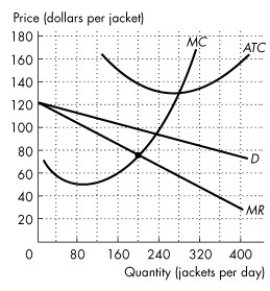 Figure 14.2.6
-Refer to Figure 14.2.6, which shows the demand curve, marginal revenue curve and cost curves faced by Gap. Gap's economic ________ is ________ a day.
Figure 14.2.6
-Refer to Figure 14.2.6, which shows the demand curve, marginal revenue curve and cost curves faced by Gap. Gap's economic ________ is ________ a day. (Multiple Choice)
4.8/5 (80)
(80) Use the figure below to answer the following questions.
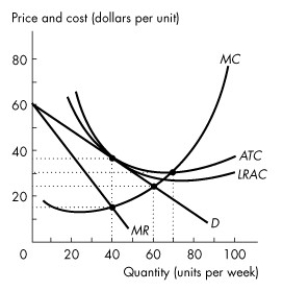 Figure 14.2.2
-Refer to Figure 14.2.2. To maximize economic profit, this firm in monopolistic competition produces an output
Figure 14.2.2
-Refer to Figure 14.2.2. To maximize economic profit, this firm in monopolistic competition produces an output (Multiple Choice)
4.7/5 (71)
(71) 
Filters
- Essay(0)
- Multiple Choice(0)
- Short Answer(0)
- True False(0)
- Matching(0)