



 Chat with AI
Exam 14: Monopolistic Competition

Exam 1: What Is Economics212 Questions
Exam 2: The Economic Problem159 Questions
Exam 3: Demand and Supply197 Questions
Exam 4: Elasticity186 Questions
Exam 5: Efficiency and Equity119 Questions
Exam 6: Governments Actions in Markets130 Questions
Exam 7: Global Markets in Action138 Questions
Exam 8: Utility and Demand120 Questions
Exam 9: Possibilities, Preferences, and Choices124 Questions
Exam 10: Organizing Production111 Questions
Exam 11: Output and Costs142 Questions
Exam 12: Perfect Competition117 Questions
Exam 13: Monopoly118 Questions
Exam 14: Monopolistic Competition122 Questions
Exam 15: Oligopoly106 Questions
Exam 16: Externalities116 Questions
Exam 17: Public Goods and Common Resources98 Questions
Exam 18: Markets for Factors of Production128 Questions
Exam 19: Economic Inequality124 Questions
Exam 20: Measuring Gdp and Economic Growth133 Questions
Exam 21: Monitoring Jobs and Inflation121 Questions
Exam 22: Economic Growth98 Questions
Exam 23: Finance, Saving, and Investment141 Questions
Exam 24: Money, the Price Level, and Inflation126 Questions
Exam 25: The Exchange Rate and the Balance of Payments126 Questions
Exam 26: Aggregate Supply and Aggregate Demand136 Questions
Exam 27: Expenditure Multipliers171 Questions
Exam 28: The Business Cycle, Inflation, and Deflation110 Questions
Exam 29: Fiscal Policy97 Questions
Exam 30: Monetary Policy97 Questions
Exam 31: Macro Only: International Trade Policy126 Questions
Select questions type


Product innovation and development is efficient if the marginal social cost of a new and improved product ________ its marginal social benefit. In monopolistic competition marginal revenue is less than price, so product innovation is probably ________ to its efficient level.
(Multiple Choice)
4.9/5  (79)
(79) An advantage of monopolistic competition over perfect competition is
(Multiple Choice)
4.9/5 (72)
(72) In the short-run, the similarity between a monopolist and a monopolistically competitive firm is that
(Multiple Choice)
4.9/5 (71)
(71) Dole Co. operates in a monopolistically competitive market. Which of the following does not characterize Dole Co.'s market?
(Multiple Choice)
4.8/5 (76)
(76) Use the information below to answer the following questions.
Fact 14.3.3
Suppose that Roots' marginal cost of a jacket is a constant $125.00 and the total fixed cost at one of its stores is $1,500 a day. This store sells 20 jackets a day, which is its profit-maximizing number of jackets. Then the stores nearby start to advertise their jackets. The Roots store now spends $2,000 a day advertising its jackets, and its profit-maximizing number of jackets sold jumps to 70 a day.
-Refer to Fact 14.3.3. Before the advertising begins, the average total cost of a jacket sold in this store is
(Multiple Choice)
4.8/5 (83)
(83) Which of the following is always true regarding a profit-maximizing monopolistically competitive firm in short-run equilibrium?
(Multiple Choice)
4.8/5 (79)
(79) When firms in monopolistic competition make an economic profit,
(Multiple Choice)
4.9/5 (76)
(76) In long-run equilibrium, a firm in monopolistic competition
(Multiple Choice)
4.8/5 (77)
(77) Under monopolistic competition, long-run economic profit is zero because of
(Multiple Choice)
4.8/5 (76)
(76) In monopolistic competition, firms can make an economic profit in
(Multiple Choice)
4.8/5 (83)
(83) Use the figure below to answer the following questions.
 Figure 14.2.5
-Refer to Figure 14.2.5. The figure shows the situation facing Smart Digit, Inc., a firm in monopolistic competition that produces calculators. The firm's markup is ________ per calculator.
Figure 14.2.5
-Refer to Figure 14.2.5. The figure shows the situation facing Smart Digit, Inc., a firm in monopolistic competition that produces calculators. The firm's markup is ________ per calculator. (Multiple Choice)
4.7/5 (78)
(78) Use the figure below to answer the following question.
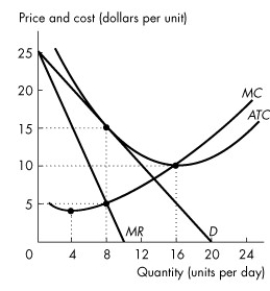 Figure 14.2.7
-Refer to Figure 14.2.7. The figure shows the demand, marginal revenue, and cost curves for a monopolistically competitive firm in the long run. The firm has excess capacity of
Figure 14.2.7
-Refer to Figure 14.2.7. The figure shows the demand, marginal revenue, and cost curves for a monopolistically competitive firm in the long run. The firm has excess capacity of (Multiple Choice)
5.0/5 (72)
(72) A textbook publisher is in monopolistic competition. If the firm spends nothing on advertising, it can sell no books at $100 a book, but for each $10 cut in price, the quantity of books it can sell increases by 20 books a day. The firm's total fixed cost is $2,400 a day. Its average variable cost and marginal cost is a constant $20 per book. If the firm spends $1,200 a day on advertising, it can increase the quantity of books sold at each price by 50 percent. If the publisher advertises, its profit maximizing level of output is
(Multiple Choice)
4.8/5 (69)
(69) Use the information below to answer the following questions.
Fact 14.2.1 Groceries for the Gourmet Palate
No food, it seems, is safe from being repackaged to look like an upscale product. Samuel Adams' $120 Utopias, in a ridiculous copper-covered 24-oz. bottle meant to resemble an old-fashioned brew kettle, is barely beer. It's not carbonated like a Bud, but aged in oak barrels like scotch. It has a vintage year, like a Bordeaux, is light, complex, and free of any alcohol sting, despite having six times as much alcohol content as a regular can of brew.
Source: Time, April 14, 2008
-Refer to Fact 14.2.1. Samuel Adams makes the market for beer inefficient if
(Multiple Choice)
4.7/5 (76)
(76) Use the information below to answer the following questions.
Fact 14.3.2
Suppose that Tommy Hilfiger's marginal cost of a jacket is $100 (a constant marginal cost)and at one of the firm's shops, total fixed cost is $2,000 a day. The profit-maximizing number of jackets sold in this shop is 20 a day. Then the shops nearby start to advertise their jackets. The Tommy Hilfiger shop now spends $2,000 a day advertising its jackets, and its profit-maximizing number of jackets sold jumps to 50 a day.
-Refer to Fact 14.3.2. Having a brand name helps Tommy Hilfiger increase its economic profit because
(Multiple Choice)
4.8/5 (79)
(79) 
Filters
- Essay(0)
- Multiple Choice(0)
- Short Answer(0)
- True False(0)
- Matching(0)