



 Chat with AI
Exam 2: A: Some Tools of the Economist

Exam 1: The Economic Approach210 Questions
Exam 2: A: Some Tools of the Economist224 Questions
Exam 2: B: Some Tools of the Economist33 Questions
Exam 3: A: Supply, Demand, and the Market Process225 Questions
Exam 3: B: Supply, Demand, and the Market Process180 Questions
Exam 4: A: Supply and Demand: Applications and Extensions233 Questions
Exam 4: B: Supply and Demand: Applications and Extensions98 Questions
Exam 5: Difficult Cases for the Market and the Role of Government168 Questions
Exam 6: The Economics of Collective Decision-Making180 Questions
Exam 7: Consumer Choice and Elasticity223 Questions
Exam 8: A: Costs and the Supply of Goods223 Questions
Exam 8: B: Costs and the Supply of Goods8 Questions
Exam 9: A: Price Takers and the Competitive Process237 Questions
Exam 9: B: Price Takers and the Competitive Process23 Questions
Exam 10: Price-Searcher Markets With Low Entry Barriers216 Questions
Exam 11: A: Price-Searcher Markets With High Entry Barriers229 Questions
Exam 11: B: Price-Searcher Markets With High Entry Barriers25 Questions
Exam 12: The Supply of and Demand for Productive Resources200 Questions
Exam 13: Earnings, Productivity, and the Job Market109 Questions
Exam 14: Investment, the Capital Market, and the Wealth of Nations129 Questions
Exam 15: Income Inequality and Poverty136 Questions
Exam 16: Appendix: Government Spending and Taxation79 Questions
Exam 17: Appendix: the Economics of Social Security54 Questions
Exam 18: Appendix: the Stock Market: Its Function, Performance, and Potential As an Investment Opportunity70 Questions
Exam 19: Appendix: Great Debates in Economics: Keynes Versus Hayek8 Questions
Exam 20: Appendix: the Crisis of 2008: Causes and Lessons for the Future64 Questions
Exam 21: Appendix: Lessons From the Great Depression60 Questions
Exam 22: Appendix: the Economics of Healthcare68 Questions
Exam 23: Appendix:education: Problems and Performance60 Questions
Exam 24: Appendix: Earnings Differences Between Men and Women47 Questions
Exam 26: Appendix: the Question of Resource Exhaustion61 Questions
Exam 25: Appendix: Do Labor Unions Increase the Wages of Workers74 Questions
Exam 27: Appendix: Difficult Environmental Cases and the Role of Government63 Questions
Select questions type


In Zimbabwe and Botswana, elephants can be owned by local tribes and trade in ivory is legal, while in countries such as Kenya, it is illegal to trade in ivory and elephants cannot be privately owned but are protected by the government. Which of the following is true regarding the change in the elephant populations since 1979 in these countries?
(Multiple Choice)
4.8/5  (85)
(85) Table 2-1

 -Refer to Table 2-1. Which of the following is true?
 (Multiple Choice)
4.7/5 (74)
(74) Which of the following activities describes the opportunity cost of watching a play in a theater?
(Multiple Choice)
5.0/5 (71)
(71) In a market economy, what is produced is ultimately determined by
(Multiple Choice)
4.8/5 (74)
(74) When private ownership of a resource is clearly defined and enforced, the private owner
(Multiple Choice)
4.9/5 (87)
(87) A point inside the production possibilities curve represents a combination of goods that is
(Multiple Choice)
4.9/5 (70)
(70) Which of the following is true of the production possibilities curve?
(Multiple Choice)
4.8/5 (79)
(79) Land used to grow alfalfa could also be used to grow hay. Which of the following is true when the farmer plants hay and the market price of alfalfa rises?
(Multiple Choice)
4.8/5 (77)
(77) Figure 2-10
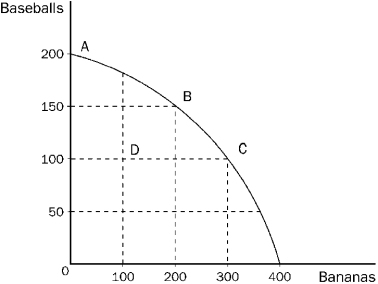 -Refer to Figure 2-10. If this economy put all available resources into the production of bananas, it could produce
 (Multiple Choice)
4.8/5 (69)
(69) Which of the following appropriately applies the law of comparative advantage?
(Multiple Choice)
5.0/5 (85)
(85) "If I didn't have a date tonight, I would save $10 and spend the evening playing tennis." The opportunity cost of the date is
(Multiple Choice)
4.9/5 (87)
(87) Suppose an economy produces only two goods, computers and TVs. If the economy operates at a point on its production possibilities curve, it can produce more computers only if
(Multiple Choice)
4.8/5 (86)
(86) In Africa, which of the following policies has been most successful at increasing elephant populations?
(Multiple Choice)
4.8/5 (73)
(73) When collective decision making is utilized to resolve economic questions regarding the allocation of resources,
(Multiple Choice)
5.0/5 (83)
(83) Which of the following is true of the production possibilities curve?
(Multiple Choice)
4.9/5 (88)
(88) According to the law of comparative advantage, both individuals and nations will be able to produce a larger joint output if each productive activity is undertaken by
(Multiple Choice)
4.8/5 (74)
(74) When an economy is operating efficiently, the production of more of one good will result in the production of less of some other good because
(Multiple Choice)
4.8/5 (76)
(76) 
Filters
- Essay(0)
- Multiple Choice(0)
- Short Answer(0)
- True False(0)
- Matching(0)