



 Chat with AI
Exam 2: A: Some Tools of the Economist

Exam 1: The Economic Approach210 Questions
Exam 2: A: Some Tools of the Economist224 Questions
Exam 2: B: Some Tools of the Economist33 Questions
Exam 3: A: Supply, Demand, and the Market Process225 Questions
Exam 3: B: Supply, Demand, and the Market Process180 Questions
Exam 4: A: Supply and Demand: Applications and Extensions233 Questions
Exam 4: B: Supply and Demand: Applications and Extensions98 Questions
Exam 5: Difficult Cases for the Market and the Role of Government168 Questions
Exam 6: The Economics of Collective Decision-Making180 Questions
Exam 7: Consumer Choice and Elasticity223 Questions
Exam 8: A: Costs and the Supply of Goods223 Questions
Exam 8: B: Costs and the Supply of Goods8 Questions
Exam 9: A: Price Takers and the Competitive Process237 Questions
Exam 9: B: Price Takers and the Competitive Process23 Questions
Exam 10: Price-Searcher Markets With Low Entry Barriers216 Questions
Exam 11: A: Price-Searcher Markets With High Entry Barriers229 Questions
Exam 11: B: Price-Searcher Markets With High Entry Barriers25 Questions
Exam 12: The Supply of and Demand for Productive Resources200 Questions
Exam 13: Earnings, Productivity, and the Job Market109 Questions
Exam 14: Investment, the Capital Market, and the Wealth of Nations129 Questions
Exam 15: Income Inequality and Poverty136 Questions
Exam 16: Appendix: Government Spending and Taxation79 Questions
Exam 17: Appendix: the Economics of Social Security54 Questions
Exam 18: Appendix: the Stock Market: Its Function, Performance, and Potential As an Investment Opportunity70 Questions
Exam 19: Appendix: Great Debates in Economics: Keynes Versus Hayek8 Questions
Exam 20: Appendix: the Crisis of 2008: Causes and Lessons for the Future64 Questions
Exam 21: Appendix: Lessons From the Great Depression60 Questions
Exam 22: Appendix: the Economics of Healthcare68 Questions
Exam 23: Appendix:education: Problems and Performance60 Questions
Exam 24: Appendix: Earnings Differences Between Men and Women47 Questions
Exam 26: Appendix: the Question of Resource Exhaustion61 Questions
Exam 25: Appendix: Do Labor Unions Increase the Wages of Workers74 Questions
Exam 27: Appendix: Difficult Environmental Cases and the Role of Government63 Questions
Select questions type


Internet sites such as eBay make it easier for sellers and buyers to find one another and, by doing so,
(Multiple Choice)
4.7/5  (78)
(78) Economic thinking suggests that a nation in which middlemen are considered to be unproductive seekers of profit, and where their activities are heavily restricted by law, will
(Multiple Choice)
4.8/5 (79)
(79) Figure 2-6
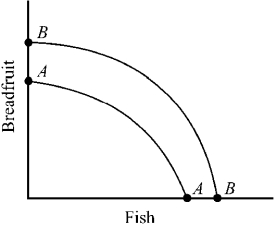 -Which of the following will most likely shift the production possibilities curve for breadfruit and fish outward from AA to BB in Figure 2-6?
 (Multiple Choice)
5.0/5 (77)
(77) Beginning in the early 1990s, private landowners in Zimbabwe have started fencing in large areas of land that contain black rhinos, which were on the verge of extinction. These private owners charge fees for a stay at the lodges on the property (eco-tourism) and also sell hunting safaris and photo safaris. As a result,
(Multiple Choice)
4.8/5 (71)
(71) Ken values his boat at $5,000, and Monica values it at $8,000. If Monica buys it from Ken for $7,000, which of the following is true?
(Multiple Choice)
4.7/5 (76)
(76) An airline ticket from Seattle to Miami costs $525. A bus ticket is $325. Traveling by plane will take 5 hours, compared with 25 hours by bus. Thus, the plane costs $200 more but saves 20 hours of time. (Hint: Note how we are "thinking at the margin" here by looking at the changes.) Other things constant, an individual will gain by choosing air travel if, and only if, each hour of her time is valued at more than
(Multiple Choice)
4.8/5 (73)
(73) Air travel from New York to Miami costs $300 and takes 6 hours. A bus ticket between the cities costs $150 and takes 56 hours. Other things constant, the minimum value of one's time that would induce a rational individual to fly rather than drive would be
(Multiple Choice)
4.7/5 (89)
(89) A system of economic organization in which the ownership and control of productive capital assets rests with the state and in which resources are allocated through central planning and political decision making is called
(Multiple Choice)
4.8/5 (80)
(80) Suppose that country A produces mostly consumption goods and few investment goods, while country B produces mostly investment goods with few consumption goods. Other things constant, which of the following is most likely to happen in the future?
(Multiple Choice)
4.9/5 (82)
(82) "Now that Blake paints the broad surfaces and I do the trim work, we can paint a house in three-fourths the time that it took for each of us to do both." This statement most clearly reflects
(Multiple Choice)
4.9/5 (80)
(80) Which of the following is true with regard to value and exchange?
(Multiple Choice)
4.8/5 (88)
(88) A point outside the production possibilities curve represents a combination of goods that is
(Multiple Choice)
4.9/5 (71)
(71) The notion that specialization in goods that one can produce at a low opportunity cost will make it possible for trading partners to produce a larger joint output is called
(Multiple Choice)
4.7/5 (84)
(84) Over time, an increase in a nation's stock of physical capital will
(Multiple Choice)
4.7/5 (81)
(81) Table 2-2

 -Refer to Table 2-2. Which of the following would be a mutually agreeable rate of exchange?
 (Multiple Choice)
4.8/5 (73)
(73) Increasing opportunity costs of producing goods imply that the production possibilities curve will be
(Multiple Choice)
4.7/5 (64)
(64) Compared to a situation where transaction costs are zero, the existence of transaction costs
(Multiple Choice)
4.8/5 (84)
(84) 
Filters
- Essay(0)
- Multiple Choice(0)
- Short Answer(0)
- True False(0)
- Matching(0)