



 Chat with AI
Exam 2: A: Some Tools of the Economist

Exam 1: The Economic Approach210 Questions
Exam 2: A: Some Tools of the Economist224 Questions
Exam 2: B: Some Tools of the Economist33 Questions
Exam 3: A: Supply, Demand, and the Market Process225 Questions
Exam 3: B: Supply, Demand, and the Market Process180 Questions
Exam 4: A: Supply and Demand: Applications and Extensions233 Questions
Exam 4: B: Supply and Demand: Applications and Extensions98 Questions
Exam 5: Difficult Cases for the Market and the Role of Government168 Questions
Exam 6: The Economics of Collective Decision-Making180 Questions
Exam 7: Consumer Choice and Elasticity223 Questions
Exam 8: A: Costs and the Supply of Goods223 Questions
Exam 8: B: Costs and the Supply of Goods8 Questions
Exam 9: A: Price Takers and the Competitive Process237 Questions
Exam 9: B: Price Takers and the Competitive Process23 Questions
Exam 10: Price-Searcher Markets With Low Entry Barriers216 Questions
Exam 11: A: Price-Searcher Markets With High Entry Barriers229 Questions
Exam 11: B: Price-Searcher Markets With High Entry Barriers25 Questions
Exam 12: The Supply of and Demand for Productive Resources200 Questions
Exam 13: Earnings, Productivity, and the Job Market109 Questions
Exam 14: Investment, the Capital Market, and the Wealth of Nations129 Questions
Exam 15: Income Inequality and Poverty136 Questions
Exam 16: Appendix: Government Spending and Taxation79 Questions
Exam 17: Appendix: the Economics of Social Security54 Questions
Exam 18: Appendix: the Stock Market: Its Function, Performance, and Potential As an Investment Opportunity70 Questions
Exam 19: Appendix: Great Debates in Economics: Keynes Versus Hayek8 Questions
Exam 20: Appendix: the Crisis of 2008: Causes and Lessons for the Future64 Questions
Exam 21: Appendix: Lessons From the Great Depression60 Questions
Exam 22: Appendix: the Economics of Healthcare68 Questions
Exam 23: Appendix:education: Problems and Performance60 Questions
Exam 24: Appendix: Earnings Differences Between Men and Women47 Questions
Exam 26: Appendix: the Question of Resource Exhaustion61 Questions
Exam 25: Appendix: Do Labor Unions Increase the Wages of Workers74 Questions
Exam 27: Appendix: Difficult Environmental Cases and the Role of Government63 Questions
Select questions type


Production possibilities curve are usually bowed outward. This is because
(Multiple Choice)
4.9/5  (72)
(72) Ms. Liebowitz has a choice of driving or flying from Morgantown, West Virginia to Washington, D.C. for a one-day business trip. If she travels by air, she will be able to work seven hours in D.C., while if she drives, she will only have time to work four hours once there. Her expected income from each hour of work in D.C. is $40. If Ms. Liebowitz is a rational decision maker, she will chose to fly if and only if the price differential (air cost minus driving cost) is less than
(Multiple Choice)
4.9/5 (88)
(88) For most students attending state universities, the largest cost component of going to college is
(Multiple Choice)
4.8/5 (77)
(77) Suppose you can type a paper in two hours or mow the lawn in four hours, while it takes your friend Ann eight hours to type a paper or two hours to mow the lawn. Which of the following is true?
(Multiple Choice)
4.8/5 (72)
(72) A form of economic organization that relies primarily on private ownership of productive assets, freedom of exchange, and market prices to allocate goods and resources is often called
(Multiple Choice)
4.8/5 (80)
(80) Figure 2-8
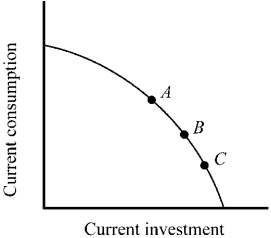 -Points A, B, and C in Figure 2-8 indicate consumption and investment for three economies. Other things constant, which of the economies is likely to grow more rapidly in the future?
 (Multiple Choice)
4.8/5 (78)
(78) The most important source of gain from the division of labor is
(Multiple Choice)
5.0/5 (86)
(86) Statistical data provided by the U.S. Department of Transportation shows that the median income of individuals traveling on the nation's bus systems is $18,000 compared to $65,000 for those who normally travel by air. This finding is best explained by which of the following statements?
(Multiple Choice)
4.8/5 (96)
(96) Figure 2-5
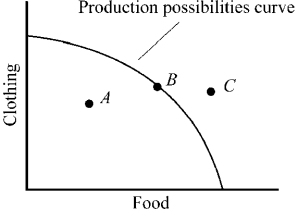 -In Figure 2-5, which of the following is true?
 (Multiple Choice)
4.7/5 (74)
(74) Figure 2-2
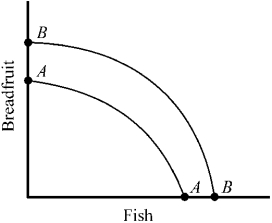 -Which of the following would most likely cause the production possibilities curve for breadfruit and fish to shift outward from AA to BB in Figure 2-2?
 (Multiple Choice)
4.8/5 (98)
(98) If Shawn can produce donuts at a lower opportunity cost than Sue, then
(Multiple Choice)
4.9/5 (62)
(62) In economics, the term that refers to the time, effort, and other resources needed to search out, negotiate, and consummate an exchange is
(Multiple Choice)
4.9/5 (95)
(95) Table 2-3
 -Refer to Table 2-3. The rancher has a comparative advantage in
 (Multiple Choice)
4.8/5 (79)
(79) A profit-seeking decision maker who decides which business projects to undertake and how they should be undertaken is called
(Multiple Choice)
4.9/5 (76)
(76) When private ownership of a resource is clearly defined and enforced, the private owner
(Multiple Choice)
4.9/5 (83)
(83) Table 2-3
-Refer to Table 2-3. The opportunity cost of 1 pound of potatoes for the rancher is
-Refer to Table 2-3. The opportunity cost of 1 pound of potatoes for the rancher is (Multiple Choice)
4.8/5 (70)
(70) 
Filters
- Essay(0)
- Multiple Choice(0)
- Short Answer(0)
- True False(0)
- Matching(0)