



 Chat with AI
Exam 12: Firms in Perfectly Competitive Markets

Exam 1: Economics: Foundations and Models240 Questions
Exam 2: Trade-Offs, Comparative Advantage, and the Market System258 Questions
Exam 3: Where Prices Come From: the Interaction of Demand and Supply242 Questions
Exam 4: Economic Efficiency, Government Price Setting, and Taxes208 Questions
Exam 5: Externalities, Environmental Policy, and Public Goods262 Questions
Exam 6: Elasticity: the Responsiveness of Demand and Supply293 Questions
Exam 7: The Economics of Health Care171 Questions
Exam 8: Firms, the Stock Market, and Corporate Governance261 Questions
Exam 9: Comparative Advantage and the Gains From International Trade188 Questions
Exam 10: Consumer Choice and Behavioral Economics304 Questions
Exam 11: Technology, Production, and Costs327 Questions
Exam 12: Firms in Perfectly Competitive Markets297 Questions
Exam 13: Monopolistic Competition: the Competitive Model in a272 Questions
Exam 14: Oligopoly: Firms in Less Competitive Markets257 Questions
Exam 15: Monopoly and Antitrust Policy279 Questions
Exam 16: Pricing Strategy258 Questions
Exam 17: The Markets for Labor and Other Factors of Production279 Questions
Exam 18: Public Choice, Taxes, and the Distribution of Income258 Questions
Select questions type


If price is equal to average variable cost, then a perfectly competitive firm breaks even.
(True/False)
4.7/5  (74)
(74) Figure 12-1
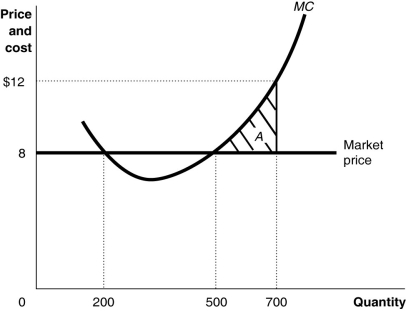 -Refer to Figure 12-1.If the firm is producing 700 units,
 (Multiple Choice)
5.0/5 (71)
(71) A perfectly competitive firm in a constant-cost industry produces 1,000 units of a good at a total cost of $50,000.If the prevailing market price is $48, the number of firms and the industry's output will decrease in the long run.
(True/False)
4.8/5 (74)
(74) Suppose there are economies of scale in the production of a specialized memory chip that is used in manufacturing microwaves.This suggests that the microwave industry is a decreasing-cost industry.
(True/False)
4.8/5 (91)
(91) In the short run, a firm that incurs losses might choose to produce rather than shut down if the amount of its revenue is less than its fixed cost.
(True/False)
4.9/5 (76)
(76) Figure 12-6
 Figure 12-6 shows the demand, marginal cost (MC)and average total cost (ATC)curves for Jason's House of Apples.
-Refer to Figure 12-6.If Jason maximizes his profit he will produce the output level indicated by point ________ and his average profit will equal ________.
Figure 12-6 shows the demand, marginal cost (MC)and average total cost (ATC)curves for Jason's House of Apples.
-Refer to Figure 12-6.If Jason maximizes his profit he will produce the output level indicated by point ________ and his average profit will equal ________. (Multiple Choice)
4.9/5 (68)
(68) A perfectly competitive firm in long-run equilibrium produces output at the lowest possible average total cost.
(True/False)
4.9/5 (68)
(68) After an increase in demand in a constant-cost industry, firms will find themselves with higher average cost curves.
(True/False)
4.8/5 (89)
(89) In the short run, a firm might choose to produce rather than shut down even if its market price is less than its average total cost of production.
(True/False)
4.9/5 (84)
(84) A wheat farmer and a firm in a perfectly competitive market are similar in that
(Multiple Choice)
4.9/5 (77)
(77) Perfectly competitive industries tend to produce low-priced, low-technology products.
(True/False)
4.8/5 (73)
(73) What is always true at the quantity where a firm's average total cost equals average revenue?
(Multiple Choice)
4.9/5 (80)
(80) In long-run competitive equilibrium, the perfectly competitive firm produces where price equals minimum average total cost.
a.What is this efficiency criterion called?
b.How does it benefit consumers?
(Essay)
4.8/5 (69)
(69) A perfectly competitive firm breaks even at a price equal to its minimum average total cost.
(True/False)
4.8/5 (82)
(82) Under what conditions should a competitive firm shut down in the short run?
(Essay)
4.8/5 (79)
(79) Table 12-2
 Table 12-2 lists the various pounds (lbs.)of apples that Margie Stattler can sell. Assume that Margie operates in a perfectly competitive market.
-Refer to Table 12-2.What is Margie's total revenue if she sells 250 pounds of apples?
Table 12-2 lists the various pounds (lbs.)of apples that Margie Stattler can sell. Assume that Margie operates in a perfectly competitive market.
-Refer to Table 12-2.What is Margie's total revenue if she sells 250 pounds of apples? (Multiple Choice)
4.9/5 (92)
(92) 
Filters
- Essay(0)
- Multiple Choice(0)
- Short Answer(0)
- True False(0)
- Matching(0)