



 Chat with AI
Exam 12: Firms in Perfectly Competitive Markets

Exam 1: Economics: Foundations and Models240 Questions
Exam 2: Trade-Offs, Comparative Advantage, and the Market System258 Questions
Exam 3: Where Prices Come From: the Interaction of Demand and Supply242 Questions
Exam 4: Economic Efficiency, Government Price Setting, and Taxes208 Questions
Exam 5: Externalities, Environmental Policy, and Public Goods262 Questions
Exam 6: Elasticity: the Responsiveness of Demand and Supply293 Questions
Exam 7: The Economics of Health Care171 Questions
Exam 8: Firms, the Stock Market, and Corporate Governance261 Questions
Exam 9: Comparative Advantage and the Gains From International Trade188 Questions
Exam 10: Consumer Choice and Behavioral Economics304 Questions
Exam 11: Technology, Production, and Costs327 Questions
Exam 12: Firms in Perfectly Competitive Markets297 Questions
Exam 13: Monopolistic Competition: the Competitive Model in a272 Questions
Exam 14: Oligopoly: Firms in Less Competitive Markets257 Questions
Exam 15: Monopoly and Antitrust Policy279 Questions
Exam 16: Pricing Strategy258 Questions
Exam 17: The Markets for Labor and Other Factors of Production279 Questions
Exam 18: Public Choice, Taxes, and the Distribution of Income258 Questions
Select questions type


Figure 12-5
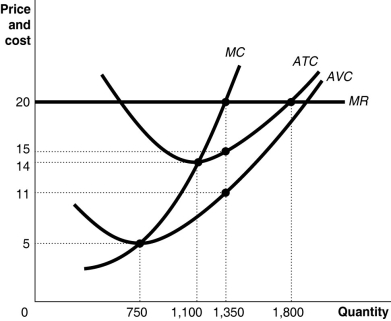 Figure 12-5 shows cost and demand curves facing a typical firm in a constant-cost, perfectly competitive industry.
-Refer to Figure 12-5.What is the minimum price the firm requires to produce output?
Figure 12-5 shows cost and demand curves facing a typical firm in a constant-cost, perfectly competitive industry.
-Refer to Figure 12-5.What is the minimum price the firm requires to produce output? (Multiple Choice)
4.9/5  (68)
(68) If a firm in a perfectly competitive industry experiences persistent losses, in the long run it should
(Multiple Choice)
5.0/5 (79)
(79) If a firm's total variable cost exceeds its total revenue, the firm should stop production by shutting down temporarily.
(True/False)
4.9/5 (65)
(65) In a decreasing-cost industry, the entry of new firms lowers average cost at each level of output.
(True/False)
5.0/5 (82)
(82) Which of the following is a characteristic of an oligopolistic market structure?
(Multiple Choice)
4.8/5 (79)
(79) Figure 12-4
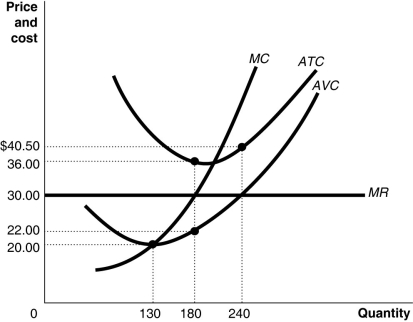 Figure 12-4 shows the cost and demand curves for a profit-maximizing firm in a perfectly competitive market.
-Refer to Figure 12-4.If the market price is $30 and the firm is producing output, what is the amount of the firm's profit or loss?
Figure 12-4 shows the cost and demand curves for a profit-maximizing firm in a perfectly competitive market.
-Refer to Figure 12-4.If the market price is $30 and the firm is producing output, what is the amount of the firm's profit or loss? (Multiple Choice)
4.9/5 (65)
(65) A firm's total profit can be calculated as all of the following except
(Multiple Choice)
4.9/5 (73)
(73) In the long run, a firm in a perfectly competitive industry will supply output only if its total revenue covers its
(Multiple Choice)
4.8/5 (87)
(87) A perfectly competitive market is in long-run equilibrium.At present there are 100 identical firms each producing 5,000 units of output.The prevailing market price is $20.Assume that each firm faces increasing marginal cost.Now suppose there is a sudden increase in demand for the industry's product which causes the price of the good to rise to $24.Which of the following describes the effect of this increase in demand on a typical firm in the industry?
(Multiple Choice)
4.9/5 (86)
(86) Table 12-1
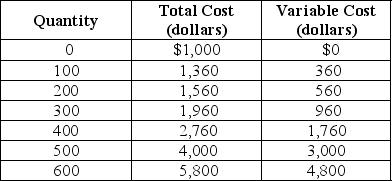 Table 12-1 shows the short-run cost data of a perfectly competitive firm that produces plastic camera cases. Assume that output can only be increased in batches of 100 units.
-Refer to Table 12-1.If the market price of each camera case is $8, what is the profit-maximizing quantity according to the MR = MC rule?
Table 12-1 shows the short-run cost data of a perfectly competitive firm that produces plastic camera cases. Assume that output can only be increased in batches of 100 units.
-Refer to Table 12-1.If the market price of each camera case is $8, what is the profit-maximizing quantity according to the MR = MC rule? (Multiple Choice)
4.9/5 (82)
(82) If a firm shuts down in the short run, its maximum loss equals the amount of its fixed cost.
(True/False)
4.7/5 (88)
(88) A perfectly competitive firm produces 3,000 units of a good at a total cost of $36,000.The price of each good is $10.Calculate the firm's short-run profit or loss.
(Multiple Choice)
4.9/5 (74)
(74) What is meant by productive efficiency? How does a perfectly competitive firm achieve productive efficiency?
(Essay)
4.9/5 (84)
(84) Marty's Bird House suffers a short-run loss.Marty can reduce his loss below the amount of his total fixed costs by continuing to produce if his revenue
(Multiple Choice)
5.0/5 (88)
(88) Perfectly competitive firms produce up to the point where the price of the good equals the marginal cost of producing the last unit.This condition is referred to as
(Multiple Choice)
4.8/5 (72)
(72) Which of the following is the best example of a perfectly competitive industry?
(Multiple Choice)
4.9/5 (67)
(67) Figure 12-10
 -Refer to Figure 12-10.At the profit-maximizing output level, the firm earns
 (Multiple Choice)
4.8/5 (87)
(87) 
Filters
- Essay(0)
- Multiple Choice(0)
- Short Answer(0)
- True False(0)
- Matching(0)