



 Chat with AI
Exam 12: Firms in Perfectly Competitive Markets

Exam 1: Economics: Foundations and Models240 Questions
Exam 2: Trade-Offs, Comparative Advantage, and the Market System258 Questions
Exam 3: Where Prices Come From: the Interaction of Demand and Supply242 Questions
Exam 4: Economic Efficiency, Government Price Setting, and Taxes208 Questions
Exam 5: Externalities, Environmental Policy, and Public Goods262 Questions
Exam 6: Elasticity: the Responsiveness of Demand and Supply293 Questions
Exam 7: The Economics of Health Care171 Questions
Exam 8: Firms, the Stock Market, and Corporate Governance261 Questions
Exam 9: Comparative Advantage and the Gains From International Trade188 Questions
Exam 10: Consumer Choice and Behavioral Economics304 Questions
Exam 11: Technology, Production, and Costs327 Questions
Exam 12: Firms in Perfectly Competitive Markets297 Questions
Exam 13: Monopolistic Competition: the Competitive Model in a272 Questions
Exam 14: Oligopoly: Firms in Less Competitive Markets257 Questions
Exam 15: Monopoly and Antitrust Policy279 Questions
Exam 16: Pricing Strategy258 Questions
Exam 17: The Markets for Labor and Other Factors of Production279 Questions
Exam 18: Public Choice, Taxes, and the Distribution of Income258 Questions
Select questions type


In the short run, a profit-maximizing firm will shut down if its total revenue is greater than its variable costs.
(True/False)
4.9/5  (85)
(85) Figure 12-13
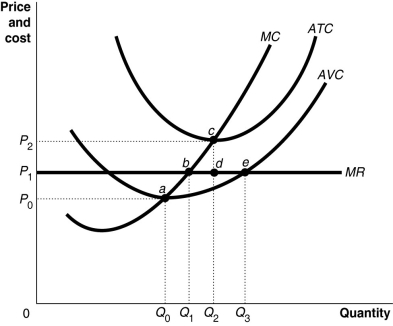 -Refer to Figure 12-13.Suppose the prevailing price is P₁ and the firm is currently producing its loss-minimizing quantity.If the firm represented in the diagram continues to stay in business, in the long-run equilibrium
 (Multiple Choice)
4.9/5 (75)
(75) Of the following industries, which are perfectly competitive? For those that are not perfectly competitive, explain why.
a.Restaurants
b.Corn
c.College education
d.Local radio and television
(Essay)
4.8/5 (94)
(94) A perfectly competitive firm's marginal revenue curve is downward sloping.
(True/False)
4.8/5 (72)
(72) Assume that the market for cage-free eggs is perfectly competitive.All else equal, as farmers find it less profitable to produce and sell cage-free eggs in this market
(Multiple Choice)
4.8/5 (83)
(83) In a perfectly competitive industry, in the long-run equilibrium,
(Multiple Choice)
4.7/5 (83)
(83) Which of the following does not hold true for a perfectly competitive firm in long-run equilibrium?
(Multiple Choice)
4.9/5 (86)
(86) Figure 12-17
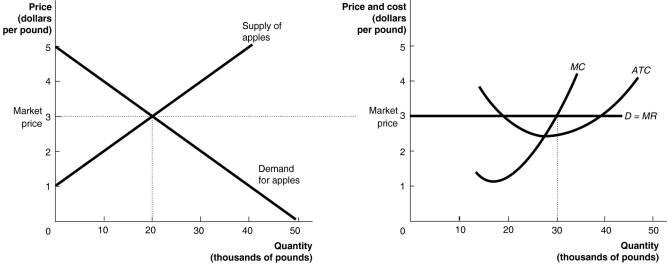 The graphs in Figure 12-17 represent the perfectly competitive market demand and supply curves for the apple industry and demand and cost curves for a typical firm in the industry.
-Refer to Figure 12-17.The graphs depict a short-run equilibrium.How will this differ from the long-run equilibrium? (Assume this is a constant-cost industry.)
The graphs in Figure 12-17 represent the perfectly competitive market demand and supply curves for the apple industry and demand and cost curves for a typical firm in the industry.
-Refer to Figure 12-17.The graphs depict a short-run equilibrium.How will this differ from the long-run equilibrium? (Assume this is a constant-cost industry.) (Multiple Choice)
4.8/5 (74)
(74) Hogrocket, which developed the Tiny Invaders game for the iPhone, found that to maintain sales in a profitable competitive market, the price of a product
(Multiple Choice)
4.8/5 (78)
(78) In the short run, if price falls below a firm's minimum average total cost, then the firm should shut down.
(True/False)
4.9/5 (70)
(70) Figure 12-2
 -Refer to Figure 12-2.What is the amount of profit if the firm produces Q₂ units?
 (Multiple Choice)
4.8/5 (63)
(63) Figure 12-9
 Figure 12-9 shows cost and demand curves facing a profit-maximizing, perfectly competitive firm.
-Refer to Figure 12-9.At price P₃, the firm would
Figure 12-9 shows cost and demand curves facing a profit-maximizing, perfectly competitive firm.
-Refer to Figure 12-9.At price P₃, the firm would (Multiple Choice)
4.7/5 (80)
(80) If a typical firm in a perfectly competitive industry is incurring losses, then
(Multiple Choice)
4.9/5 (72)
(72) Figure 12-20
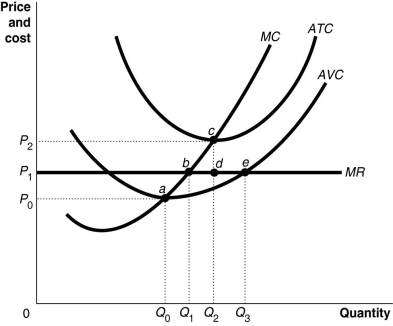 -Refer to Figure 12-20.If the market price is P₁, what is the allocatively efficient output level?
 (Multiple Choice)
4.9/5 (70)
(70) If a firm shuts down in the short run, it avoids its variable cost but not its fixed cost.
(True/False)
4.9/5 (81)
(81) Figure 12-2
-Refer to Figure 12-2.What happens if the firm produces more than Q₄ units?
-Refer to Figure 12-2.What happens if the firm produces more than Q₄ units? (Multiple Choice)
4.7/5 (79)
(79) Writing in the New York Times on the technology boom of the late 1990s, Michael Lewis argues, "The sad truth, for investors, seems to be that most of the benefits of new technologies are passed right through to consumers free of charge." What does Lewis means by the benefits of new technology being "passed right through to consumers free of charge"?
(Multiple Choice)
4.9/5 (88)
(88) 
Filters
- Essay(0)
- Multiple Choice(0)
- Short Answer(0)
- True False(0)
- Matching(0)