



 Chat with AI
Exam 10: Consumer Choice and Behavioral Economics

Exam 1: Economics: Foundations and Models240 Questions
Exam 2: Trade-Offs, Comparative Advantage, and the Market System258 Questions
Exam 3: Where Prices Come From: the Interaction of Demand and Supply242 Questions
Exam 4: Economic Efficiency, Government Price Setting, and Taxes208 Questions
Exam 5: Externalities, Environmental Policy, and Public Goods262 Questions
Exam 6: Elasticity: the Responsiveness of Demand and Supply293 Questions
Exam 7: The Economics of Health Care171 Questions
Exam 8: Firms, the Stock Market, and Corporate Governance261 Questions
Exam 9: Comparative Advantage and the Gains From International Trade188 Questions
Exam 10: Consumer Choice and Behavioral Economics304 Questions
Exam 11: Technology, Production, and Costs327 Questions
Exam 12: Firms in Perfectly Competitive Markets297 Questions
Exam 13: Monopolistic Competition: the Competitive Model in a272 Questions
Exam 14: Oligopoly: Firms in Less Competitive Markets257 Questions
Exam 15: Monopoly and Antitrust Policy279 Questions
Exam 16: Pricing Strategy258 Questions
Exam 17: The Markets for Labor and Other Factors of Production279 Questions
Exam 18: Public Choice, Taxes, and the Distribution of Income258 Questions
Select questions type


Results of the ultimatum game indicate that most people value fairness enough that they will refuse to participate in a transaction they consider unfair, even if they are worse off financially as a result.
(True/False)
4.8/5  (81)
(81) The income effect of a price increase causes a decrease in the quantity of a normal good demanded.
(True/False)
4.8/5 (83)
(83) Table 10-6
 Table 10-6 lists Jay's marginal utilities for burgers and Pepsi. Jay has $7 to spend on these two goods. The price of a burger is $2 and the price of a can of Pepsi is $1.
-Refer to Table 10-6.What is Jay's optimal consumption bundle?
Table 10-6 lists Jay's marginal utilities for burgers and Pepsi. Jay has $7 to spend on these two goods. The price of a burger is $2 and the price of a can of Pepsi is $1.
-Refer to Table 10-6.What is Jay's optimal consumption bundle? (Multiple Choice)
4.7/5 (77)
(77) Which of the following is held constant along an indifference curve?
(Multiple Choice)
4.9/5 (87)
(87) The income effect of an increase in the price of peaches is
(Multiple Choice)
4.8/5 (91)
(91) In their surveys of consumers, Daniel Kahneman, Jack Knetsch and Richard Thaler found that
(Multiple Choice)
4.8/5 (79)
(79) Behavioral economics is the study of situations in which people make rational choices.
(True/False)
4.7/5 (83)
(83) All but one of the following people were awarded a Nobel prize for their contributions to experimental economics and their explorations of the influence fairness has on consumer decision-making.Which person did not receive a Nobel Prize for this work?
(Multiple Choice)
4.8/5 (62)
(62) In the utility maximizing model, consumer preferences are assumed to be transitive.What does this mean?
(Multiple Choice)
4.8/5 (79)
(79) Figure 10-5
 -Refer to Figure 10-5.What is the marginal rate of substitution for one bar of chocolate between g and h?
 (Multiple Choice)
5.0/5 (86)
(86) The endowment effect is the tendency of people to be unwilling to sell a good they already own even if they are offered a price greater than they would be willing to pay to buy the good if they did not already own it.
(True/False)
4.9/5 (84)
(84) What must be true in terms of the income effect, the substitution effect, and the type of good for the good's demand curve to be upward sloping?
(Essay)
4.8/5 (84)
(84) If a consumer receives 20 units of utility from consuming two candy bars, and 25 units of utility from consuming three candy bars, the marginal utility of the second candy bar is
(Multiple Choice)
5.0/5 (65)
(65) Table 10-4
 -Refer to Table 10-4.For steak and cheese sandwiches and grilled chicken sandwiches, the table contains the values of the marginal utility (MU)and marginal utility per dollar (MU/P)for Mabel Jarvis.Mabel has $14 to spend on steak and cheese sandwiches and grilled chicken sandwiches.Which of the following statements is false?
 (Multiple Choice)
4.8/5 (84)
(84) If your total satisfaction increases when you consume another unit, your marginal utility must be
(Multiple Choice)
4.9/5 (68)
(68) Table 10-7
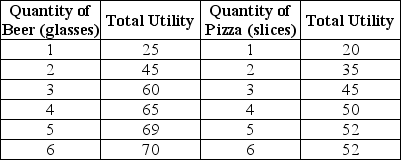 Table 10-7 shows Antonio's utility from beer and pizza.
-Refer to Table 10-7.Suppose Antonio has $10 to spend and the price of beer = $2 per glass and the price of pizza = $2 per slice.How many of each good will he consume when he maximizes his utility?
Table 10-7 shows Antonio's utility from beer and pizza.
-Refer to Table 10-7.Suppose Antonio has $10 to spend and the price of beer = $2 per glass and the price of pizza = $2 per slice.How many of each good will he consume when he maximizes his utility? (Multiple Choice)
4.7/5 (82)
(82) Figure 10-6
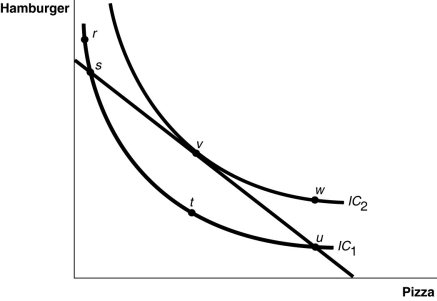 -Refer to Figure 10-6.Suppose the price of pizza increases while the price of hamburger remains constant.Then, the consumer's
 (Multiple Choice)
4.8/5 (72)
(72) 
Filters
- Essay(0)
- Multiple Choice(0)
- Short Answer(0)
- True False(0)
- Matching(0)