



 Chat with AI
Exam 10: Consumer Choice and Behavioral Economics

Exam 1: Economics: Foundations and Models240 Questions
Exam 2: Trade-Offs, Comparative Advantage, and the Market System258 Questions
Exam 3: Where Prices Come From: the Interaction of Demand and Supply242 Questions
Exam 4: Economic Efficiency, Government Price Setting, and Taxes208 Questions
Exam 5: Externalities, Environmental Policy, and Public Goods262 Questions
Exam 6: Elasticity: the Responsiveness of Demand and Supply293 Questions
Exam 7: The Economics of Health Care171 Questions
Exam 8: Firms, the Stock Market, and Corporate Governance261 Questions
Exam 9: Comparative Advantage and the Gains From International Trade188 Questions
Exam 10: Consumer Choice and Behavioral Economics304 Questions
Exam 11: Technology, Production, and Costs327 Questions
Exam 12: Firms in Perfectly Competitive Markets297 Questions
Exam 13: Monopolistic Competition: the Competitive Model in a272 Questions
Exam 14: Oligopoly: Firms in Less Competitive Markets257 Questions
Exam 15: Monopoly and Antitrust Policy279 Questions
Exam 16: Pricing Strategy258 Questions
Exam 17: The Markets for Labor and Other Factors of Production279 Questions
Exam 18: Public Choice, Taxes, and the Distribution of Income258 Questions
Select questions type


A study discussed in the Making the Connection feature in the text found that there is ________ that some consumers are not well aware of prices, even for goods they buy regularly.
(Multiple Choice)
4.8/5  (71)
(71) Marge buys 5 CDs and 7 DVDs.The marginal utility of the 5th CD and the marginal utility of the 7th DVD are both equal to 30 utils.Can we say that this is the optimal combination of CDs and DVDs for Marge?
(Multiple Choice)
4.8/5 (66)
(66) Which of the following is not a characteristic of indifference curves?
(Multiple Choice)
4.9/5 (67)
(67) Arnold Kim began blogging about Apple products during his fourth year of medical school.Kim's Website, MacRumors.com, became so successful that he decided to give up his medical career and work full time on his Website, despite the nearly $200,000 he had invested in his education.In making his decision, Kim decided to ignore the money and time he spent on his education.Economists would say that Kim made a
(Multiple Choice)
4.7/5 (70)
(70) Figure 10-7
 The above panels show various combinations of indifference curves and budget constraints for two products: Popcorn and Candy.
-Refer to Figure 10-7.Which diagram demonstrates an increase in total utility following a decrease in the price of popcorn?
The above panels show various combinations of indifference curves and budget constraints for two products: Popcorn and Candy.
-Refer to Figure 10-7.Which diagram demonstrates an increase in total utility following a decrease in the price of popcorn? (Multiple Choice)
4.9/5 (76)
(76) If Paul decides to buy a $60 ticket to a Cirque du Soleil show rather than a $45 ticket for a Blue Man Group performance, we can conclude that
(Multiple Choice)
4.9/5 (83)
(83) Table 10-2
 Table 10-2 above shows Keira's utility from soup and sandwiches. The price of soup is $2 per cup and the price of a sandwich is $3. Keira has $18 to spend on these two goods.
-Refer to Table 10-2.What is Keira's marginal utility per dollar spent on the third cup of soup?
Table 10-2 above shows Keira's utility from soup and sandwiches. The price of soup is $2 per cup and the price of a sandwich is $3. Keira has $18 to spend on these two goods.
-Refer to Table 10-2.What is Keira's marginal utility per dollar spent on the third cup of soup? (Multiple Choice)
4.9/5 (78)
(78) Which of the following refers to the increase in the usefulness of a product as the number of consumers who use it increases?
(Multiple Choice)
4.9/5 (74)
(74) Table 10-7
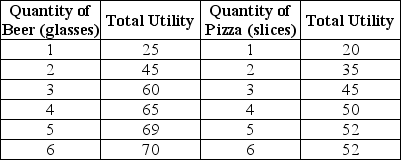 Table 10-7 shows Antonio's utility from beer and pizza.
-Refer to Table 10-7.What is Antonio's marginal utility from consuming the fifth beer?
Table 10-7 shows Antonio's utility from beer and pizza.
-Refer to Table 10-7.What is Antonio's marginal utility from consuming the fifth beer? (Multiple Choice)
4.7/5 (82)
(82) Figure 10-7
The above panels show various combinations of indifference curves and budget constraints for two products: Popcorn and Candy.
-Refer to Figure 10-7.A change in the price of popcorn only is shown in
The above panels show various combinations of indifference curves and budget constraints for two products: Popcorn and Candy.
-Refer to Figure 10-7.A change in the price of popcorn only is shown in (Multiple Choice)
4.9/5 (81)
(81) The demand curve for an inferior good can never be downward sloping.
(True/False)
4.9/5 (71)
(71) Which of the following is an experiment which tests whether fairness is important in consumer decision making?
(Multiple Choice)
4.9/5 (92)
(92) Figure 10-4
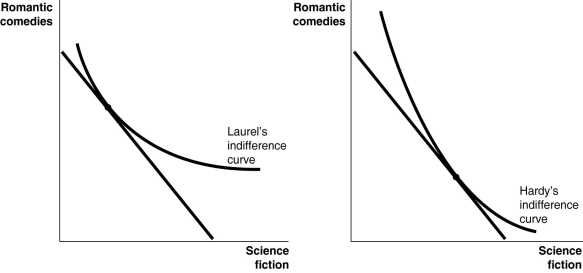 -Refer to Figure 10-4.Best friends Laurel and Hardy both enjoy watching romantic comedies and science fiction movies.Based on the diagrams above what can you conclude about their movie preferences?
 (Multiple Choice)
4.8/5 (67)
(67) A common mistake made by consumers is the failure to take into account the monetary costs of their actions.
(True/False)
4.8/5 (86)
(86) 
Filters
- Essay(0)
- Multiple Choice(0)
- Short Answer(0)
- True False(0)
- Matching(0)