



 Chat with AI
Exam 10: Consumer Choice and Behavioral Economics

Exam 1: Economics: Foundations and Models240 Questions
Exam 2: Trade-Offs, Comparative Advantage, and the Market System258 Questions
Exam 3: Where Prices Come From: the Interaction of Demand and Supply242 Questions
Exam 4: Economic Efficiency, Government Price Setting, and Taxes208 Questions
Exam 5: Externalities, Environmental Policy, and Public Goods262 Questions
Exam 6: Elasticity: the Responsiveness of Demand and Supply293 Questions
Exam 7: The Economics of Health Care171 Questions
Exam 8: Firms, the Stock Market, and Corporate Governance261 Questions
Exam 9: Comparative Advantage and the Gains From International Trade188 Questions
Exam 10: Consumer Choice and Behavioral Economics304 Questions
Exam 11: Technology, Production, and Costs327 Questions
Exam 12: Firms in Perfectly Competitive Markets297 Questions
Exam 13: Monopolistic Competition: the Competitive Model in a272 Questions
Exam 14: Oligopoly: Firms in Less Competitive Markets257 Questions
Exam 15: Monopoly and Antitrust Policy279 Questions
Exam 16: Pricing Strategy258 Questions
Exam 17: The Markets for Labor and Other Factors of Production279 Questions
Exam 18: Public Choice, Taxes, and the Distribution of Income258 Questions
Select questions type


During a study session for an economics exam with three other students, Peter Daltry commented on an example of a consumer who had to decide on number of slices of pizza and cups of Coca-Cola he would consume.Peter explained that "To maximize his utility this consumer must equate the marginal utility per dollar for pizza and Coca-Cola." Was Peter's analysis correct?
(Multiple Choice)
4.9/5  (87)
(87) Table 10-1
 Keegan has $30 to spend on Pita Wraps and Bubble Tea. The price of a Pita Wrap is $6 and the price of a glass of Bubble Tea is $3. Table 10-1 shows his total utility from different quantities of the two items.
-Refer to Table 10-1.If Keegan can drink all the bubble tea he wants for free, how many glasses will he consume?
Keegan has $30 to spend on Pita Wraps and Bubble Tea. The price of a Pita Wrap is $6 and the price of a glass of Bubble Tea is $3. Table 10-1 shows his total utility from different quantities of the two items.
-Refer to Table 10-1.If Keegan can drink all the bubble tea he wants for free, how many glasses will he consume? (Multiple Choice)
4.9/5 (79)
(79) Table 10-2
 Table 10-2 above shows Keira's utility from soup and sandwiches. The price of soup is $2 per cup and the price of a sandwich is $3. Keira has $18 to spend on these two goods.
-Refer to Table 10-2.Holding prices constant, when Keira's income changed from $18 to $23, what happens to her total utility and to the marginal utilities of the last cup of soup and the last sandwich purchased?
Table 10-2 above shows Keira's utility from soup and sandwiches. The price of soup is $2 per cup and the price of a sandwich is $3. Keira has $18 to spend on these two goods.
-Refer to Table 10-2.Holding prices constant, when Keira's income changed from $18 to $23, what happens to her total utility and to the marginal utilities of the last cup of soup and the last sandwich purchased? (Multiple Choice)
4.9/5 (87)
(87) The quantity of tickets demanded to the Super Bowl is always greater than the quantity supplied.Which of the following in the best explanation why the National Football League does not raise the price of tickets to the level where the quantity demanded equals the quantity supplied?
(Multiple Choice)
4.9/5 (83)
(83) Which of the following is a common mistake consumers commit when they make decisions?
(Multiple Choice)
4.8/5 (95)
(95) The amount of income a consumer has to spend on goods and services is known as
(Multiple Choice)
4.8/5 (80)
(80) Figure 10-6
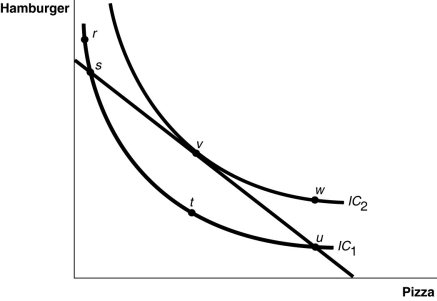 -Refer to Figure 10-6.The consumer can afford consumption bundles
 (Multiple Choice)
4.9/5 (79)
(79) Molly received an autographed poster of David Hasselhoff for her 21st birthday.Her friend Helga offered her $50 for the poster, but Molly refused to sell the poster even though she knows she would never pay that much to replace it if it was ever damaged or destroyed.Explain this inconsistency in Molly's behavior.
(Essay)
4.8/5 (92)
(92) If Lisa spends her income on veggie burgers and pints of soy milk and the price of veggie burgers is three times the price of a pint of soy milk, then when Lisa maximizes her utility she will buy
(Multiple Choice)
4.9/5 (78)
(78) A consumer maximizes her total utility from a bundle of goods when her marginal utility from each good is equal.
(True/False)
4.8/5 (81)
(81) If marginal utility of apples is diminishing and is a positive amount, consuming one more apple will cause
(Multiple Choice)
4.8/5 (70)
(70) There are two conditions necessary for a consumer to maximize her utility.One is that the marginal utilities per dollar spent on each good and service consumed are equal.What is the other condition?
(Multiple Choice)
4.9/5 (71)
(71) Under J.C.Penney's everyday low pricing policy, the everyday low prices
(Multiple Choice)
4.8/5 (77)
(77) Figure 10-9
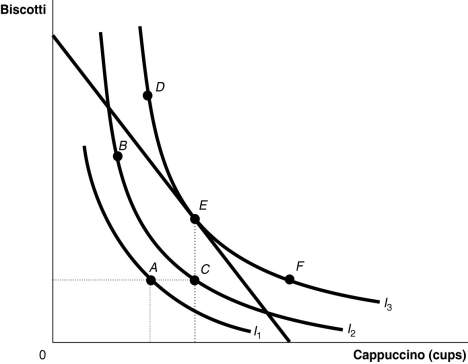 -Refer to Figure 10-9.Given the budget constraint in the diagram, which of the following statements is false?
 (Multiple Choice)
4.9/5 (75)
(75) What did economists Robert Jensen and Nolan Miller determine must be true for a good to be a Giffen good, where the income effect is larger than its substitution effect?
(Essay)
4.9/5 (83)
(83) Farah has $100 to spend each month on bread and chicken.Suppose the price of bread is $4 a loaf and the price of chicken is $5 per pound.
a.Draw her budget constraint and label it BC₀.Put bread on the horizontal axis and chicken on the vertical axis.Be sure to identify the intercept values.
b.Suppose Farah is a utility maximizer and she consumes 10 loaves of bread and 12 pounds of chicken.On the same graph you drew in part (a), draw an indifference curve to identify her optimal bundle.Label this bundle "E."
c.Is her budget exhausted? Verify your answer.
d.Now suppose Farah's income falls to so that she can now devote $80 to the two goods.Prices however remain unchanged.In the same diagram, graph her new budget constraint and label it BC₁.Be sure to identify any new intercept values.
e.Following the change in income, can Farah consume the same bundle "E"? Explain your answer.
f.What must happen to her total utility following the decrease in her income?
(Essay)
4.9/5 (76)
(76) 
Filters
- Essay(0)
- Multiple Choice(0)
- Short Answer(0)
- True False(0)
- Matching(0)