



 Chat with AI
Exam 10: Consumer Choice and Behavioral Economics

Exam 1: Economics: Foundations and Models240 Questions
Exam 2: Trade-Offs, Comparative Advantage, and the Market System258 Questions
Exam 3: Where Prices Come From: the Interaction of Demand and Supply242 Questions
Exam 4: Economic Efficiency, Government Price Setting, and Taxes208 Questions
Exam 5: Externalities, Environmental Policy, and Public Goods262 Questions
Exam 6: Elasticity: the Responsiveness of Demand and Supply293 Questions
Exam 7: The Economics of Health Care171 Questions
Exam 8: Firms, the Stock Market, and Corporate Governance261 Questions
Exam 9: Comparative Advantage and the Gains From International Trade188 Questions
Exam 10: Consumer Choice and Behavioral Economics304 Questions
Exam 11: Technology, Production, and Costs327 Questions
Exam 12: Firms in Perfectly Competitive Markets297 Questions
Exam 13: Monopolistic Competition: the Competitive Model in a272 Questions
Exam 14: Oligopoly: Firms in Less Competitive Markets257 Questions
Exam 15: Monopoly and Antitrust Policy279 Questions
Exam 16: Pricing Strategy258 Questions
Exam 17: The Markets for Labor and Other Factors of Production279 Questions
Exam 18: Public Choice, Taxes, and the Distribution of Income258 Questions
Select questions type


A curve that shows combinations of consumption bundles that give a consumer the same utility is called
(Multiple Choice)
4.7/5  (80)
(80) Assume that Anne has $300 to spend on DVDs and CDs.Her optimal consumption of DVDs and CDs is illustrated by a tangency between a budget line and an indifference curve.Now assume that the price of CDs rises but the price of DVDs falls.How can you show that Anne is made better off by these price changes?
(Multiple Choice)
4.9/5 (84)
(84) Consumers maximize total utility within their budget constraint by
(Multiple Choice)
5.0/5 (78)
(78) In a survey of consumers, Daniel Kahneman, Jack Knetsch and Richard Thaler asked their opinion of a hardware store's decision to
(Multiple Choice)
4.8/5 (88)
(88) Consider a downward-sloping demand curve.When the price of an inferior good decreases, the income and substitution effects
(Multiple Choice)
4.9/5 (73)
(73) The only Giffen goods that have been identified so far in the real world are luxury goods.
(True/False)
4.8/5 (76)
(76) The substitution effect of an increase in the price of peaches is
(Multiple Choice)
4.8/5 (90)
(90) For a demand curve to be upward sloping, the good would have to be an inferior good, and
(Multiple Choice)
4.8/5 (83)
(83) Which of the following correctly describes the result of a price increase for an inferior good?
(Multiple Choice)
4.9/5 (83)
(83) Table 10-5
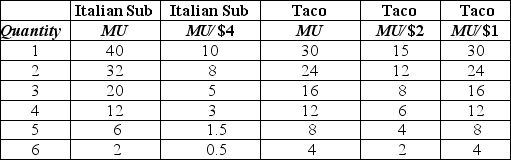 -Refer to Table 10-5, which lists the values of Harry Taber's marginal utility and marginal utility per dollar for Italian submarine (sub)sandwiches and tacos.Assume that the price of a sub sandwich is $4 and the price of a taco is $2.When Harry's income is $14, he buys two Italian sub sandwiches and three tacos.The last column lists the values of the marginal utility per dollar for tacos when the price of a taco decreases to $1.Complete this statement: As a result of the change in price, the marginal utility of each taco Harry consumes increases and
 (Multiple Choice)
4.8/5 (74)
(74) Psychologists Daniel Kahneman and Amos Tversky conducted the following experiments by asking a sample of people the following questions:
Scenario A: "Imagine that you have decided to see a play and paid the admission price of $10 per ticket.As you enter the theater you discover that you have lost the ticket.The seat was not marked and the ticket cannot be recovered.Would you pay $10 for another ticket?"
Scenario B: "Imagine that you have decided to see a play where admission is $10 per ticket.As you enter the theater you discover that you have lost a $10 bill.Would you still pay $10 for a ticket for the play?"
As long as additional tickets are available, there's no meaningful difference between losing $10 in cash before buying a ticket, and losing the $10 ticket after buying it.In both cases, you are out $10.Yet, far more subjects (88 percent)in Scenario B say they would pay $10 for another ticket and see the play while in Scenario A, only 46 percent of the subjects say they would be willing to spend another $10 to see the play.
Which of the following is the best explanation for the results of the experiment?
(Multiple Choice)
4.8/5 (75)
(75) Which of the following does not explain why consumers buy products that many other consumers are already buying?
(Multiple Choice)
4.8/5 (84)
(84) Suppose Barry is maximizing his utility from consuming used paperback novels and audio books.The price of a used novel = $4 and the price of an audio book = $8.If the marginal utility of the last novel was 32 units of utility (utils)what was the marginal utility of the last audio book purchased?
(Multiple Choice)
4.9/5 (80)
(80) One reason college students do not study enough to get high grades is that they are unrealistic about their future behavior.
(True/False)
4.8/5 (72)
(72) Terence has $50 per week to spend on Subway sandwiches and milkshakes.The price of a Subway sandwich is $5 and the price of a milkshake is $4.He buys 6 sandwiches and 5 milkshakes.The marginal utility of the 6th sandwich = 25 and the marginal utility of the 5th milkshake = 24.Which of the following is true?
(Multiple Choice)
4.8/5 (81)
(81) If a consumer receives 20 units of utility from consuming two candy bars, and 25 units of utility from consuming three candy bars, the marginal utility of the third candy bar is
(Multiple Choice)
4.8/5 (88)
(88) Grace Makutsi finally bought a pair of blue shoes that she had been coveting for a long time.In less than a week she discovered that the shoes were uncomfortable.Grace went back to wearing her old pair and stashed away the new pair.When asked by her boss, Mme.Ramotswe, why does she not simply give away the new pair, she said: "But I paid so much for them." Grace's behavior
(Multiple Choice)
4.8/5 (90)
(90) Which of the following is used to explain why a consumer's willingness to buy a cell phone increases as the number of other people who own and use cell phones increases?
(Multiple Choice)
4.9/5 (94)
(94) 
Filters
- Essay(0)
- Multiple Choice(0)
- Short Answer(0)
- True False(0)
- Matching(0)