



 Chat with AI
Exam 10: Consumer Choice and Behavioral Economics

Exam 1: Economics: Foundations and Models240 Questions
Exam 2: Trade-Offs, Comparative Advantage, and the Market System258 Questions
Exam 3: Where Prices Come From: the Interaction of Demand and Supply242 Questions
Exam 4: Economic Efficiency, Government Price Setting, and Taxes208 Questions
Exam 5: Externalities, Environmental Policy, and Public Goods262 Questions
Exam 6: Elasticity: the Responsiveness of Demand and Supply293 Questions
Exam 7: The Economics of Health Care171 Questions
Exam 8: Firms, the Stock Market, and Corporate Governance261 Questions
Exam 9: Comparative Advantage and the Gains From International Trade188 Questions
Exam 10: Consumer Choice and Behavioral Economics304 Questions
Exam 11: Technology, Production, and Costs327 Questions
Exam 12: Firms in Perfectly Competitive Markets297 Questions
Exam 13: Monopolistic Competition: the Competitive Model in a272 Questions
Exam 14: Oligopoly: Firms in Less Competitive Markets257 Questions
Exam 15: Monopoly and Antitrust Policy279 Questions
Exam 16: Pricing Strategy258 Questions
Exam 17: The Markets for Labor and Other Factors of Production279 Questions
Exam 18: Public Choice, Taxes, and the Distribution of Income258 Questions
Select questions type


Economists Gary Becker and Kevin Murphy are associated with which of the following?
(Multiple Choice)
4.9/5  (82)
(82) For which of the following products is social influence likely to have the greatest impact?
(Multiple Choice)
4.8/5 (79)
(79) The income effect of a decrease in the price of macaroni and cheese (assume this is an inferior good)results in
(Multiple Choice)
4.8/5 (84)
(84) Article Summary
The use of celebrity endorsements can be a good way to promote a brand, as long as the brand fits the celebrity. The article discusses three reasons why a company should use celebrity endorsements:
1. Celebrities have a large range of followers, giving them the ability to build brand equity which created product differentiation to consumers.
2. Companies can reach a global audience since celebrities have worldwide fan bases, and an endorsement can link the product to a celebrity's skills, making fans feel closer to and more like the celebrity.
3. Celebrity endorsements increase consumers' awareness of a product, since consumers are more likely to remember an ad linked to a celebrity.
However, not all celebrities are the right fit for all products. Endorsements can backfire if the celebrities are promoting something they would never use, giving the impression of nothing more than a sponsored advertisement.
Source: Erika Warne, "Why Brands Should Use Celebrity Endorsements," weareanthology.com, April 20, 2017.
-Refer to the Article Summary.One explanation for the increase in product sales because of celebrity endorsements is that people seem to receive ________ from goods they believe are popular.
(Multiple Choice)
4.8/5 (70)
(70) Which of the following statements about utility and preferences is false?
(Multiple Choice)
4.9/5 (73)
(73) Which of the following is explained by the law of diminishing marginal utility?
(Multiple Choice)
4.8/5 (87)
(87) Figure 10-4
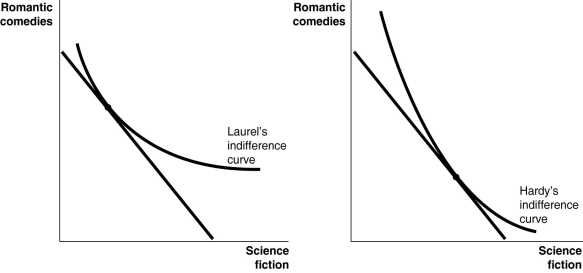 -Refer to Figure 10-4.Best friends Laurel and Hardy, both enjoy watching romantic comedies and science fiction movies.Based on the diagrams above what can you conclude about their movie preferences?
 (Multiple Choice)
4.8/5 (86)
(86) If by purchasing more apples and fewer oranges you increase your total utility, then apples must be cheaper than oranges.
(True/False)
4.9/5 (78)
(78) Alan Krueger conducted a survey of fans at the 2001 Super Bowl who purchased tickets to the game for $325 or $400.Krueger found that (a)94 percent of those surveyed would not have paid $3,000 for their tickets, and (b)92 percent of those surveyed would not have sold their tickets for $3,000.These results are an example of
(Multiple Choice)
4.9/5 (84)
(84) The satisfaction a person receives from consuming goods and services is called
(Multiple Choice)
4.8/5 (80)
(80) Figure 10-7
 The above panels show various combinations of indifference curves and budget constraints for two products: Popcorn and Candy.
-Refer to Figure 10-7.A change in income is shown in
The above panels show various combinations of indifference curves and budget constraints for two products: Popcorn and Candy.
-Refer to Figure 10-7.A change in income is shown in (Multiple Choice)
4.9/5 (74)
(74) Harvey Miller owns a baseball that was hit for a home run by Ted Williams.Harvey, a long-time Boston Red Sox fan, recently refused to sell his baseball for $75,000 even though he would not have paid someone more than $10,000 for the baseball if he did not already own it.Harvey explained his decision not to sell the baseball by noting that: "Ted Williams was my hero.This baseball has a great deal of sentimental value for me." Which of the following can explain Harvey's behavior?
(Multiple Choice)
4.9/5 (79)
(79) If you received negative marginal utility from consuming the 4th slice of pizza, then your total utility from 4 slices of pizza must be less than your total utility from 3 slices of pizza.
(True/False)
4.8/5 (78)
(78) Suppose the marginal utilities for the first three cans of soda are 100, 80 and 60, respectively.The total utility received from consuming 2 cans is
(Multiple Choice)
4.8/5 (76)
(76) The ultimatum game and the dictator game are used in economic experiments to test whether fairness is an important influence on consumer decision-making.
(True/False)
4.9/5 (93)
(93) Some online penny auctions charge a fee, such as $1, for every bid placed.Why should these costs of $1 per bid be considered sunk costs? Would it be smart for someone who has "already invested $5 in bidding costs" to keep bidding to "protect his or her sunk investments"? Why or why not?
(Essay)
4.9/5 (73)
(73) Economists usually assume that people act in a rational, self-interested way.In explaining how consumers make choices this means that economists believe
(Multiple Choice)
4.9/5 (82)
(82) Economists do not think it is possible to compare the relative utility that two people get from consuming an additional unit of a particular good.
(True/False)
4.8/5 (81)
(81) Standard economic theory asserts that sunk costs are irrelevant in making economic decisions, yet studies conducted by behavioral economists reveal that sunk costs often affect economic decisions.Which of the following could explain this observation?
(Multiple Choice)
4.7/5 (73)
(73) 
Filters
- Essay(0)
- Multiple Choice(0)
- Short Answer(0)
- True False(0)
- Matching(0)