



 Chat with AI
Exam 19: Comparative Advantage, international Trade, and Exchange Rates

Exam 1: Economics: Foundations and Models444 Questions
Exam 2: Trade-Offs, comparative Advantage, and the Market System498 Questions
Exam 3: Where Prices Come From: the Interaction of Demand and Supply475 Questions
Exam 4: Market Efficiency and Market Failure465 Questions
Exam 5: The Economics of Health Care334 Questions
Exam 6: Firms, the Stock Market, and Corporate Governance250 Questions
Exam 7: Consumer Choice and Elasticity380 Questions
Exam 8: Technology, production, and Costs276 Questions
Exam 9: Firms in Perfectly Competitive Markets297 Questions
Exam 10: Monopoly and Antitrust Policy271 Questions
Exam 11: Monopolistic Competition and Oligopoly414 Questions
Exam 12: Gdp: Measuring Total Production and Income266 Questions
Exam 13: Unemployment and Inflation292 Questions
Exam 14: Economic Growth, the Financial System, and Business Cycles257 Questions
Exam 15: Aggregate Demand and Aggregate Supply Analysis284 Questions
Exam 16: Money, banks, and the Federal Reserve System279 Questions
Exam 17: Monetary Policy277 Questions
Exam 18: Fiscal Policy282 Questions
Exam 19: Comparative Advantage, international Trade, and Exchange Rates446 Questions
Select questions type


Figure 19-3
 Since 1953 the United States has imposed a quota to limit the imports of peanuts. Figure 19-3 illustrates the impact of the quota.
-Refer to Figure 19-3.With a quota in place,what is the quantity supplied by domestic producers?
Since 1953 the United States has imposed a quota to limit the imports of peanuts. Figure 19-3 illustrates the impact of the quota.
-Refer to Figure 19-3.With a quota in place,what is the quantity supplied by domestic producers? (Multiple Choice)
4.9/5  (80)
(80) A tax imposed by a government on imports of a good into a country is called a
(Multiple Choice)
4.8/5 (90)
(90) Table 19-6
Saddles Spurs (pairs) Mateo 75 225 Celeste 100 225
Mateo and Celeste produce custom saddles and spurs.Table 19-6 lists the number of saddles and pairs of spurs Mateo and Celeste can each produce in one month.
-Refer to Table 19-6.Select the statement that accurately interprets the data in the table.
(Multiple Choice)
4.8/5 (91)
(91) Figure 19-6
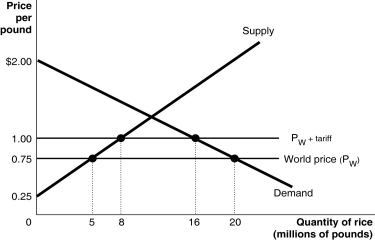 -Refer to Figure 19-6.Suppose the U.S.government imposes a $0.25 per pound tariff on rice imports.Figure 19-6 shows the demand and supply curves for rice and the impact of this tariff.Use the figure to answer questions a-i.
a.Following the imposition of the tariff,what is the price that domestic consumers must now pay and what is the quantity purchased?
b.Calculate the value of consumer surplus with the tariff in place.
c.What is the quantity supplied by domestic rice growers with the tariff in place?
d.Calculate the value of producer surplus received by U.S.rice growers with the tariff in place.
e.What is the quantity of rice imported with the tariff in place?
f.What is the amount of tariff revenue collected by the government?
g.The tariff has reduced consumer surplus.Calculate the loss in consumer surplus due to the tariff.
h.What portion of the consumer surplus loss is redistributed to domestic producers? To the government?
i.Calculate the deadweight loss due to the tariff.
-Refer to Figure 19-6.Suppose the U.S.government imposes a $0.25 per pound tariff on rice imports.Figure 19-6 shows the demand and supply curves for rice and the impact of this tariff.Use the figure to answer questions a-i.
a.Following the imposition of the tariff,what is the price that domestic consumers must now pay and what is the quantity purchased?
b.Calculate the value of consumer surplus with the tariff in place.
c.What is the quantity supplied by domestic rice growers with the tariff in place?
d.Calculate the value of producer surplus received by U.S.rice growers with the tariff in place.
e.What is the quantity of rice imported with the tariff in place?
f.What is the amount of tariff revenue collected by the government?
g.The tariff has reduced consumer surplus.Calculate the loss in consumer surplus due to the tariff.
h.What portion of the consumer surplus loss is redistributed to domestic producers? To the government?
i.Calculate the deadweight loss due to the tariff. (Essay)
4.9/5 (75)
(75) Figure 19-3
Since 1953 the United States has imposed a quota to limit the imports of peanuts. Figure 19-3 illustrates the impact of the quota.
-Refer to Figure 19-3.Without the quota,the domestic price of peanuts equals the world price which is $2.00 per pound.What is the quantity of peanuts supplied by domestic producers in the absence of a quota?
Since 1953 the United States has imposed a quota to limit the imports of peanuts. Figure 19-3 illustrates the impact of the quota.
-Refer to Figure 19-3.Without the quota,the domestic price of peanuts equals the world price which is $2.00 per pound.What is the quantity of peanuts supplied by domestic producers in the absence of a quota? (Multiple Choice)
4.9/5 (80)
(80) The ratio at which a country can trade its exports for imports from other countries is called comparative advantage.
(True/False)
4.8/5 (74)
(74) Table 19-2
Pies Cakes Sarita 15 25 Gabriel 12 16
Sarita and Gabriel own S&G Bakery.Table 19-2 lists the number of pies and cakes Sarita and Gabriel can each bake in one day.
-Refer to Table 19-2.Select the statement that accurately interprets the data in the table.
(Multiple Choice)
4.9/5 (75)
(75) How have U.S.imports and exports,as a fraction of GDP,changed from 1970 to the present?
(Essay)
4.9/5 (63)
(63) Figure 19-5
 Suppose the U.S.government imposes a $0.75 per pound tariff on coffee imports.Figure 19-5 shows the impact of this tariff.
-Refer to Figure 19-5.The tariff revenue collected by the government equals
Suppose the U.S.government imposes a $0.75 per pound tariff on coffee imports.Figure 19-5 shows the impact of this tariff.
-Refer to Figure 19-5.The tariff revenue collected by the government equals (Multiple Choice)
4.8/5 (91)
(91) Table 19-12
Production and
Consumption Production
Without Trade With Trade
Swards Beltr Svards Beltr Estoria 100 50 200 0 Morocco 50 40 0 120
Estonia and Morocco can produce both swords and belts.Table 19-12 shows the production and consumption quantities without trade, and the production numbers with trade.
-Refer to Table 19-12.Prior to trade,what was the opportunity cost to produce 1 belt in Morocco?
(Multiple Choice)
5.0/5 (77)
(77) If a country has a comparative advantage in producing a product,it may not have an absolute advantage in producing that product.
(True/False)
4.9/5 (65)
(65) Which of the following describes the infant industry argument for protectionism?
(Multiple Choice)
4.9/5 (73)
(73) Table 19-7
Output Per Hour of Work
Handbags Jackets Cambodia 15 3 Thailand 24 6
Table 19-7 shows the output per hour of work for handbags and jackets in Cambodia and in Thailand.
-Refer to Table 19-7.
a.Which country has an absolute advantage in the production of handbags and jackets?
b.Which country has a comparative advantage in the production of handbags?
c.Which country has a comparative advantage in the production of jackets?
(Essay)
4.8/5 (92)
(92) Figure 19-3
Since 1953 the United States has imposed a quota to limit the imports of peanuts. Figure 19-3 illustrates the impact of the quota.
-Refer to Figure 19-3.If there was no quota,how many pounds of peanuts would be imported?
Since 1953 the United States has imposed a quota to limit the imports of peanuts. Figure 19-3 illustrates the impact of the quota.
-Refer to Figure 19-3.If there was no quota,how many pounds of peanuts would be imported? (Multiple Choice)
5.0/5 (83)
(83) Figure 19-4
 Figure 19-4 shows the U.S.demand and supply for leather footwear.
-Refer to Figure 19-4.Under autarky,the consumer surplus is area
Figure 19-4 shows the U.S.demand and supply for leather footwear.
-Refer to Figure 19-4.Under autarky,the consumer surplus is area (Multiple Choice)
4.9/5 (84)
(84) Article Summary
Over the past two years, the Indian rupee has fallen 26 percent in value against the U.S. dollar, reaching a record low of 61.80 rupees per dollar in August 2013. The decline reflects increasing capital outflows and pessimism regarding the government's attempts to reverse this trend. The Indian government was expected to announce potential measures to increase the inflow of capital, including the possibility of raising debt abroad, raising money from Indians who live abroad, easing restrictions on overseas borrowing, and raising interest rates. Critics argue that current and well-entrenched policies deter capital inflow from investors and corporations, and raising interest rates may reduce confidence in the economy, which experienced a decade-low growth rate of 5 percent in 2013.
-Refer to the Article Summary.All else equal,a depreciation of the Indian rupee relative to a currency such as the U.S.dollar should ________ Indian exports and ________ imports to India.
(Multiple Choice)
4.8/5 (81)
(81) 
Filters
- Essay(0)
- Multiple Choice(0)
- Short Answer(0)
- True False(0)
- Matching(0)