



 Chat with AI
Exam 19: Comparative Advantage, international Trade, and Exchange Rates

Exam 1: Economics: Foundations and Models444 Questions
Exam 2: Trade-Offs, comparative Advantage, and the Market System498 Questions
Exam 3: Where Prices Come From: the Interaction of Demand and Supply475 Questions
Exam 4: Market Efficiency and Market Failure465 Questions
Exam 5: The Economics of Health Care334 Questions
Exam 6: Firms, the Stock Market, and Corporate Governance250 Questions
Exam 7: Consumer Choice and Elasticity380 Questions
Exam 8: Technology, production, and Costs276 Questions
Exam 9: Firms in Perfectly Competitive Markets297 Questions
Exam 10: Monopoly and Antitrust Policy271 Questions
Exam 11: Monopolistic Competition and Oligopoly414 Questions
Exam 12: Gdp: Measuring Total Production and Income266 Questions
Exam 13: Unemployment and Inflation292 Questions
Exam 14: Economic Growth, the Financial System, and Business Cycles257 Questions
Exam 15: Aggregate Demand and Aggregate Supply Analysis284 Questions
Exam 16: Money, banks, and the Federal Reserve System279 Questions
Exam 17: Monetary Policy277 Questions
Exam 18: Fiscal Policy282 Questions
Exam 19: Comparative Advantage, international Trade, and Exchange Rates446 Questions
Select questions type


Wall Street,in the borough of Manhattan in New York City,is the heart of the U.S.financial system,where banks,brokerage houses,other financial firms,and the New York Stock Exchange are all located.What is the reason for New York City's comparative advantage in the financial market?
(Multiple Choice)
4.8/5  (84)
(84) Protectionism is the use of ________ to protect domestic firms from foreign competition.
(Multiple Choice)
5.0/5 (84)
(84) Ceteris paribus,a real depreciation of the dollar will decrease net exports in the United States.
(True/False)
4.8/5 (95)
(95) Figure 19-12
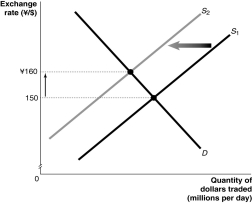 -Refer to Figure 19-12.Consider the market for U.S.dollars against the Japanese yen shown above.An event which could have caused the changes shown in the graph would be
 (Multiple Choice)
4.8/5 (79)
(79) Figure 19-2
 Suppose the U.S.government imposes a $0.40 per pound tariff on rice imports.Figure 19-2 shows the impact of this tariff.
-Refer to Figure 19-2.Without the tariff in place,the United States produces
Suppose the U.S.government imposes a $0.40 per pound tariff on rice imports.Figure 19-2 shows the impact of this tariff.
-Refer to Figure 19-2.Without the tariff in place,the United States produces (Multiple Choice)
5.0/5 (76)
(76) If the exchange rate changes from $0.08 = 1 mexican peso to $0.09 = 1 mexican peso,then
(Multiple Choice)
4.8/5 (75)
(75) 
Filters
- Essay(0)
- Multiple Choice(0)
- Short Answer(0)
- True False(0)
- Matching(0)