



 Chat with AI
Exam 14: Economic Growth, the Financial System, and Business Cycles

Exam 1: Economics: Foundations and Models444 Questions
Exam 2: Trade-Offs, comparative Advantage, and the Market System498 Questions
Exam 3: Where Prices Come From: the Interaction of Demand and Supply475 Questions
Exam 4: Market Efficiency and Market Failure465 Questions
Exam 5: The Economics of Health Care334 Questions
Exam 6: Firms, the Stock Market, and Corporate Governance250 Questions
Exam 7: Consumer Choice and Elasticity380 Questions
Exam 8: Technology, production, and Costs276 Questions
Exam 9: Firms in Perfectly Competitive Markets297 Questions
Exam 10: Monopoly and Antitrust Policy271 Questions
Exam 11: Monopolistic Competition and Oligopoly414 Questions
Exam 12: Gdp: Measuring Total Production and Income266 Questions
Exam 13: Unemployment and Inflation292 Questions
Exam 14: Economic Growth, the Financial System, and Business Cycles257 Questions
Exam 15: Aggregate Demand and Aggregate Supply Analysis284 Questions
Exam 16: Money, banks, and the Federal Reserve System279 Questions
Exam 17: Monetary Policy277 Questions
Exam 18: Fiscal Policy282 Questions
Exam 19: Comparative Advantage, international Trade, and Exchange Rates446 Questions
Select questions type


If Ebenezer Scrooge spends rather than saves his vast wealth he will
(Multiple Choice)
4.8/5  (72)
(72) Figure 14-6
 -Refer to Figure 14-6.The loanable funds market is in equilibrium,as shown in the figure above.An increase in the supply of loanable funds could result in which of the following combinations of the real interest rate and quantity of loanable funds at a new equilibrium?
 (Multiple Choice)
4.9/5 (82)
(82) Figure 14-3
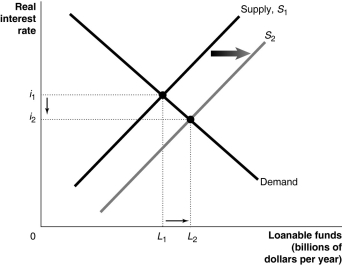 -Refer to Figure 14-3.Which of the following is consistent with the graph depicted above?
 (Multiple Choice)
4.7/5 (79)
(79) How will an increase in the government budget surplus as a result of lower government spending (with no change in net taxes)affect private saving in the economy?
(Multiple Choice)
4.9/5 (73)
(73) Scenario 14-1
Consider the following data for a closed economy:
Y = $12 trillion
C = $8 trillion
I= $2 trillion
G = $2 trillion
TR = $2 trillion
T = $3 trillion
-Refer to Scenario 14-1.Based on the information above,what is the level of private saving in the economy?
(Multiple Choice)
4.8/5 (73)
(73) If,in a closed economy,real GDP is $30 billion,consumption is $20 billion,and government purchases are $5 billion,what is total saving in the economy?
(Multiple Choice)
4.8/5 (78)
(78) Scenario 14-1
Consider the following data for a closed economy:
Y = $12 trillion
C = $8 trillion
I= $2 trillion
G = $2 trillion
TR = $2 trillion
T = $3 trillion
-Refer to Scenario 14-1.Based on the information above,what is the level of public saving?
(Multiple Choice)
4.7/5 (81)
(81) Centrally-planned economies tend to grow more quickly than market economies.
(True/False)
4.8/5 (85)
(85) Figure 14-6
-Refer to Figure 14-6.The loanable funds market is in equilibrium,as shown in the figure above.As a result of an increase in the government budget deficit,the ________ for loanable funds will ________,thereby ________ the equilibrium real interest rate and ________ the equilibrium quantity of loanable funds.
-Refer to Figure 14-6.The loanable funds market is in equilibrium,as shown in the figure above.As a result of an increase in the government budget deficit,the ________ for loanable funds will ________,thereby ________ the equilibrium real interest rate and ________ the equilibrium quantity of loanable funds. (Multiple Choice)
4.9/5 (73)
(73) If consumers decide to be more frugal and save more out of their income,then this will cause
(Multiple Choice)
4.8/5 (74)
(74) Which of the following would occur if the United States switched from income taxes to consumption taxes?
(Multiple Choice)
4.9/5 (85)
(85) Outline the various actions the government sector could take to promote growth.
(Essay)
4.8/5 (63)
(63) During a recession,spending on ________ tends to fall more dramatically than spending on ________.
(Multiple Choice)
4.7/5 (92)
(92) In the United States,the average length of expansions from 1950 to 2009 was more than twice as long than they were from 1900 to 1950.
(True/False)
4.9/5 (92)
(92) Figure 14-6
-Refer to Figure 14-6.The market is in equilibrium.If the government budget deficit rises,which of the following would you expect to see?
-Refer to Figure 14-6.The market is in equilibrium.If the government budget deficit rises,which of the following would you expect to see? (Multiple Choice)
4.8/5 (81)
(81) 
Filters
- Essay(0)
- Multiple Choice(0)
- Short Answer(0)
- True False(0)
- Matching(0)