



 Chat with AI
Exam 14: Economic Growth, the Financial System, and Business Cycles

Exam 1: Economics: Foundations and Models444 Questions
Exam 2: Trade-Offs, comparative Advantage, and the Market System498 Questions
Exam 3: Where Prices Come From: the Interaction of Demand and Supply475 Questions
Exam 4: Market Efficiency and Market Failure465 Questions
Exam 5: The Economics of Health Care334 Questions
Exam 6: Firms, the Stock Market, and Corporate Governance250 Questions
Exam 7: Consumer Choice and Elasticity380 Questions
Exam 8: Technology, production, and Costs276 Questions
Exam 9: Firms in Perfectly Competitive Markets297 Questions
Exam 10: Monopoly and Antitrust Policy271 Questions
Exam 11: Monopolistic Competition and Oligopoly414 Questions
Exam 12: Gdp: Measuring Total Production and Income266 Questions
Exam 13: Unemployment and Inflation292 Questions
Exam 14: Economic Growth, the Financial System, and Business Cycles257 Questions
Exam 15: Aggregate Demand and Aggregate Supply Analysis284 Questions
Exam 16: Money, banks, and the Federal Reserve System279 Questions
Exam 17: Monetary Policy277 Questions
Exam 18: Fiscal Policy282 Questions
Exam 19: Comparative Advantage, international Trade, and Exchange Rates446 Questions
Select questions type


Which of the following would you expect to increase the equilibrium interest rate?
(Multiple Choice)
4.8/5  (71)
(71) The demand for loanable funds is determined by the willingness of ________ to borrow money to engage in new investment projects.
(Multiple Choice)
4.8/5 (81)
(81) Inflation usually increases during a recession and decreases during an expansion.
(True/False)
4.9/5 (88)
(88) Potential GDP is estimated to grow at a rate of 3.2% in the United States.Actual GDP in the U.S.
(Multiple Choice)
4.8/5 (88)
(88) An increase in the demand for loanable funds will occur if there is
(Multiple Choice)
4.8/5 (72)
(72) Explain and show graphically how a decrease in household saving affects the equilibrium interest rate and the equilibrium quantity of loanable funds.
(Essay)
4.8/5 (84)
(84) Suppose that real GDP for 2012 was $10,000 billion and real GDP for 2013 was $9,500 billion.What is the rate of growth of real GDP between 2012 and 2013?
(Multiple Choice)
4.7/5 (76)
(76) Since 1950,expansions in the United States have become ________,while recessions have become ________.
(Multiple Choice)
4.8/5 (79)
(79) Figure 14-4
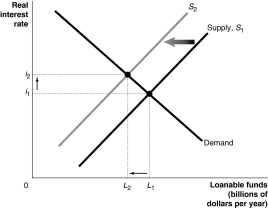 -Refer to Figure 14-4.Which of the following is consistent with the graph depicted?
 (Multiple Choice)
4.7/5 (86)
(86) According to Robert Fogel,economic growth ________ health,and health ________ economic growth.
(Multiple Choice)
4.9/5 (70)
(70) What is the name of the organization that defines business cycle peaks and troughs in the United States?
(Multiple Choice)
4.9/5 (82)
(82) Which of the following does not describe governmental policy actions that are helpful in supporting growth in an economy? Governmental policies that
(Multiple Choice)
4.8/5 (68)
(68) In a closed economy,which of the following components of GDP is not included?
(Multiple Choice)
5.0/5 (76)
(76) An increase in the real interest rate results in which of the following?
(Multiple Choice)
5.0/5 (81)
(81) Use the rule of 70 to illustrate how small differences in growth rates can have a large impact on how rapidly the standard of living in a country increases.
(Essay)
4.8/5 (73)
(73) The supply of loanable funds has a ________ slope because the greater the interest rate,the ________ the reward to saving,and the ________ the quantity of loanable funds supplied.
(Multiple Choice)
4.9/5 (77)
(77) If you invest $10,000 in a bond that earns 8% interest per year,how many years will it take to double your money?
(Multiple Choice)
4.8/5 (89)
(89) 
Filters
- Essay(0)
- Multiple Choice(0)
- Short Answer(0)
- True False(0)
- Matching(0)