



 Chat with AI
Exam 9: Firms in Perfectly Competitive Markets

Exam 1: Economics: Foundations and Models444 Questions
Exam 2: Trade-Offs, comparative Advantage, and the Market System498 Questions
Exam 3: Where Prices Come From: the Interaction of Demand and Supply475 Questions
Exam 4: Market Efficiency and Market Failure465 Questions
Exam 5: The Economics of Health Care334 Questions
Exam 6: Firms, the Stock Market, and Corporate Governance250 Questions
Exam 7: Consumer Choice and Elasticity380 Questions
Exam 8: Technology, production, and Costs276 Questions
Exam 9: Firms in Perfectly Competitive Markets297 Questions
Exam 10: Monopoly and Antitrust Policy271 Questions
Exam 11: Monopolistic Competition and Oligopoly414 Questions
Exam 12: Gdp: Measuring Total Production and Income266 Questions
Exam 13: Unemployment and Inflation292 Questions
Exam 14: Economic Growth, the Financial System, and Business Cycles257 Questions
Exam 15: Aggregate Demand and Aggregate Supply Analysis284 Questions
Exam 16: Money, banks, and the Federal Reserve System279 Questions
Exam 17: Monetary Policy277 Questions
Exam 18: Fiscal Policy282 Questions
Exam 19: Comparative Advantage, international Trade, and Exchange Rates446 Questions
Select questions type


The demand curve for an individual seller's product in perfect competition is
(Multiple Choice)
4.7/5  (79)
(79) In an increasing-cost industry the long-run supply curve is upward sloping.
(True/False)
4.8/5 (71)
(71) If a perfectly competitive firm's price is less than its average total cost but greater than its average variable cost,the firm
(Multiple Choice)
4.9/5 (72)
(72) Fill in the columns in the following table and use the values in the table to determine the profit-maximizing level of output.
Quantity Total Revenue (RR) Tatal Cast (TC) Prafit Mar ginal Revenue (MR) Marginal Cast (MC) 0 0 3 1 5 5 2 10 6 3 15 8 4 20 11 5 25 15 6 30 21 7 35 30 8 40 42 9 45 60 10 50 85
(Essay)
4.9/5 (60)
(60) Being a price-taker,a perfectly competitive firm cannot receive a producer surplus in the short run.
(True/False)
4.8/5 (91)
(91) A perfectly competitive firm's marginal revenue curve is downward sloping.
(True/False)
4.9/5 (68)
(68) Figure 9-6
 Figure 9-6 shows the demand, marginal cost (MC)and average total cost (ATC)curves for Jason's House of Apples.
-Refer to Figure 9-6.Which of the following statements is true?
Figure 9-6 shows the demand, marginal cost (MC)and average total cost (ATC)curves for Jason's House of Apples.
-Refer to Figure 9-6.Which of the following statements is true? (Multiple Choice)
4.8/5 (69)
(69) All of the following can be used to compute average profit except
(Multiple Choice)
4.9/5 (78)
(78) Maximizing average profit is equivalent to maximizing total profit.
(True/False)
4.9/5 (93)
(93) Which of the following is a characteristic of an oligopolistic market structure?
(Multiple Choice)
4.9/5 (91)
(91) Figure 9-15
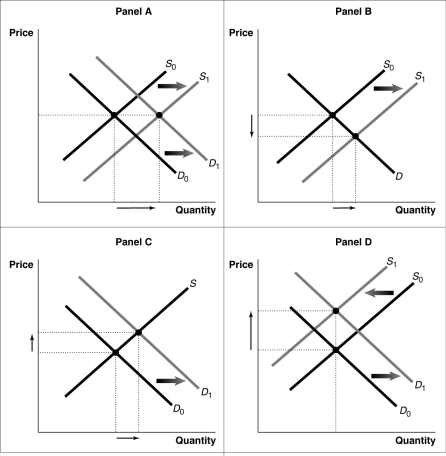 -Refer to Figure 9-15.Suppose a typical firm in a perfectly competitive market is earning economic profits in the short run.Which of the diagrams in the figure depicts what happens to in the industry as it transitions to along run equilibrium?
 (Multiple Choice)
4.8/5 (85)
(85) Figure 9-14
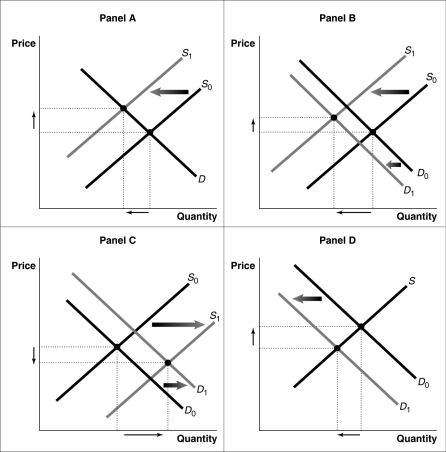 -Refer to Figure 9-14.Consider a typical firm in a perfectly competitive industry which is incurring short-run losses.Which of the diagrams in the figure shows the effect on the industry as it transitions to a long-run equilibrium?
 (Multiple Choice)
4.8/5 (79)
(79) Figure 9-7
 Figure 9-7 illustrates the cost curves of a perfectly competitive firm.
-Refer to Figure 9-7.If the market price is P₁
Figure 9-7 illustrates the cost curves of a perfectly competitive firm.
-Refer to Figure 9-7.If the market price is P₁ (Multiple Choice)
4.7/5 (88)
(88) Both buyers and sellers are price takers in a perfectly competitive market because
(Multiple Choice)
4.9/5 (78)
(78) In August 2008,Ethan Nicholas developed the iShoot application for the apple iPhone 3G,and within five months had earned $800,000 from this program.By May 2009,Nicholas had dropped the price from $4.99 to $1.99 in an attempt to maintain sales.This example indicates that in a competitive market
(Multiple Choice)
4.8/5 (86)
(86) When plasma television sets were first introduced prices were high and few firms were in the market.Later,economic profits attracted new firms and the price of plasma televisions fell.This example illustrates
(Multiple Choice)
4.8/5 (78)
(78) New York Times writer Michael Lewis wrote that "The sad truth,for investors,seems to be that most of the benefits....are passed through to consumers free of charge." To which of the following did Lewis refer?
(Multiple Choice)
4.8/5 (74)
(74) 
Filters
- Essay(0)
- Multiple Choice(0)
- Short Answer(0)
- True False(0)
- Matching(0)