



 Chat with AI
Exam 5: The Economics of Health Care

Exam 1: Economics: Foundations and Models444 Questions
Exam 2: Trade-Offs, comparative Advantage, and the Market System498 Questions
Exam 3: Where Prices Come From: the Interaction of Demand and Supply475 Questions
Exam 4: Market Efficiency and Market Failure465 Questions
Exam 5: The Economics of Health Care334 Questions
Exam 6: Firms, the Stock Market, and Corporate Governance250 Questions
Exam 7: Consumer Choice and Elasticity380 Questions
Exam 8: Technology, production, and Costs276 Questions
Exam 9: Firms in Perfectly Competitive Markets297 Questions
Exam 10: Monopoly and Antitrust Policy271 Questions
Exam 11: Monopolistic Competition and Oligopoly414 Questions
Exam 12: Gdp: Measuring Total Production and Income266 Questions
Exam 13: Unemployment and Inflation292 Questions
Exam 14: Economic Growth, the Financial System, and Business Cycles257 Questions
Exam 15: Aggregate Demand and Aggregate Supply Analysis284 Questions
Exam 16: Money, banks, and the Federal Reserve System279 Questions
Exam 17: Monetary Policy277 Questions
Exam 18: Fiscal Policy282 Questions
Exam 19: Comparative Advantage, international Trade, and Exchange Rates446 Questions
Select questions type


Changes in the health of the average person are an important indicator of changes in the standard of living.
(True/False)
4.7/5  (80)
(80) If a state requires all drivers to buy health insurance,the problem of adverse selection is eliminated.
(True/False)
4.9/5 (84)
(84) One reason why adverse selection problems arise in health insurance markets is that
(Multiple Choice)
4.8/5 (71)
(71) Figure 5-4
 Figure 5-4 represents the market for medical services with and without insurance, and the effect of a third-party payer system on the demand for medical services.
-Refer to Figure 5-4.The efficient quantity of medical services is
Figure 5-4 represents the market for medical services with and without insurance, and the effect of a third-party payer system on the demand for medical services.
-Refer to Figure 5-4.The efficient quantity of medical services is (Multiple Choice)
4.8/5 (75)
(75) Better health allows people to work harder,which raises a country's total income.This indicates that in effect,better health
(Multiple Choice)
4.9/5 (90)
(90) In the United States in 2012,the percentage of firms that employed between 3 and 199 workers and did not offer health insurance as a fringe benefit to the workers was about
(Multiple Choice)
4.7/5 (92)
(92) What are two reasons why employees would prefer for their employer pay for their health insurance rather than receiving increased wages and paying for their own health insurance?
(Essay)
5.0/5 (92)
(92) Figure 5-6
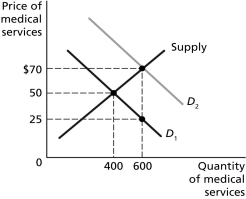 Figure 5-6 represents the supply and demand for medical services with and without a third-party payer.
-Refer to Figure 5-6.Answer the following questions:
1.What would be the equilibrium price and quantity if consumers had to pay the full price of medical services?
2.With insurance acting as a third-party payer,what price will consumers pay for medical service?
3.With insurance acting as a third-party payer,what price will doctors receive for medical service?
4.With insurance acting as a third-party payer,what will be the equilibrium quantity of medical services?
5.With insurance acting as a third-party payer,what will be the value of the deadweight loss?
Figure 5-6 represents the supply and demand for medical services with and without a third-party payer.
-Refer to Figure 5-6.Answer the following questions:
1.What would be the equilibrium price and quantity if consumers had to pay the full price of medical services?
2.With insurance acting as a third-party payer,what price will consumers pay for medical service?
3.With insurance acting as a third-party payer,what price will doctors receive for medical service?
4.With insurance acting as a third-party payer,what will be the equilibrium quantity of medical services?
5.With insurance acting as a third-party payer,what will be the value of the deadweight loss? (Short Answer)
4.9/5 (79)
(79) In the United States in 2012,the percentage of people without some form of private health insurance was about
(Multiple Choice)
5.0/5 (89)
(89) Vaccinations tend to result in a positive externality.Draw a graph showing the market for vaccinations,including both the marginal private benefit curve and the marginal social benefit curve.Identify the market equilibrium price and quantity,the efficient equilibrium price and quantity,and the deadweight loss.
(Essay)
4.9/5 (75)
(75) In 2013,the average height of adult males in the United States was
(Multiple Choice)
4.8/5 (80)
(80) Compared to other high-income countries,health care spending per person in the United States has been
(Multiple Choice)
4.9/5 (78)
(78) Figure 5-4
Figure 5-4 represents the market for medical services with and without insurance, and the effect of a third-party payer system on the demand for medical services.
-Refer to Figure 5-4.If consumers paid the full price of medical services,the equilibrium quantity would be
Figure 5-4 represents the market for medical services with and without insurance, and the effect of a third-party payer system on the demand for medical services.
-Refer to Figure 5-4.If consumers paid the full price of medical services,the equilibrium quantity would be (Multiple Choice)
4.9/5 (86)
(86) Figure 5-1
 Figure 5-1 represents the market for vaccinations.Vaccinations are considered a benefit to society, and the figure shows both the marginal private benefit and the marginal social benefit from vaccinations.
-Refer to Figure 5-1.At the efficient equilibrium
Figure 5-1 represents the market for vaccinations.Vaccinations are considered a benefit to society, and the figure shows both the marginal private benefit and the marginal social benefit from vaccinations.
-Refer to Figure 5-1.At the efficient equilibrium (Multiple Choice)
4.7/5 (67)
(67) Figure 5-1
Figure 5-1 represents the market for vaccinations.Vaccinations are considered a benefit to society, and the figure shows both the marginal private benefit and the marginal social benefit from vaccinations.
-Refer to Figure 5-1.The market equilibrium quantity is ________ thousand vaccinations.
Figure 5-1 represents the market for vaccinations.Vaccinations are considered a benefit to society, and the figure shows both the marginal private benefit and the marginal social benefit from vaccinations.
-Refer to Figure 5-1.The market equilibrium quantity is ________ thousand vaccinations. (Multiple Choice)
4.8/5 (72)
(72) The health care system in ________ is referred to as socialized medicine,under which the government owns most of the hospitals and employs most of the doctors.
(Multiple Choice)
4.9/5 (71)
(71) Of the following,the most to the rapid rise in health care costs in the United States can be attributed to
(Multiple Choice)
4.7/5 (82)
(82) 
Filters
- Essay(0)
- Multiple Choice(0)
- Short Answer(0)
- True False(0)
- Matching(0)