



 Chat with AI
Exam 5: The Economics of Health Care

Exam 1: Economics: Foundations and Models444 Questions
Exam 2: Trade-Offs, comparative Advantage, and the Market System498 Questions
Exam 3: Where Prices Come From: the Interaction of Demand and Supply475 Questions
Exam 4: Market Efficiency and Market Failure465 Questions
Exam 5: The Economics of Health Care334 Questions
Exam 6: Firms, the Stock Market, and Corporate Governance250 Questions
Exam 7: Consumer Choice and Elasticity380 Questions
Exam 8: Technology, production, and Costs276 Questions
Exam 9: Firms in Perfectly Competitive Markets297 Questions
Exam 10: Monopoly and Antitrust Policy271 Questions
Exam 11: Monopolistic Competition and Oligopoly414 Questions
Exam 12: Gdp: Measuring Total Production and Income266 Questions
Exam 13: Unemployment and Inflation292 Questions
Exam 14: Economic Growth, the Financial System, and Business Cycles257 Questions
Exam 15: Aggregate Demand and Aggregate Supply Analysis284 Questions
Exam 16: Money, banks, and the Federal Reserve System279 Questions
Exam 17: Monetary Policy277 Questions
Exam 18: Fiscal Policy282 Questions
Exam 19: Comparative Advantage, international Trade, and Exchange Rates446 Questions
Select questions type


Some economists and policymakers who are in favor of government-provided health care believe that providing health care will generate
(Multiple Choice)
4.8/5  (88)
(88) Health insurance markets have a problem with insuring people who are "poor health risks" while many people who are "good health risks" do not buy insurance.This problem is an example of
(Multiple Choice)
4.9/5 (70)
(70) In the United States in 2011,over 90 percent of people without health insurance were below the age of 34.
(True/False)
4.8/5 (79)
(79) Figure 5-2
 Figure 5-2 represents the market for vaccinations.Vaccinations are considered a benefit to society, and the figure shows both the marginal private benefit and the marginal social benefit from vaccinations.
-Refer to Figure 5-2.Marginal private benefit is represented by which curve?
Figure 5-2 represents the market for vaccinations.Vaccinations are considered a benefit to society, and the figure shows both the marginal private benefit and the marginal social benefit from vaccinations.
-Refer to Figure 5-2.Marginal private benefit is represented by which curve? (Multiple Choice)
4.8/5 (70)
(70) How can changes over time of the average height of the people in a country help to indicate the standard of living in a country?
(Essay)
4.9/5 (71)
(71) Figure 5-1
 Figure 5-1 represents the market for vaccinations.Vaccinations are considered a benefit to society, and the figure shows both the marginal private benefit and the marginal social benefit from vaccinations.
-Refer to Figure 5-1.At the market equilibrium,the deadweight loss is equal to
Figure 5-1 represents the market for vaccinations.Vaccinations are considered a benefit to society, and the figure shows both the marginal private benefit and the marginal social benefit from vaccinations.
-Refer to Figure 5-1.At the market equilibrium,the deadweight loss is equal to (Multiple Choice)
4.9/5 (77)
(77) A doctor pursuing the interests of his patients rather than his own interests is an example of the principal-agent problem.
(True/False)
4.8/5 (68)
(68) If a doctor knows that an insurance company will pay for most of a patient's bill,the doctor has more of an incentive to require additional medical procedures and tests,even if the patient may not require them.This is an example of
(Multiple Choice)
4.9/5 (78)
(78) Figure 5-5
 Figure 5-5 represents the market for medical services with and without insurance, and the effect of a third-party payer system on the demand for medical services.
-Refer to Figure 5-5.With insurance and a third-party payer system,what is the amount of the deadweight loss?
Figure 5-5 represents the market for medical services with and without insurance, and the effect of a third-party payer system on the demand for medical services.
-Refer to Figure 5-5.With insurance and a third-party payer system,what is the amount of the deadweight loss? (Multiple Choice)
4.8/5 (77)
(77) Figure 5-3
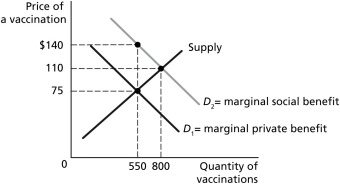 Figure 5-3 shows the effect of a positive externality on the market for vaccinations.
-Refer to Figure 5-3.On the above graph,identify the market equilibrium price and quantity,the efficient equilibrium price and quantity,and the value of the deadweight loss resulting from too few people receiving vaccinations.
Figure 5-3 shows the effect of a positive externality on the market for vaccinations.
-Refer to Figure 5-3.On the above graph,identify the market equilibrium price and quantity,the efficient equilibrium price and quantity,and the value of the deadweight loss resulting from too few people receiving vaccinations. (Essay)
4.9/5 (92)
(92) The Congressional Budget Office estimates that most of the increase in federal spending on Medicare and Medicaid will be due to
(Multiple Choice)
4.8/5 (78)
(78) Adverse selection in the market for health insurance arises because
(Multiple Choice)
4.8/5 (74)
(74) What has happened to health care's share of gross domestic product in the United States since 1965? How does this compare to what has happened to out-of-pocket spending on health care as a percentage of all spending on health care?
(Essay)
5.0/5 (76)
(76) Under the Patient Protection and Affordable Care Act (ACA),residents who do not have health insurance will not be allowed to seek employment.
(True/False)
4.8/5 (75)
(75) 
Filters
- Essay(0)
- Multiple Choice(0)
- Short Answer(0)
- True False(0)
- Matching(0)