



 Chat with AI
Exam 16: Pricing Strategy

Exam 1: Economics: Foundations and Models145 Questions
Exam 2: Trade-Offs, Comparative Advantage, and the Market System151 Questions
Exam 3: Where Prices Come From: the Interaction of Demand and Supply159 Questions
Exam 4: Economic Efficiency, Government Price Setting, and Taxes127 Questions
Exam 5: Externalities, Environmental Policy, and Public Goods141 Questions
Exam 6: Elasticity: the Responsiveness of Demand and Supply149 Questions
Exam 7: Comparative Advantage and the Gains From International Trade125 Questions
Exam 8: Consumer Choice and Behavioral Economics154 Questions
Exam 9: Technology, Production, and Costs169 Questions
Exam 10: Firms in Perfectly Competitive Markets153 Questions
Exam 11: Monopolistic Competition140 Questions
Exam 12: Oligopoly: Firms in Less Competitive Markets130 Questions
Exam 13: Monopoly and Antitrust Policy146 Questions
Exam 14: The Markets for Labour and Other Factors of Production149 Questions
Exam 15: Public Choice, Taxes, and the Distribution of Income134 Questions
Exam 16: Pricing Strategy132 Questions
Exam 17: Firms, the Stock Market, and Corporate Governance137 Questions
Select questions type


Assuming zero transaction cost, if your local grocer buys oranges at a low price from an orchard and resells them to you at a higher price, then the grocer's revenue minus costs is known as
(Multiple Choice)
5.0/5  (82)
(82) Differentiating products to suit customers' tastes is a form of price discrimination.
(True/False)
5.0/5 (76)
(76) Figure 16.4
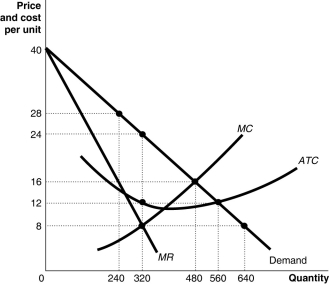 -Refer to Figure 16.4.Suppose the firm represented in the diagram decides to use a two-part pricing strategy such that it charges a fixed fee and a per-unit price equal to the competitive price.(This is also called an optimal two-part tariff.) What is the total revenue it can expect to collect from the fixed fee portion of the price?
 (Multiple Choice)
4.9/5 (77)
(77) An optimal two-part tariff pricing schedule maximizes consumer surplus.
(True/False)
4.8/5 (75)
(75) From an economic perspective, price discrimination is desirable because
(Multiple Choice)
4.7/5 (87)
(87) Table 16.2
Quantity Demanded in Middle Fall (tubes per week) Price per Tube Quantity Demanded in West Fall (tubes per week) Price per Tube 1 \ 8 1 \ 5.00 2 7 2 4.50 3 6 3 4.00 4 5 4 3.50 5 4 5 3.00
Neem Products sells its Ayurvedic Neem toothpaste in two completely isolated markets with demand schedules as shown in Table 16.2. The average cost of production is constant at $2 per tube.
-Refer to Table 16.2.What are the total profits from both markets combined?
(Multiple Choice)
4.8/5 (100)
(100) Figure 16.2
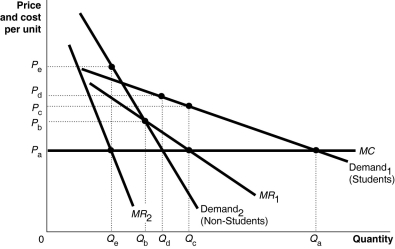 Plato Playhouse, a theatre company in the university town of Wegg, caters to two groups of customers: students and the non-student population. Figure 16.2 shows the demand curves for the two groups of customers.
-Refer to Figure 16.2.Suppose Plato Playhouse charges a single price of Pd for each performance.Which of the following statements is true?
Plato Playhouse, a theatre company in the university town of Wegg, caters to two groups of customers: students and the non-student population. Figure 16.2 shows the demand curves for the two groups of customers.
-Refer to Figure 16.2.Suppose Plato Playhouse charges a single price of Pd for each performance.Which of the following statements is true? (Multiple Choice)
4.9/5 (76)
(76) Figure 16.1
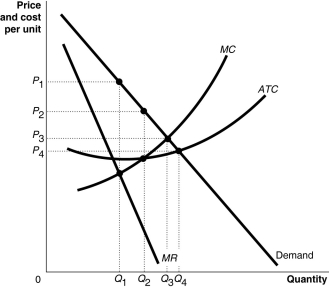 -Refer to Figure 16.1.What is the consumer surplus received under perfect price discrimination?
 (Multiple Choice)
4.9/5 (85)
(85) When you buy at a low price in one market then sell at a higher price in another market you are engaging in
(Multiple Choice)
4.9/5 (82)
(82) What is the difference between price discrimination and other forms of discrimination?
(Essay)
4.8/5 (82)
(82) To successfully price discriminate, a firm must ensure that there are no opportunities for arbitrage.
(True/False)
4.9/5 (88)
(88) 
Filters
- Essay(0)
- Multiple Choice(0)
- Short Answer(0)
- True False(0)
- Matching(0)