



 Chat with AI
Exam 16: Pricing Strategy

Exam 1: Economics: Foundations and Models145 Questions
Exam 2: Trade-Offs, Comparative Advantage, and the Market System151 Questions
Exam 3: Where Prices Come From: the Interaction of Demand and Supply159 Questions
Exam 4: Economic Efficiency, Government Price Setting, and Taxes127 Questions
Exam 5: Externalities, Environmental Policy, and Public Goods141 Questions
Exam 6: Elasticity: the Responsiveness of Demand and Supply149 Questions
Exam 7: Comparative Advantage and the Gains From International Trade125 Questions
Exam 8: Consumer Choice and Behavioral Economics154 Questions
Exam 9: Technology, Production, and Costs169 Questions
Exam 10: Firms in Perfectly Competitive Markets153 Questions
Exam 11: Monopolistic Competition140 Questions
Exam 12: Oligopoly: Firms in Less Competitive Markets130 Questions
Exam 13: Monopoly and Antitrust Policy146 Questions
Exam 14: The Markets for Labour and Other Factors of Production149 Questions
Exam 15: Public Choice, Taxes, and the Distribution of Income134 Questions
Exam 16: Pricing Strategy132 Questions
Exam 17: Firms, the Stock Market, and Corporate Governance137 Questions
Select questions type


Figure 16.4
 -Refer to Figure 16.4.Suppose the firm represented in the diagram decides to practice perfect price discrimination.What is the profit-maximizing quantity?
 (Multiple Choice)
4.7/5  (73)
(73) Figure 16.4
-Refer to Figure 16.4.Suppose the firm represented in the diagram decides to use a two-part pricing strategy such that it charges a fixed fee and a per-unit price equal to the monopoly price.What is the per-unit price?
-Refer to Figure 16.4.Suppose the firm represented in the diagram decides to use a two-part pricing strategy such that it charges a fixed fee and a per-unit price equal to the monopoly price.What is the per-unit price? (Multiple Choice)
4.9/5 (71)
(71) One method of setting price using the cost-plus method is to add
(Multiple Choice)
5.0/5 (76)
(76) Many Canadians living close to the US border regularly cross the border to buy milk, eggs, and other goods at considerably lower prices.
Is this an example of arbitrage?
(Multiple Choice)
4.8/5 (80)
(80) The following table contains the actual prices charged by four websites for a blu-ray copy of the movie Despicable Me 2.
Amazon.ca 23.67 Chapters.ca 28.49 FutureShop.ca 24.99 Walmart.ca 24.97
Explain whether the information in this table contradicts the law of one price.
(Essay)
4.9/5 (67)
(67) Requiring those who have season tickets for a professional sports team to pay for equity seat rights or personal seat licenses shifts more of the burden of paying for a new stadium or arena to
(Multiple Choice)
4.8/5 (66)
(66) Lou buys a classic Mario Bros.game from Evan for $30 and resells it on eBay for $60.Which of the following statements is false?
(Multiple Choice)
4.7/5 (86)
(86) Buying at a low price in one market and reselling at a higher price in another market will
(Multiple Choice)
4.9/5 (75)
(75) Table 16.2
Quantity Demanded in Middle Fall (tubes per week) Price per Tube Quantity Demanded in West Fall (tubes per week) Price per Tube 1 \ 8 1 \ 5.00 2 7 2 4.50 3 6 3 4.00 4 5 4 3.50 5 4 5 3.00
Neem Products sells its Ayurvedic Neem toothpaste in two completely isolated markets with demand schedules as shown in Table 16.2. The average cost of production is constant at $2 per tube.
-Refer to Table 16.2.Which of the following statements is true about the two markets?
(Multiple Choice)
5.0/5 (83)
(83) Which of the following does not arise from price discrimination?
(Multiple Choice)
4.8/5 (79)
(79) Consider the following pricing strategies:
a)perfect price discrimination
b)charging different prices to different groups of customers
c)optimal two-part tariff
d)single-price monopoly pricing
Which of the pricing strategies allows a producer to capture the entire consumer surplus that would have gone to consumers under perfect competitive pricing?
(Multiple Choice)
4.9/5 (68)
(68) Which of the following is a necessary condition for successful price discrimination?
(Multiple Choice)
4.9/5 (78)
(78) Because each customer pays according to her willingness to pay, a consumer maximizes her consumer surplus under first-degree price discrimination.
(True/False)
4.9/5 (91)
(91) If a monopolist engages in perfect price discrimination, it will produce the same output level as a perfectly competitive industry.
(True/False)
4.9/5 (78)
(78) Figure 16.3
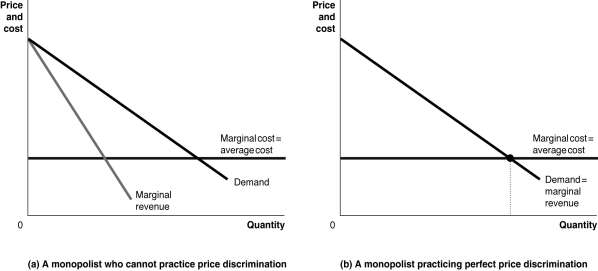 -Refer to Figure 16.3.Graph (a)represents a monopolist who cannot price discriminate and graph (b)represents a monopolist practicing perfect price discrimination.On each graph, identify the monopoly price, the monopoly output, the efficient output, and the areas representing profit, consumer surplus, and deadweight loss.
 (Essay)
4.9/5 (74)
(74) Which of the following products allows the seller to identify different groups of consumers (segment the market)at virtually no cost?
(Multiple Choice)
4.9/5 (73)
(73) Figure 16.4
-Refer to Figure 16.4.Consider the following two pricing strategies:
a)a fixed fee and a per-unit price equal to the monopoly price
b)a fixed fee and a per-unit price equal to the competitive price
The firm represented in the diagram earns a higher profit under strategy ________ and deadweight loss is eliminated under ________.
-Refer to Figure 16.4.Consider the following two pricing strategies:
a)a fixed fee and a per-unit price equal to the monopoly price
b)a fixed fee and a per-unit price equal to the competitive price
The firm represented in the diagram earns a higher profit under strategy ________ and deadweight loss is eliminated under ________. (Multiple Choice)
4.9/5 (70)
(70) 
Filters
- Essay(0)
- Multiple Choice(0)
- Short Answer(0)
- True False(0)
- Matching(0)