



 Chat with AI
Exam 16: Pricing Strategy

Exam 1: Economics: Foundations and Models145 Questions
Exam 2: Trade-Offs, Comparative Advantage, and the Market System151 Questions
Exam 3: Where Prices Come From: the Interaction of Demand and Supply159 Questions
Exam 4: Economic Efficiency, Government Price Setting, and Taxes127 Questions
Exam 5: Externalities, Environmental Policy, and Public Goods141 Questions
Exam 6: Elasticity: the Responsiveness of Demand and Supply149 Questions
Exam 7: Comparative Advantage and the Gains From International Trade125 Questions
Exam 8: Consumer Choice and Behavioral Economics154 Questions
Exam 9: Technology, Production, and Costs169 Questions
Exam 10: Firms in Perfectly Competitive Markets153 Questions
Exam 11: Monopolistic Competition140 Questions
Exam 12: Oligopoly: Firms in Less Competitive Markets130 Questions
Exam 13: Monopoly and Antitrust Policy146 Questions
Exam 14: The Markets for Labour and Other Factors of Production149 Questions
Exam 15: Public Choice, Taxes, and the Distribution of Income134 Questions
Exam 16: Pricing Strategy132 Questions
Exam 17: Firms, the Stock Market, and Corporate Governance137 Questions
Select questions type


The law of one price states that identical products should sell for the same price everywhere as long as transactions costs are zero.
(True/False)
4.9/5  (77)
(77) Figure 16.1
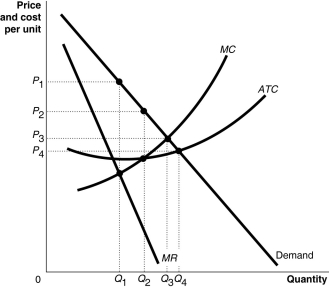 -Refer to Figure 16.1.With perfect price discrimination, the firm will produce and sell
 (Multiple Choice)
4.9/5 (83)
(83) If firms differentiate their products in different ways and charge different price because of these differentiation factors, then
(Multiple Choice)
5.0/5 (76)
(76) The act of buying a product at a low price in one market and reselling the product at a higher price in another market is called arbitrage.
(True/False)
4.9/5 (79)
(79) Suppose the per-unit production cost of a book is $4.00 and the retail price is $32.If the book publisher sells books to a bookstore at a 40 percent discount, what is the amount of the publisher's markup per book? Assume that bookstores sell books at the retail price.
(Multiple Choice)
4.7/5 (83)
(83) Joss is a marketing consultant.Iris and Daphne are potential customers interested in commissioning Joss to undertake a market survey and compile the findings in a report.Iris is willing to pay $500 for the service while Daphne is willing to pay $800.Suppose that the opportunity cost of Joss's time is $1,200.Assume that Iris and Daphne do not know each other.Which of the following statements is true?
(Multiple Choice)
5.0/5 (88)
(88) Suppose a restaurant is trying to determine how much to charge for a bowl of chili, and decides to run an experiment to see how much its customers are willing to pay by allowing them to set their own price for this menu item.
a.Is charging a customer the price he or she is willing to pay for the bowl of chili an example of price discrimination? Briefly explain.
b.What is it called when a firm knows every consumer's willingness to pay, and can charge every consumer a different price? What happens to consumer surplus in this situation?
(Essay)
4.8/5 (83)
(83) Figure 16.4
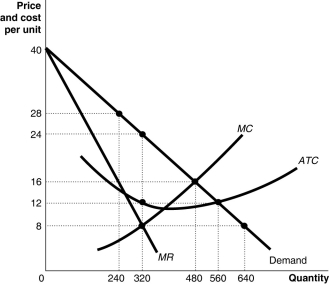 -Refer to Figure 16.4.Suppose the firm represented in the diagram decides to practice perfect price discrimination.What is the total revenue collected by the firm?
 (Multiple Choice)
4.8/5 (82)
(82) Cost-plus pricing is a reasonable way to determine the optimal price when
(Multiple Choice)
4.7/5 (72)
(72) The Canadian National Exhibition in Toronto charges people to enter the fair grounds as well as for each ride they go on.This pricing strategy is an example of
(Multiple Choice)
4.8/5 (71)
(71) Figure 16.1
-Refer to Figure 16.1.What is the economically efficient output level?
-Refer to Figure 16.1.What is the economically efficient output level? (Multiple Choice)
4.8/5 (86)
(86) Figure 16.4
-Refer to Figure 16.4.Suppose the firm represented in the diagram decides to use a two-part pricing strategy such that it charges a fixed fee and a per-unit price equal to the monopoly price.What is the revenue collected from the fixed fee portion of the price?
-Refer to Figure 16.4.Suppose the firm represented in the diagram decides to use a two-part pricing strategy such that it charges a fixed fee and a per-unit price equal to the monopoly price.What is the revenue collected from the fixed fee portion of the price? (Multiple Choice)
4.8/5 (88)
(88) Figure 16.4
-Refer to Figure 16.4.Suppose the firm represented in the diagram decides to use a two-part pricing strategy such that it charges a fixed fee and a per-unit price equal to the competitive price.(This is also called an optimal two-part tariff.)What is the value of the consumer surplus from this pricing strategy?
-Refer to Figure 16.4.Suppose the firm represented in the diagram decides to use a two-part pricing strategy such that it charges a fixed fee and a per-unit price equal to the competitive price.(This is also called an optimal two-part tariff.)What is the value of the consumer surplus from this pricing strategy? (Multiple Choice)
4.8/5 (87)
(87) If the selling price of a firm's product is $200 and the estimated average cost of producing this product is $150, what is the firm's markup?
(Multiple Choice)
4.8/5 (88)
(88) Yield management and price discrimination have enabled firms to increase profits and, at the same time,
(Multiple Choice)
4.9/5 (83)
(83) In a perfectly competitive market, in the long run, arbitrage profits will be bid away.
(True/False)
4.7/5 (72)
(72) The Athenian Theatre sells play tickets for the same play at different prices: a lower price to those who opt for the seats at the back of the theatre and a higher price for those who purchase seats in the front, around the stage.Which of the following statements is true?
(Multiple Choice)
4.8/5 (75)
(75) 
Filters
- Essay(0)
- Multiple Choice(0)
- Short Answer(0)
- True False(0)
- Matching(0)