



 Chat with AI
Exam 10: Firms in Perfectly Competitive Markets

Exam 1: Economics: Foundations and Models145 Questions
Exam 2: Trade-Offs, Comparative Advantage, and the Market System151 Questions
Exam 3: Where Prices Come From: the Interaction of Demand and Supply159 Questions
Exam 4: Economic Efficiency, Government Price Setting, and Taxes127 Questions
Exam 5: Externalities, Environmental Policy, and Public Goods141 Questions
Exam 6: Elasticity: the Responsiveness of Demand and Supply149 Questions
Exam 7: Comparative Advantage and the Gains From International Trade125 Questions
Exam 8: Consumer Choice and Behavioral Economics154 Questions
Exam 9: Technology, Production, and Costs169 Questions
Exam 10: Firms in Perfectly Competitive Markets153 Questions
Exam 11: Monopolistic Competition140 Questions
Exam 12: Oligopoly: Firms in Less Competitive Markets130 Questions
Exam 13: Monopoly and Antitrust Policy146 Questions
Exam 14: The Markets for Labour and Other Factors of Production149 Questions
Exam 15: Public Choice, Taxes, and the Distribution of Income134 Questions
Exam 16: Pricing Strategy132 Questions
Exam 17: Firms, the Stock Market, and Corporate Governance137 Questions
Select questions type


Use a graph to show the demand, AVC, ATC, MC, and MR curves of a firm that should temporarily shut down in the short run.Identify the shutdown point on the graph.

Free
(Essay)
4.9/5  (81)
(81) Correct Answer: Verified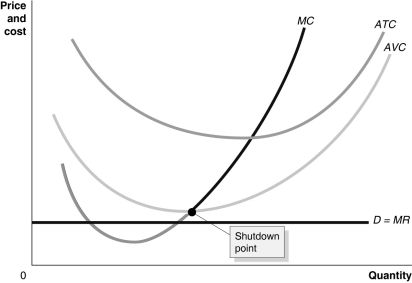
Max Shreck, an accountant, quit his $80,000-a-year job and bought an existing tattoo parlor from its previous owner, Mary Pickford.The lease has five years remaining and requires a monthly payment of $4,000.The lease
Free
(Multiple Choice)
4.8/5 (81)
(81) Correct Answer:Verified
VerifiedA
Figure 10.5
 Figure 10.5 shows cost and demand curves facing a typical firm in a constant-cost, perfectly competitive industry.
-Refer to Figure 10.5.What is the minimum price the firm requires to produce output?
Figure 10.5 shows cost and demand curves facing a typical firm in a constant-cost, perfectly competitive industry.
-Refer to Figure 10.5.What is the minimum price the firm requires to produce output?Free
(Multiple Choice)
4.8/5 (73)
(73) Correct Answer:Verified
VerifiedC
Figure 10.9
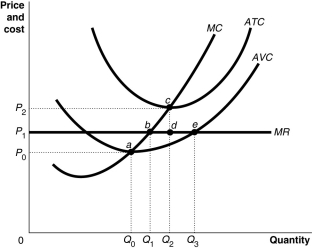 -Refer to Figure 10.9.Suppose the prevailing price is P₁ and the firm is currently producing its loss-minimizing quantity.If the firm represented in the diagram continues to stay in business, in the long-run equilibrium,
 (Multiple Choice)
4.8/5 (78)
(78) A very large number of small sellers who sell identical products imply
(Multiple Choice)
4.9/5 (80)
(80) Under what conditions should a competitive firm shut down in the short run?
(Essay)
4.7/5 (80)
(80) A decrease in demand for organic products will ________ a firm's economic profit, and the increase in costs to produce organic produce will ________ a firm's economic profit.
(Multiple Choice)
4.8/5 (73)
(73) An individual seller in perfect competition will not sell at a price lower than the market price because
(Multiple Choice)
4.8/5 (85)
(85) Figure 10.3
 -Refer to Figure 10.3.Suppose the prevailing price is P₁ and the firm is currently producing its loss-minimizing quantity.Identify the area that represents the loss.
 (Multiple Choice)
4.9/5 (82)
(82) An increase in a firm's fixed cost will not change the firm's profit-maximizing output in the short run.
(True/False)
4.9/5 (82)
(82) In the short run, a firm that incurs losses might choose to produce rather than shut down if the amount of its revenue is less than its fixed cost.
(True/False)
4.8/5 (84)
(84) Firms in perfect competition produce the allocatively efficient output in the short run and in the long run.
(True/False)
4.9/5 (79)
(79) If, for the last unit of a good produced by a perfectly competitive firm, MR > MC, then in producing it, the firm
(Multiple Choice)
4.9/5 (92)
(92) What is a long-run supply curve? What does a long-run supply curve look like on a perfectly competitive market graph?
(Essay)
4.8/5 (72)
(72) Table 10.1
Quantity Total Cost (dollars) Variable Cost (dollars) 0 \ 1,000 \ 0 100 1,360 360 200 1,560 560 300 1,960 960 400 2,760 1,760 500 4,000 3,000 600 5,800 4,800
Table 10.1 shows the short-run cost data of a perfectly competitive firm that produces plastic camera cases. Assume that output can only be increased in batches of 100 units.
-Refer to Table 10.1.If the market price of each camera case is $8, what is the firm's total revenue?
(Multiple Choice)
4.8/5 (70)
(70) Figure 10.13
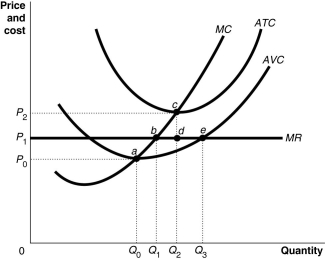 -Refer to Figure 10.13.If the market price is P₁, what is the allocatively efficient output level?
 (Multiple Choice)
4.7/5 (64)
(64) The minimum point on the average variable cost curve is called the loss-minimizing point.
(True/False)
4.9/5 (85)
(85) Figure 10.6
 Figure 10.6 shows cost and demand curves facing a profit-maximizing, perfectly competitive firm.
-Refer to Figure 10.6.Identify the short-run shut down point for the firm.
Figure 10.6 shows cost and demand curves facing a profit-maximizing, perfectly competitive firm.
-Refer to Figure 10.6.Identify the short-run shut down point for the firm. (Multiple Choice)
4.9/5 (82)
(82) Table 10.1
Quantity Total Cost (dollars) Variable Cost (dollars) 0 \ 1,000 \ 0 100 1,360 360 200 1,560 560 300 1,960 960 400 2,760 1,760 500 4,000 3,000 600 5,800 4,800
Table 10.1 shows the short-run cost data of a perfectly competitive firm that produces plastic camera cases. Assume that output can only be increased in batches of 100 units.
-Refer to Table 10.1.If the market price of each camera case is $8, what is the profit-maximizing quantity?
(Multiple Choice)
4.9/5 (74)
(74) 
Filters
- Essay(0)
- Multiple Choice(0)
- Short Answer(0)
- True False(0)
- Matching(0)