



 Chat with AI
Exam 16: Pricing Strategy

Exam 1: Economics: Foundations and Models145 Questions
Exam 2: Trade-Offs, Comparative Advantage, and the Market System151 Questions
Exam 3: Where Prices Come From: the Interaction of Demand and Supply159 Questions
Exam 4: Economic Efficiency, Government Price Setting, and Taxes127 Questions
Exam 5: Externalities, Environmental Policy, and Public Goods141 Questions
Exam 6: Elasticity: the Responsiveness of Demand and Supply149 Questions
Exam 7: Comparative Advantage and the Gains From International Trade125 Questions
Exam 8: Consumer Choice and Behavioral Economics154 Questions
Exam 9: Technology, Production, and Costs169 Questions
Exam 10: Firms in Perfectly Competitive Markets153 Questions
Exam 11: Monopolistic Competition140 Questions
Exam 12: Oligopoly: Firms in Less Competitive Markets130 Questions
Exam 13: Monopoly and Antitrust Policy146 Questions
Exam 14: The Markets for Labour and Other Factors of Production149 Questions
Exam 15: Public Choice, Taxes, and the Distribution of Income134 Questions
Exam 16: Pricing Strategy132 Questions
Exam 17: Firms, the Stock Market, and Corporate Governance137 Questions
Select questions type


What three conditions must hold for a firm to successfully price discriminate?
(Essay)
4.8/5  (74)
(74) Under what circumstances will the law of one price hold, and when might it not hold?
(Essay)
4.9/5 (79)
(79) When a monopolist engages in perfect price discrimination, the quantity produced and sold
(Multiple Choice)
5.0/5 (81)
(81) Figure 16.1
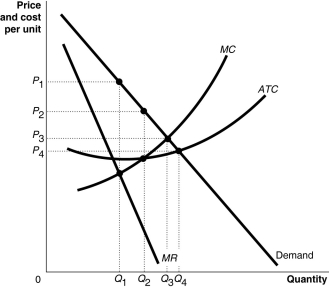 -Refer to Figure 16.1.What is the price charged under perfect price discrimination?
 (Multiple Choice)
4.9/5 (81)
(81) Table 16.2
Quantity Demanded in Middle Fall (tubes per week) Price per Tube Quantity Demanded in West Fall (tubes per week) Price per Tube 1 \ 8 1 \ 5.00 2 7 2 4.50 3 6 3 4.00 4 5 4 3.50 5 4 5 3.00
Neem Products sells its Ayurvedic Neem toothpaste in two completely isolated markets with demand schedules as shown in Table 16.2. The average cost of production is constant at $2 per tube.
-Refer to Table 16.2.What is the total revenue received from both markets combined?
(Multiple Choice)
4.8/5 (76)
(76) A two-part tariff refers to a pricing schedule under which a buyer must pay a fixed fee for the right to purchase the product, in addition to a per-unit price.
(True/False)
4.7/5 (84)
(84) For many products, such as fast foods, a variety of prices can be found, but sellers with higher prices can expect to sell their products because
(Multiple Choice)
4.7/5 (88)
(88) Why is it necessary for a firm that practices price discrimination be a price maker rather than a price taker?
(Essay)
4.8/5 (67)
(67) Table 16.2
Quantity Demanded in Middle Fall (tubes per week) Price per Tube Quantity Demanded in West Fall (tubes per week) Price per Tube 1 \ 8 1 \ 5.00 2 7 2 4.50 3 6 3 4.00 4 5 4 3.50 5 4 5 3.00
Neem Products sells its Ayurvedic Neem toothpaste in two completely isolated markets with demand schedules as shown in Table 16.2. The average cost of production is constant at $2 per tube.
-Refer to Table 16.2.How many tubes of toothpaste will Neem sell in Middle Fall and at what price?
(Multiple Choice)
4.9/5 (72)
(72) Table 16.2
Quantity Demanded in Middle Fall (tubes per week) Price per Tube Quantity Demanded in West Fall (tubes per week) Price per Tube 1 \ 8 1 \ 5.00 2 7 2 4.50 3 6 3 4.00 4 5 4 3.50 5 4 5 3.00
Neem Products sells its Ayurvedic Neem toothpaste in two completely isolated markets with demand schedules as shown in Table 16.2. The average cost of production is constant at $2 per tube.
-Refer to Table 16.2.How many tubes of toothpaste will Neem sell in West Fall and at what price?
(Multiple Choice)
4.8/5 (84)
(84) Most supermarkets charge the same price for the majority of goods sold.This suggest that
(Multiple Choice)
4.7/5 (82)
(82) Which of the following is a reason why airline yield management is an effective method to increase revenue?
(Multiple Choice)
4.9/5 (86)
(86) Which of the following is not a way by which price discriminating firms can segment a market?
(Multiple Choice)
4.8/5 (68)
(68) Which of the following firms is not able to practice price discrimination?
(Multiple Choice)
4.9/5 (79)
(79) If, at the firm's projected sales level, the marginal cost is $40, the average cost is $50 and the markup is 30 percent, then its selling price is
(Multiple Choice)
5.0/5 (75)
(75) Consider three pricing strategies that the firm can pursue:
a)optimal two-part tariff pricing
b)perfect price discrimination
c)single-price monopoly pricing
Of these three strategies, which method gives the firm the highest profit?
(Multiple Choice)
4.9/5 (76)
(76) Booking a flight at the last minute is often much more expensive than booking months in advance.Why is this the case?
(Multiple Choice)
4.8/5 (69)
(69) Figure 16.4
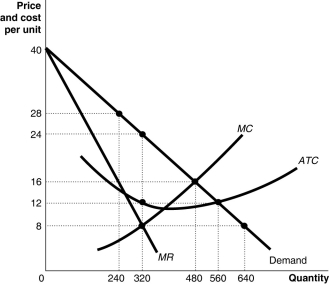 -Refer to Figure 16.4.Suppose the firm represented in the diagram decides to use a two-part pricing strategy such that it charges a fixed fee and a per-unit price equal to the monopoly price.What is the quantity it should produce?
 (Multiple Choice)
4.8/5 (76)
(76) 
Filters
- Essay(0)
- Multiple Choice(0)
- Short Answer(0)
- True False(0)
- Matching(0)