



 Chat with AI
Exam 2: Frequency Distributions, Percentiles,

Exam 1: Introduction25 Questions
Exam 2: Frequency Distributions, Percentiles,34 Questions
Exam 3: Graphic Representation of Frequency Distributions25 Questions
Exam 4: Central Tendency25 Questions
Exam 5: Variability and Standard Z Scores37 Questions
Exam 6: Standard Scores and the Normal Curve27 Questions
Exam 7: Correlation38 Questions
Exam 8: Prediction40 Questions
Exam 9: Interpretive Aspects of Correlation and Regression23 Questions
Exam 10: Probability29 Questions
Exam 11: Random Sampling and Sampling Distributions24 Questions
Exam 12: Introduction to Statistical Inference: Testing Hypotheses About Single Means Z and T74 Questions
Exam 13: Interpreting the Results of Hypothesis Testing: Effect Size, Type I and Type II Errors, and Power42 Questions
Exam 14: Testing Hypotheses About the Difference Between Two Independent Groups33 Questions
Exam 15: Testing for a Difference18 Questions
Exam 16: Inference About Correlation Coefficients24 Questions
Exam 17: An Alternative to Hypothesis Testing: Confidence Intervals28 Questions
Exam 18: Testing for Differences Among Three or More Groups: One-Way Analysis of Variance and Some Alternatives49 Questions
Exam 19: Factorial Analysis of Variance30 Questions
Exam 20: Chi-Square and Inference About Frequencies27 Questions
Exam 21: Some Almost Assumption-Free Tests19 Questions
Select questions type


The director of the work-experience program at a suburban high school wants to find out the hourly wages being offered to high school students for summer jobs in the community. His secretary conducts a survey of local businesses and obtains the following results ($ per hour) for 40 different job openings:
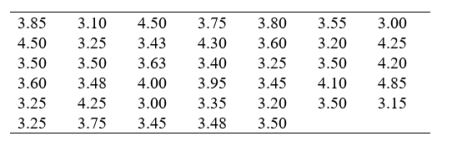 (a) Construct a frequency distribution of the hourly wages. Use an interval width of $.20 and $3.00-$3.19 as the lowest interval.
(b) Convert the frequencies to relative frequencies (use percentages).
(a) Construct a frequency distribution of the hourly wages. Use an interval width of $.20 and $3.00-$3.19 as the lowest interval.
(b) Convert the frequencies to relative frequencies (use percentages). (Short Answer)
5.0/5  (78)
(78) It is claimed that class intervals should be continuous, of the same width throughout, mutually exclusive, and laid out with the highest interval placed at the top. Which characteristic, if any, is not an appropriate requirement?
(Multiple Choice)
5.0/5 (74)
(74) When scores are grouped, it is desirable to use ____________ class intervals.
(Multiple Choice)
4.9/5 (76)
(76) If we sum the values of ƒ for a frequency distribution we obtain
(Multiple Choice)
4.8/5 (83)
(83) Base your answers to the questions on the following distribution:
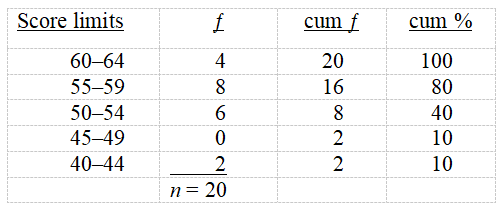 -Eighty percent of the scores fall below
 (Multiple Choice)
4.8/5 (74)
(74) Twelve cases fall in the interval 40-49, and the relative frequency for that interval is .20. What is the total number of cases for the entire distribution?
(Multiple Choice)
4.9/5 (79)
(79) Base your answers to the questions on the following distribution:
-The score above which 12 cases fall is
-The score above which 12 cases fall is (Multiple Choice)
4.8/5 (86)
(86) We plan to use an interval size of 4, and 14 is the lowest score in our sample. According to our guidelines, ____________ would be the best choice for the bottom interval.
(Multiple Choice)
4.9/5 (86)
(86) Patrons at a local sports bar were asked to name the sport they enjoyed the most on television. The results are as follows:
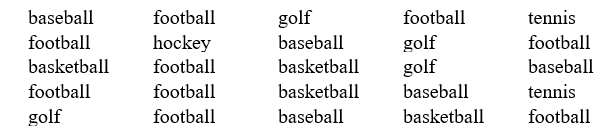 (a) Construct a frequency distribution.
(b) Convert the frequencies to relative frequencies (use percentages).
(a) Construct a frequency distribution.
(b) Convert the frequencies to relative frequencies (use percentages). (Short Answer)
4.8/5 (81)
(81) Base your answers to the questions on the following distribution:
-P40 is
-P40 is (Multiple Choice)
4.7/5 (75)
(75) Base your answers to the questions on the following distribution:
-We observe that there are six scores falling
-We observe that there are six scores falling (Multiple Choice)
4.8/5 (76)
(76) In computing percentiles from a cumulative frequency distribution, we
(Multiple Choice)
4.7/5 (75)
(75) 
Filters
- Essay(0)
- Multiple Choice(0)
- Short Answer(0)
- True False(0)
- Matching(0)