



 Chat with AI
Exam 2: Frequency Distributions, Percentiles,

Exam 1: Introduction25 Questions
Exam 2: Frequency Distributions, Percentiles,34 Questions
Exam 3: Graphic Representation of Frequency Distributions25 Questions
Exam 4: Central Tendency25 Questions
Exam 5: Variability and Standard Z Scores37 Questions
Exam 6: Standard Scores and the Normal Curve27 Questions
Exam 7: Correlation38 Questions
Exam 8: Prediction40 Questions
Exam 9: Interpretive Aspects of Correlation and Regression23 Questions
Exam 10: Probability29 Questions
Exam 11: Random Sampling and Sampling Distributions24 Questions
Exam 12: Introduction to Statistical Inference: Testing Hypotheses About Single Means Z and T74 Questions
Exam 13: Interpreting the Results of Hypothesis Testing: Effect Size, Type I and Type II Errors, and Power42 Questions
Exam 14: Testing Hypotheses About the Difference Between Two Independent Groups33 Questions
Exam 15: Testing for a Difference18 Questions
Exam 16: Inference About Correlation Coefficients24 Questions
Exam 17: An Alternative to Hypothesis Testing: Confidence Intervals28 Questions
Exam 18: Testing for Differences Among Three or More Groups: One-Way Analysis of Variance and Some Alternatives49 Questions
Exam 19: Factorial Analysis of Variance30 Questions
Exam 20: Chi-Square and Inference About Frequencies27 Questions
Exam 21: Some Almost Assumption-Free Tests19 Questions
Select questions type


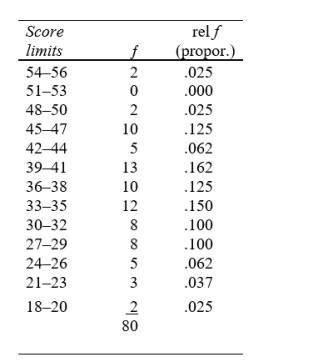
The following scores were obtained by university freshmen on an achievement test in history:  (a) Construct a grouped frequency distribution.
(b)Convert the frequencies to relative frequencies (use proportions).
(a) Construct a grouped frequency distribution.
(b)Convert the frequencies to relative frequencies (use proportions).
Free
(Short Answer)
4.9/5  (76)
(76) Correct Answer: Verified
range: 54 - 18 = 36
Interval width: 36/10 = 3.6, 36/20 = 1.8, so i = 2 or 3 is okay; we chose i = 3. By making the lower apparent limits a multiple of interval width, we construct the following distributions:
The lowest score is 23 and the highest score is 87. The range is
Free
(Multiple Choice)
4.8/5 (60)
(60) Correct Answer:Verified
VerifiedD
Convert the following percents to proportions (use the same degree of accuracy):
(a)42%,
(b)78%,
(c)43.7%,
(d)5.25%,
(e).8%.
Free
(Short Answer)
4.9/5 (72)
(72) Correct Answer:Verified
Verified(a)42
(b).78
(c).437
(d).0525
(e).008.
Construct a relative frequency distribution (use proportions) from the scores of the above using an interval width of 5 and 15-19 as the lowest interval.
(Short Answer)
4.8/5 (70)
(70) The lowest score is 23 and the highest score is 87. Permissible class interval widths are
(Multiple Choice)
4.8/5 (75)
(75) Base your answers to the questions on the following distribution:
 -The score below which 40% of the cases fall is
 (Multiple Choice)
4.9/5 (74)
(74) The apparent limits of an interval are 30-34. The width of the interval is
(Multiple Choice)
5.0/5 (82)
(82) If measurement is to the nearest 10 lb, then a score of 540 lb means
(Multiple Choice)
4.8/5 (74)
(74) Convert the following proportions to percents (report the percent to the same degree of accuracy as the proportion):
(a)26,
(b).05,
(c).79,
(d).555,
(e).005.
(Short Answer)
4.7/5 (72)
(72) Base your answers to the questions on the following distribution:
-The cum ƒ value of 8 means that 8 cases fall below
-The cum ƒ value of 8 means that 8 cases fall below (Multiple Choice)
4.9/5 (64)
(64) For each of the following intervals, give (1) the interval width, (2) the real limits of the interval, and (3) the apparent limits and real limits of the next higher interval (assume the scores are rounded to the nearest whole number or decimal place indicated unless otherwise specified):
(a)10-14,
(b)20-39,
(c)2.50-2.74,
(d)1.0-1.9,
(e)30-40 (accurate to the nearest 10).
(Short Answer)
4.9/5 (87)
(87) Which one, if any, of the first three alternatives is impossible?
(Multiple Choice)
4.9/5 (83)
(83) The lowest and highest scores are given below for different sets of scores. In each case, the scores are to be grouped into class intervals. For each, give
(1) the range,
(2) your choice of class interval width,
(3) the score limits for the lowest interval, and
(4) the score limits for the highest interval (do this directly without listing any of the intervals between the lowest and the highest):
a) 36, 62,
b) 27, 101,
c) 56, 69,
d) 187, 821,
e) 6.3, 21.9,
f) 1.27, 3.47.
(Short Answer)
4.9/5 (87)
(87) John uses our guidelines to arrive at an interval size of 30. Which of the following is the most likely value for the range of scores in his sample?
(Multiple Choice)
4.8/5 (81)
(81) Base your answers to the questions on the following distribution:
-The percentile rank of a score of 54.5 is
-The percentile rank of a score of 54.5 is (Multiple Choice)
4.7/5 (68)
(68) Construct a cumulative percentage distribution for the following data:

(Short Answer)
5.0/5 (74)
(74) Which one, if any, of the first three alternatives is impossible?
(Multiple Choice)
4.9/5 (88)
(88) Base your answers to the questions on the following distribution:
-There are 16 scores falling below
-There are 16 scores falling below (Multiple Choice)
4.9/5 (76)
(76) Base your answers to the questions on the following distribution:
-P10 is
-P10 is (Multiple Choice)
4.8/5 (87)
(87) 
Filters
- Essay(0)
- Multiple Choice(0)
- Short Answer(0)
- True False(0)
- Matching(0)