



 Chat with AI
Exam 4: Central Tendency

Exam 1: Introduction25 Questions
Exam 2: Frequency Distributions, Percentiles,34 Questions
Exam 3: Graphic Representation of Frequency Distributions25 Questions
Exam 4: Central Tendency25 Questions
Exam 5: Variability and Standard Z Scores37 Questions
Exam 6: Standard Scores and the Normal Curve27 Questions
Exam 7: Correlation38 Questions
Exam 8: Prediction40 Questions
Exam 9: Interpretive Aspects of Correlation and Regression23 Questions
Exam 10: Probability29 Questions
Exam 11: Random Sampling and Sampling Distributions24 Questions
Exam 12: Introduction to Statistical Inference: Testing Hypotheses About Single Means Z and T74 Questions
Exam 13: Interpreting the Results of Hypothesis Testing: Effect Size, Type I and Type II Errors, and Power42 Questions
Exam 14: Testing Hypotheses About the Difference Between Two Independent Groups33 Questions
Exam 15: Testing for a Difference18 Questions
Exam 16: Inference About Correlation Coefficients24 Questions
Exam 17: An Alternative to Hypothesis Testing: Confidence Intervals28 Questions
Exam 18: Testing for Differences Among Three or More Groups: One-Way Analysis of Variance and Some Alternatives49 Questions
Exam 19: Factorial Analysis of Variance30 Questions
Exam 20: Chi-Square and Inference About Frequencies27 Questions
Exam 21: Some Almost Assumption-Free Tests19 Questions
Select questions type


The deviations about the mean for four out of a sample of five scores are: -3, +2, +6, -1. The fifth deviation must be

Free
(Multiple Choice)
4.8/5  (81)
(81) Correct Answer: Verified
A
If one score in a distribution is changed to another value, it is certain that, according to raw score calculation,
Free
(Multiple Choice)
4.7/5 (65)
(65) Correct Answer:Verified
VerifiedA
The mean of a distribution is 75 and the median is 72. If 20 points are subtracted from each score, the mean of this altered distribution will be
Free
(Multiple Choice)
4.8/5 (90)
(90) Correct Answer:Verified
VerifiedC
Professor Jones gives a quiz in her statistics course and obtains the following 20 scores:
 Calculate:
(a) the mode
(b) the median
(c) the mean
Calculate:
(a) the mode
(b) the median
(c) the mean (Short Answer)
4.9/5 (87)
(87) In constructing a frequency distribution, a score belonging in the top class interval is inadvertently omitted. Which measure(s) might not be affected?
(Multiple Choice)
4.8/5 (72)
(72) For each of the following sets of scores, find (1) the mode, (2) the median, and (3) the mean:
(a)12, 10, 8, 19, 8,
(b)14, 12, 17, 23,
(c)11, 6, 10, 11, 11, 11.
(Short Answer)
4.9/5 (74)
(74) Which measure of central tendency would you use with the following distribution of scores? Explain.
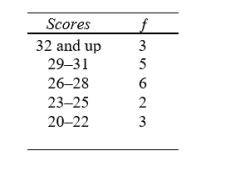
(Short Answer)
4.9/5 (81)
(81) (a) For the sample of scores: 7, 3, 5, 3, 3, show that  .
(b) State what
 means in words. To what property of the mean is it related?
.
(b) State what means in words. To what property of the mean is it related? (Short Answer)
5.0/5 (79)
(79) The measure of central tendency that may be considered as the "balance point" of the distribution is the
(Multiple Choice)
4.8/5 (72)
(72) Several situations tend to make the median a more attractive choice than it might otherwise be. Which, among those described below, does not add to its attractiveness?
(Multiple Choice)
4.8/5 (84)
(84) The highest point of a frequency curve is most closely associated with
(Multiple Choice)
4.8/5 (85)
(85) What shape would you predict for each of the following distributions:
(a)  (b)
 (c)

(b) (c) (Short Answer)
4.8/5 (82)
(82) For a symmetrical distribution of 10 scores the mean is calculated to be 32.6. Later it is learned that John's recorded score of 28 really should be a 35. Correcting this error will change the calculated value of
(Multiple Choice)
4.7/5 (69)
(69) Measures of central tendency differ in their resistance to the effect of sampling fluctuation. From most resistant to least resistant, the order is
(Multiple Choice)
4.9/5 (94)
(94) 
Filters
- Essay(0)
- Multiple Choice(0)
- Short Answer(0)
- True False(0)
- Matching(0)