



 Chat with AI
Exam 17: An Alternative to Hypothesis Testing: Confidence Intervals

Exam 1: Introduction25 Questions
Exam 2: Frequency Distributions, Percentiles,34 Questions
Exam 3: Graphic Representation of Frequency Distributions25 Questions
Exam 4: Central Tendency25 Questions
Exam 5: Variability and Standard Z Scores37 Questions
Exam 6: Standard Scores and the Normal Curve27 Questions
Exam 7: Correlation38 Questions
Exam 8: Prediction40 Questions
Exam 9: Interpretive Aspects of Correlation and Regression23 Questions
Exam 10: Probability29 Questions
Exam 11: Random Sampling and Sampling Distributions24 Questions
Exam 12: Introduction to Statistical Inference: Testing Hypotheses About Single Means Z and T74 Questions
Exam 13: Interpreting the Results of Hypothesis Testing: Effect Size, Type I and Type II Errors, and Power42 Questions
Exam 14: Testing Hypotheses About the Difference Between Two Independent Groups33 Questions
Exam 15: Testing for a Difference18 Questions
Exam 16: Inference About Correlation Coefficients24 Questions
Exam 17: An Alternative to Hypothesis Testing: Confidence Intervals28 Questions
Exam 18: Testing for Differences Among Three or More Groups: One-Way Analysis of Variance and Some Alternatives49 Questions
Exam 19: Factorial Analysis of Variance30 Questions
Exam 20: Chi-Square and Inference About Frequencies27 Questions
Exam 21: Some Almost Assumption-Free Tests19 Questions
Select questions type


Suppose a 95% confidence interval for  runs from 48 to 56. If we had tested
 against
 using
 we would
runs from 48 to 56. If we had tested
against
using
we would
Free
(Multiple Choice)
4.9/5  (88)
(88) Correct Answer: Verified
B
Suppose a 95% confidence interval for  runs from -5 to +2. If
 were tested against a two-tailed alternative hypothesis using
 our decision about

runs from -5 to +2. If
were tested against a two-tailed alternative hypothesis using
our decision about
Free
(Multiple Choice)
4.9/5 (74)
(74) Correct Answer:Verified
VerifiedC
Suppose a 95% confidence interval for  runs from -10 to -2. It appears likely that
Free
(Multiple Choice)
4.8/5 (95)
(95) Correct Answer:Verified
VerifiedB
Which set of circumstances is most likely to result in a narrow confidence interval?
(Multiple Choice)
4.8/5 (91)
(91) The rule for constructing a confidence interval of the difference between two means is
(Multiple Choice)
4.9/5 (71)
(71) The practice of making confidence intervals of  is recommended because
 (Multiple Choice)
4.8/5 (69)
(69) The advantage of expressing a confidence interval in terms of the number of standard deviations of the variable is that
(Multiple Choice)
4.8/5 (70)
(70) Suppose a 95% confidence interval for  runs from -10 to -2. If
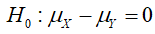 were tested against a two-tailed alternative hypothesis using
 our decision about

runs from -10 to -2. If
were tested against a two-tailed alternative hypothesis using
our decision about
(Multiple Choice)
4.8/5 (86)
(86) The following are the achievement test results for 15 matched pairs taught by Method A and Method B. 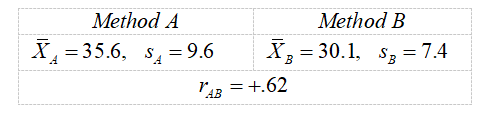 (a)Construct the 95% confidence interval for .
(b)Ignore thecorrelation coefficient and treat the two samples as though they were independent. Construct the 95% confidence interval for .
(c)What does a comparison of the answers to (a) and (b) suggest concerning the effect on interval estimates of using samples?
(a)Construct the 95% confidence interval for .
(b)Ignore thecorrelation coefficient and treat the two samples as though they were independent. Construct the 95% confidence interval for .
(c)What does a comparison of the answers to (a) and (b) suggest concerning the effect on interval estimates of using samples? (Short Answer)
4.7/5 (80)
(80) For a confidence interval of  , an interval of lesser width results
 (Multiple Choice)
5.0/5 (81)
(81) Random samples are selected and the 95% confidence interval for  is constructed. It runs from -3.1 to 9.4.
(a) If a two-tailed test were used at
 would a significant difference be found between
 and
 Explain.
(b) Give the 95% confidence interval for

is constructed. It runs from -3.1 to 9.4.
(a) If a two-tailed test were used at would a significant difference be found between and Explain.
(b) Give the 95% confidence interval for (Short Answer)
4.9/5 (91)
(91) A random sample of 20 students at Alpha College is asked how many hours a week they study on the average. The following are the results:
 and
 Construct the 95% confidence interval for the mean hours studied per week for the entire student body. What does the 95% refer to? Be very explicit and precise in your answer.
and
Construct the 95% confidence interval for the mean hours studied per week for the entire student body. What does the 95% refer to? Be very explicit and precise in your answer. (Short Answer)
4.8/5 (81)
(81) Confidence intervals are generally to be preferred over point estimates because confidence intervals
(Multiple Choice)
4.9/5 (74)
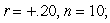
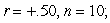
(74) Determine the 95% confidence interval for  in each of the following cases:
a)
 b)
 c)
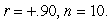 d) A comparison of the widths of the intervals obtained in (a), (b), and (c) suggests what generalization concerning the sampling variation of the correlation coefficient?
in each of the following cases:
a) b) c) d) A comparison of the widths of the intervals obtained in (a), (b), and (c) suggests what generalization concerning the sampling variation of the correlation coefficient? (Short Answer)
4.8/5 (85)
(85) Confidence intervals of a parameter are preferred over hypothesis testing when
(Multiple Choice)
4.7/5 (80)
(80) The national norm for third graders on a standardized test of reading achievement is a score of 27. Mrs. Johnson obtains the mean score on the test for a random sampling of third graders from her school district. The results for Mrs. Johnson's sample are (a) Construct the 95% confidence interval for her population mean score. (b) Construct the 99% confidence interval for her population mean score. (c) What generalization is illustrated by a comparison of the answers to (a) and (b)?
(Short Answer)
4.8/5 (78)
(78) In establishing a confidence interval for the difference between two means, selecting a confidence level of .95 rather than a confidence level of .90 implies that
(Multiple Choice)
4.8/5 (82)
(82) A 95% confidence interval for  is computed for sample results. The interval runs from -.75 to +.25. This suggests that
 (Multiple Choice)
4.9/5 (78)
(78) If we wish to estimate  or
 within given limits, the required sample size will be related to
or
within given limits, the required sample size will be related to (Multiple Choice)
4.7/5 (90)
(90) 
Filters
- Essay(0)
- Multiple Choice(0)
- Short Answer(0)
- True False(0)
- Matching(0)