



 Chat with AI
Exam 21: Some Almost Assumption-Free Tests

Exam 1: Introduction25 Questions
Exam 2: Frequency Distributions, Percentiles,34 Questions
Exam 3: Graphic Representation of Frequency Distributions25 Questions
Exam 4: Central Tendency25 Questions
Exam 5: Variability and Standard Z Scores37 Questions
Exam 6: Standard Scores and the Normal Curve27 Questions
Exam 7: Correlation38 Questions
Exam 8: Prediction40 Questions
Exam 9: Interpretive Aspects of Correlation and Regression23 Questions
Exam 10: Probability29 Questions
Exam 11: Random Sampling and Sampling Distributions24 Questions
Exam 12: Introduction to Statistical Inference: Testing Hypotheses About Single Means Z and T74 Questions
Exam 13: Interpreting the Results of Hypothesis Testing: Effect Size, Type I and Type II Errors, and Power42 Questions
Exam 14: Testing Hypotheses About the Difference Between Two Independent Groups33 Questions
Exam 15: Testing for a Difference18 Questions
Exam 16: Inference About Correlation Coefficients24 Questions
Exam 17: An Alternative to Hypothesis Testing: Confidence Intervals28 Questions
Exam 18: Testing for Differences Among Three or More Groups: One-Way Analysis of Variance and Some Alternatives49 Questions
Exam 19: Factorial Analysis of Variance30 Questions
Exam 20: Chi-Square and Inference About Frequencies27 Questions
Exam 21: Some Almost Assumption-Free Tests19 Questions
Select questions type


The sum of a set of ranks can be found from the formula:

Free
(Multiple Choice)
4.9/5  (82)
(82) Correct Answer: Verified
B
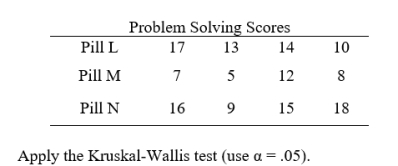
Dr. Smith wishes to compare three widely used sleeping pills with regard to possible "hangover" effects. Twelve volunteers are given a problem-solving test at 9:00 a.m. after having been administered the standard recommended dose of one of the preparations (according to random assignment) the night before. The results are given below.
Free
(Short Answer)
4.9/5 (77)
(77) Correct Answer:Verified
Verified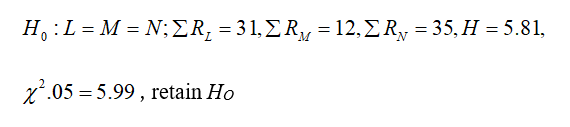
The most important reason for using assumption-freer statistical tests has to do with
Free
(Multiple Choice)
4.9/5 (93)
(93) Correct Answer:Verified
VerifiedB
If the following scores: 4, 2, 3, 6, 4, are placed in rank order, a score of 4 would be assigned a rank order of
(Multiple Choice)
4.7/5 (86)
(86) Compared to z, t, and F, assumption-freer statistical tests become increasingly attractive when
(Multiple Choice)
4.8/5 (77)
(77) Which of the following loses most in efficiency relative to its counterpart test about means?
(Multiple Choice)
4.9/5 (73)
(73) The measure that seems most reasonable to examine upon obtaining significant results from a Mann-Whitney U test is the
(Multiple Choice)
4.9/5 (79)
(79) A randomization test compares the obtained sample results with
(Multiple Choice)
5.0/5 (85)
(85) The Mann-Whitney, Kruskal-Wallis, sign, and Wilcoxon signed-ranks tests are tests about
(Multiple Choice)
4.7/5 (79)
(79) The Wilcoxon signed-ranks test is a particularly dubious choice if
(Multiple Choice)
4.9/5 (94)
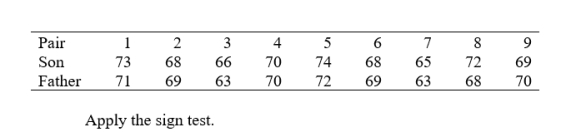
(94) Your casual observations suggest that sons, upon maturity, are in general taller than their fathers. A friend, on the other hand, argues that the opposite is true. In order to check this out, you measure the heights of a sample of nine father-son pairs. The following are the results (to the nearest inch):
(Short Answer)
4.9/5 (78)
(78) The basic data from which all other computations flow when performing a Mann-Whitney U test or a Kruskal-Wallis test are
(Multiple Choice)
4.7/5 (90)
(90) A Mann-Whitney U test is performed and significant results are obtained. This indicates a population difference with regard to
(Multiple Choice)
4.7/5 (82)
(82) The relative insensitivity of the sign test is derived in part from the fact that
(Multiple Choice)
4.9/5 (90)
(90) We wish to determine if two strains of laboratory rats differ in maze-running ability. Random samples of naive (never been experimented on) rats are selected from each strain, and each rat is run through a test maze until it can negotiate the maze with no errors on two consecutive trials. The following results are obtained (number of trials to learn):
 Apply the Mann-Whitney test. Use
 Interpret the outcome using appropriate descriptive statistics.
Apply the Mann-Whitney test. Use
Interpret the outcome using appropriate descriptive statistics. (Short Answer)
4.9/5 (78)
(78) The sign test could be considered as an alternative approach to the test of a hypothesis about
(Multiple Choice)
4.9/5 (84)
(84) 
Filters
- Essay(0)
- Multiple Choice(0)
- Short Answer(0)
- True False(0)
- Matching(0)