



 Chat with AI
Exam 22: Frontiers of Microeconomics

Exam 1: Ten Principles of Economics237 Questions
Exam 2: Thinking Like an Economist267 Questions
Exam 3: Interdependence and the Gains From Trade217 Questions
Exam 4: The Market Forces of Supply and Demand303 Questions
Exam 5: Elasticity and Its Applications282 Questions
Exam 6: Supply, demand, and Government Policies252 Questions
Exam 7: Consumers, producers, and the Efficiency of Markets248 Questions
Exam 8: Application: the Costs of Taxation245 Questions
Exam 9: Application: International Trade245 Questions
Exam 10: Externalities288 Questions
Exam 11: Public Goods and Common Resources258 Questions
Exam 12: The Design of the Tax System328 Questions
Exam 13: The Costs of Production303 Questions
Exam 14: Firms in Competitive Markets271 Questions
Exam 15: Monopoly306 Questions
Exam 16: Oligopoly291 Questions
Exam 17: Monopolistic Competition257 Questions
Exam 18: The Markets for the Factors of Production284 Questions
Exam 19: Earnings and Discrimination286 Questions
Exam 20: Income Inequality and Poverty247 Questions
Exam 21: The Theory of Consumer Choice238 Questions
Exam 22: Frontiers of Microeconomics199 Questions
Exam 23: Measuring a Nations Income215 Questions
Exam 24: Measuring the Cost of Living208 Questions
Exam 25: Production and Growth240 Questions
Exam 26: Saving, investment, and the Financial System282 Questions
Exam 27: The Basic Tools of Finance249 Questions
Exam 28: Unemployment242 Questions
Exam 29: The Monetary System277 Questions
Exam 30: Money Growth and Inflation224 Questions
Exam 31: Open-Economy Macroeconomics: Basic Concepts256 Questions
Exam 32: A Macroeconomic Theory of the Open Economy217 Questions
Exam 33: Aggregate Demand and Aggregate Supply302 Questions
Exam 34: The Influence of Monetary and Fiscal Policy on Aggregate Demand249 Questions
Exam 35: The Short Run Trade Off Between Inflation and Unemployment246 Questions
Exam 36: Five Debates Over Macroeconomic Policy140 Questions
Select questions type


Table 22-5
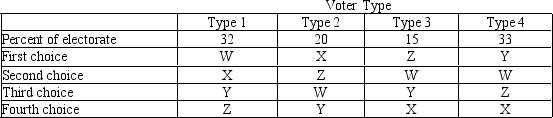 -Refer to Table 22-5.The table shows the preferences of four types of voters over four possible outcomes: W,X,Y,and Z.In addition,the table shows the percentage of voters of each type.Based on this information,which of the following statements is false?
 (Multiple Choice)
4.8/5  (87)
(87) "Signaling" refers to actions by an informed party for the sole purpose of
(Multiple Choice)
5.0/5 (84)
(84) Evidence from experiments in which real people play the ultimatum game supports the idea that people
(Multiple Choice)
4.9/5 (72)
(72) The problem that arises when one person performs a task on behalf of another person is called
(Multiple Choice)
4.8/5 (87)
(87) Table 22-6
 -Refer to Table 22-6.The table shows the preferences of 100 voters over three possible outcomes: X,Y,and Z.If a Borda count election were held among these voters,giving three points to each voter's first choice,two points to the second choice,and one point to the last choice,which outcome would win the election?
 (Multiple Choice)
4.8/5 (66)
(66) Which of the following is an example of a principal-agent relationship?
(Multiple Choice)
4.9/5 (78)
(78) The principal-agent problem is more serious in large firms than in small firms because
(Multiple Choice)
4.9/5 (82)
(82) The tendency of many people to procrastinate supports the view that people are consistent over time.
(True/False)
4.9/5 (87)
(87) When new professors are hired,their job performance is monitored closely.If they meet their institution's standards,they will eventually receive tenure.After receiving tenure,professors' job performance is less closely monitored,and they become difficult to fire.Tenure thus creates
(Multiple Choice)
4.8/5 (87)
(87) Majority rule will produce the outcome most preferred by the median voter.
(True/False)
4.9/5 (83)
(83) Students of microeconomic principles often say they are going to study "tonight," because the only way to pass the exam is to study some every night.When "tonight" comes,some students choose to do something else.Come exam-day,these students do not do well on their exam.This observation is an example of how people
(Multiple Choice)
4.7/5 (89)
(89) Most economic models incorporate the assumption of rational behavior on the part of economic actors.
(True/False)
4.8/5 (77)
(77) Insurance companies charge annual premiums to collect revenue,which they then use to pay customers who file claims for damages they incur.Because of the moral hazard problem insurance companies separate customers into groups.Group 1: customers who file few claims & Group 2: customers that file a lot of claims.After creating these groups,what happens to the average annual premium within a group?
(Multiple Choice)
4.8/5 (75)
(75) Table 22-5
-Refer to Table 22-5.The table shows the preferences of four types of voters over four possible outcomes: W,X,Y,and Z.In addition,the table shows the percentage of voters of each type.Suppose a Borda count election is held in which each voter ranks the four outcomes,giving 1 point to last place,2 points to second to last,3 points to the second best,and 4 points to the best.In this case,which outcome would win?
-Refer to Table 22-5.The table shows the preferences of four types of voters over four possible outcomes: W,X,Y,and Z.In addition,the table shows the percentage of voters of each type.Suppose a Borda count election is held in which each voter ranks the four outcomes,giving 1 point to last place,2 points to second to last,3 points to the second best,and 4 points to the best.In this case,which outcome would win? (Multiple Choice)
4.9/5 (73)
(73) When economists assume that people are rational,they assume that
(Multiple Choice)
5.0/5 (78)
(78) Scenario 22-5
Three candidates, Fred, Barb, and William, are running for office. There are three voters in the upcoming election: Heather, Don, and Luanne. Heather prefers Barb over Fred and Fred over William. Don prefers William over Barb and Barb over Fred. Luanne prefers Fred over Barb and Barb over William.
-Refer to Scenario 22-5.If the voters were given a choice of Fred versus Barb first,then the winner was in a second election versus William,who would win?
(Multiple Choice)
4.9/5 (74)
(74) 
Filters
- Essay(0)
- Multiple Choice(0)
- Short Answer(0)
- True False(0)
- Matching(0)