



 Chat with AI
Exam 22: Frontiers of Microeconomics

Exam 1: Ten Principles of Economics237 Questions
Exam 2: Thinking Like an Economist267 Questions
Exam 3: Interdependence and the Gains From Trade217 Questions
Exam 4: The Market Forces of Supply and Demand303 Questions
Exam 5: Elasticity and Its Applications282 Questions
Exam 6: Supply, demand, and Government Policies252 Questions
Exam 7: Consumers, producers, and the Efficiency of Markets248 Questions
Exam 8: Application: the Costs of Taxation245 Questions
Exam 9: Application: International Trade245 Questions
Exam 10: Externalities288 Questions
Exam 11: Public Goods and Common Resources258 Questions
Exam 12: The Design of the Tax System328 Questions
Exam 13: The Costs of Production303 Questions
Exam 14: Firms in Competitive Markets271 Questions
Exam 15: Monopoly306 Questions
Exam 16: Oligopoly291 Questions
Exam 17: Monopolistic Competition257 Questions
Exam 18: The Markets for the Factors of Production284 Questions
Exam 19: Earnings and Discrimination286 Questions
Exam 20: Income Inequality and Poverty247 Questions
Exam 21: The Theory of Consumer Choice238 Questions
Exam 22: Frontiers of Microeconomics199 Questions
Exam 23: Measuring a Nations Income215 Questions
Exam 24: Measuring the Cost of Living208 Questions
Exam 25: Production and Growth240 Questions
Exam 26: Saving, investment, and the Financial System282 Questions
Exam 27: The Basic Tools of Finance249 Questions
Exam 28: Unemployment242 Questions
Exam 29: The Monetary System277 Questions
Exam 30: Money Growth and Inflation224 Questions
Exam 31: Open-Economy Macroeconomics: Basic Concepts256 Questions
Exam 32: A Macroeconomic Theory of the Open Economy217 Questions
Exam 33: Aggregate Demand and Aggregate Supply302 Questions
Exam 34: The Influence of Monetary and Fiscal Policy on Aggregate Demand249 Questions
Exam 35: The Short Run Trade Off Between Inflation and Unemployment246 Questions
Exam 36: Five Debates Over Macroeconomic Policy140 Questions
Select questions type


Brian and Andrea are playing the ultimatum game,starting with $100.The coin flip results in Brian being the one to propose a division of the $100.Brian proposes that he gets $99 and Andrea gets $1.
(Multiple Choice)
4.8/5  (78)
(78) Arrow's impossibility theorem shows that it is impossible to find a better voting system than pairwise majority voting.
(True/False)
4.8/5 (79)
(79) According to the median voter theorem,majority rule will produce an outcome that is inconsistent with transitive preferences.
(True/False)
4.9/5 (76)
(76) In the worker-employer relationship,"inappropriate" or "immoral" behavior
(Multiple Choice)
4.9/5 (72)
(72) Table 22-2
The citizens of Paradoxopolis will decide whether to build a new school, build a new park, or build a new road. Exactly one of the three choices will prevail, and the choice will be made by way of pairwise voting, with the majority determining the outcome on each vote. The preferences of the voters are summarized in the table below.
 -Refer to Table 22-2.If (1)the first vote pits "school" against "park," and (2)the second vote pits "road" against the winner of the first vote,then the outcome is as follows:
 (Multiple Choice)
4.9/5 (74)
(74) Valerie prefers A to B and she prefers B to C.If Valerie's preferences are transitive,then she prefers A to C.
(True/False)
4.9/5 (76)
(76) How have insights from the field of psychology influenced the thinking of economists in recent years?
(Essay)
4.9/5 (77)
(77) The problem that arises when one person performs a task on behalf of another person is called the lemons problem.
(True/False)
4.8/5 (85)
(85) A radio story reported a study on the makes and models of cars that were observed going through intersections in the Washington,D.C.area without stopping at the stop signs.According to the story,Volvos were heavily overrepresented;the fraction of cars running stop signs that were Volvos was much greater than the fraction of Volvos in the total population of cars in the D.C.area.This is initially surprising because Volvo has built a reputation as an especially safe car that appeals to sensible,safety-conscious drivers.How is this observation best explained?
(Multiple Choice)
4.8/5 (77)
(77) Tom owns a small business in Sioux Falls.He travels frequently,meeting with important customers,attending conferences,and the like.Tom hired Susan to work in the Sioux Falls office as the day-to-day general manager of the business.
(Multiple Choice)
4.9/5 (72)
(72) Which of the following practices would indicate that an employer is trying to overcome a moral-hazard problem with his employees?
(Multiple Choice)
4.7/5 (86)
(86) Suppose you are covered under health insurance or belong to a Health Maintenance Organization (HMO),and you are insured against all or most of the costs of visits to the doctor. As a result you are likely to make greater use of medical services of all kinds.This tendency of people with insurance to change their behavior in a way that leads to more claims against the insurance company is called
(Multiple Choice)
4.9/5 (81)
(81) Table 22-4
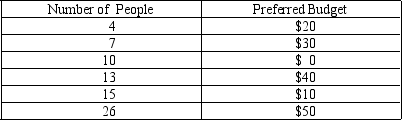 -Refer to Table 22-4.The table shows the most preferred budget of 75 voters.In an election,each voter will select the budget closest to his or her most preferred budget.Which of the following statements regarding this information is true?
 (Multiple Choice)
4.9/5 (95)
(95) An implication of the median voter theorem is that,in a race between Republicans and Democrats,
(Multiple Choice)
4.8/5 (82)
(82) Shawn buys automobile insurance from Safe-T Insurance Company.If Shawn avoids having an accident for three years,Safe-T will reduce the price he has to pay for his insurance.Nevertheless,he routinely drives fast and with reckless abandon.
(Multiple Choice)
4.9/5 (95)
(95) Scenario 22-5
Three candidates, Fred, Barb, and William, are running for office. There are three voters in the upcoming election: Heather, Don, and Luanne. Heather prefers Barb over Fred and Fred over William. Don prefers William over Barb and Barb over Fred. Luanne prefers Fred over Barb and Barb over William.
-Refer to Scenario 22-5.If the voters were given a choice of Fred versus William first,then the winner was in a second election versus Barb,who would win?
(Multiple Choice)
4.8/5 (80)
(80) 
Filters
- Essay(0)
- Multiple Choice(0)
- Short Answer(0)
- True False(0)
- Matching(0)