



 Chat with AI
Exam 22: Frontiers of Microeconomics

Exam 1: Ten Principles of Economics237 Questions
Exam 2: Thinking Like an Economist267 Questions
Exam 3: Interdependence and the Gains From Trade217 Questions
Exam 4: The Market Forces of Supply and Demand303 Questions
Exam 5: Elasticity and Its Applications282 Questions
Exam 6: Supply, demand, and Government Policies252 Questions
Exam 7: Consumers, producers, and the Efficiency of Markets248 Questions
Exam 8: Application: the Costs of Taxation245 Questions
Exam 9: Application: International Trade245 Questions
Exam 10: Externalities288 Questions
Exam 11: Public Goods and Common Resources258 Questions
Exam 12: The Design of the Tax System328 Questions
Exam 13: The Costs of Production303 Questions
Exam 14: Firms in Competitive Markets271 Questions
Exam 15: Monopoly306 Questions
Exam 16: Oligopoly291 Questions
Exam 17: Monopolistic Competition257 Questions
Exam 18: The Markets for the Factors of Production284 Questions
Exam 19: Earnings and Discrimination286 Questions
Exam 20: Income Inequality and Poverty247 Questions
Exam 21: The Theory of Consumer Choice238 Questions
Exam 22: Frontiers of Microeconomics199 Questions
Exam 23: Measuring a Nations Income215 Questions
Exam 24: Measuring the Cost of Living208 Questions
Exam 25: Production and Growth240 Questions
Exam 26: Saving, investment, and the Financial System282 Questions
Exam 27: The Basic Tools of Finance249 Questions
Exam 28: Unemployment242 Questions
Exam 29: The Monetary System277 Questions
Exam 30: Money Growth and Inflation224 Questions
Exam 31: Open-Economy Macroeconomics: Basic Concepts256 Questions
Exam 32: A Macroeconomic Theory of the Open Economy217 Questions
Exam 33: Aggregate Demand and Aggregate Supply302 Questions
Exam 34: The Influence of Monetary and Fiscal Policy on Aggregate Demand249 Questions
Exam 35: The Short Run Trade Off Between Inflation and Unemployment246 Questions
Exam 36: Five Debates Over Macroeconomic Policy140 Questions
Select questions type


Herbert Simon suggested that humans should be viewed not as rational maximizers but as
(Multiple Choice)
4.9/5  (86)
(86) In the field of study called political economy,economists make use of insights from the field of psychology.
(True/False)
4.8/5 (80)
(80) The Condorcet voting paradox demonstrates that democratic outcomes do not always obey the property of
(Multiple Choice)
4.7/5 (90)
(90) Which voter is the voter whose views on a policy issue are in the middle of the spectrum,with half of the voters on one side of this voter's view and half on the other side.
(Multiple Choice)
4.9/5 (71)
(71) Table 22-5
 -Refer to Table 22-5.The table shows the preferences of four types of voters over four possible outcomes: W,X,Y,and Z.In addition,the table shows the percentage of voters of each type.Suppose that,for some reason,W is eliminated as a possible option.Using a Borda count election,with 3 points for the best choice,2 points for the second best choice,and 1 point for the last choice,which outcome would win this election?
 (Multiple Choice)
4.8/5 (85)
(85) Scenario 22-2
Five voters must choose from among four options: W, X, Y, or Z. Each voter's preferences are summarized in the table below. Options higher in the table are more preferred by the voter.
 -Refer to Scenario 22-2.If the vote were conducted according to a Borda count system where each person's first choice receives 4 points,second choice 3 points,third choice 2 points and fourth choice 1 point,the result would be
 (Multiple Choice)
4.8/5 (81)
(81) Suppose that you major in physics because potential employers perceive that it is harder than other majors.Assuming education has no real value,your majoring in physics provides potential employers with
(Multiple Choice)
4.7/5 (77)
(77) Table 22-6
 -Refer to Table 22-6.The table shows the preferences of 100 voters over three possible outcomes: X,Y,and Z.Suppose a Borda count election was held among these voters and that the only outcomes from which the voters may choose are outcome X and outcome Z.Which of the following statements is true?
 (Multiple Choice)
4.7/5 (75)
(75) Table 22-4
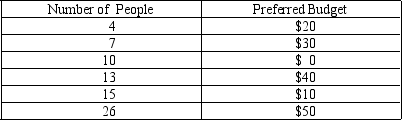 -Refer to Table 22-4.The table shows the most preferred budget of 75 voters.In an election,each voter will select the budget closest to his or her most preferred budget.Using this information,what is the most preferred budget of the median voter?
 (Multiple Choice)
4.8/5 (74)
(74) John goes to work 8 hours per day,but while he is at work he spends most of his time visiting internet sites that provide him with information on his favorite hobby.This is an example of
(Multiple Choice)
4.9/5 (79)
(79) Studies of human decision-making have detected systematic mistakes that people make.Which of the following have been detected?
(Multiple Choice)
4.9/5 (75)
(75) Scenario 22-3
The following table shows the preferences for the five voters in a city regarding how to deal with the city's diseased trees.
 A = do nothing
B = Follow the expert's advice to remove every tree
C = remove every 4th tree now and perhaps more later
D = use an untested spraying alternative
-Refer to Scenario 22-3.Consider the public policy for dealing with the diseased trees.Using pairwise majority voting with A versus B,then the winner of that vote versus C,then the winner of that vote versus D,which policy wins?
A = do nothing
B = Follow the expert's advice to remove every tree
C = remove every 4th tree now and perhaps more later
D = use an untested spraying alternative
-Refer to Scenario 22-3.Consider the public policy for dealing with the diseased trees.Using pairwise majority voting with A versus B,then the winner of that vote versus C,then the winner of that vote versus D,which policy wins? (Multiple Choice)
4.8/5 (79)
(79) Researchers have found that the systematic mistakes that people make in their decisionmaking include a lack of confidence in their own abilities.
(True/False)
4.8/5 (97)
(97) A "satisficer" is a person whose decisionmaking is the same as that predicted by mainstream economic models.
(True/False)
4.8/5 (90)
(90) Assume there are nine voters in a certain small town and let x = the preferred number of dollars spent per person per month on garbage collection.For Voters 1,2,and 3,x = $10;for Voter 4,x = $15;for Voter 5,x = $18;and for Voters 6,7,8 and 9,x = $20.The median voter is
(Multiple Choice)
4.8/5 (71)
(71) 
Filters
- Essay(0)
- Multiple Choice(0)
- Short Answer(0)
- True False(0)
- Matching(0)