



 Chat with AI
Exam 22: Frontiers of Microeconomics

Exam 1: Ten Principles of Economics237 Questions
Exam 2: Thinking Like an Economist267 Questions
Exam 3: Interdependence and the Gains From Trade217 Questions
Exam 4: The Market Forces of Supply and Demand303 Questions
Exam 5: Elasticity and Its Applications282 Questions
Exam 6: Supply, demand, and Government Policies252 Questions
Exam 7: Consumers, producers, and the Efficiency of Markets248 Questions
Exam 8: Application: the Costs of Taxation245 Questions
Exam 9: Application: International Trade245 Questions
Exam 10: Externalities288 Questions
Exam 11: Public Goods and Common Resources258 Questions
Exam 12: The Design of the Tax System328 Questions
Exam 13: The Costs of Production303 Questions
Exam 14: Firms in Competitive Markets271 Questions
Exam 15: Monopoly306 Questions
Exam 16: Oligopoly291 Questions
Exam 17: Monopolistic Competition257 Questions
Exam 18: The Markets for the Factors of Production284 Questions
Exam 19: Earnings and Discrimination286 Questions
Exam 20: Income Inequality and Poverty247 Questions
Exam 21: The Theory of Consumer Choice238 Questions
Exam 22: Frontiers of Microeconomics199 Questions
Exam 23: Measuring a Nations Income215 Questions
Exam 24: Measuring the Cost of Living208 Questions
Exam 25: Production and Growth240 Questions
Exam 26: Saving, investment, and the Financial System282 Questions
Exam 27: The Basic Tools of Finance249 Questions
Exam 28: Unemployment242 Questions
Exam 29: The Monetary System277 Questions
Exam 30: Money Growth and Inflation224 Questions
Exam 31: Open-Economy Macroeconomics: Basic Concepts256 Questions
Exam 32: A Macroeconomic Theory of the Open Economy217 Questions
Exam 33: Aggregate Demand and Aggregate Supply302 Questions
Exam 34: The Influence of Monetary and Fiscal Policy on Aggregate Demand249 Questions
Exam 35: The Short Run Trade Off Between Inflation and Unemployment246 Questions
Exam 36: Five Debates Over Macroeconomic Policy140 Questions
Select questions type


Table 22-1
Three longtime friends-Sam, Diane, and Cliff-are deciding how they will spend their Saturday evening. They all agree that they should do one of three things: go to a movie, go to a concert, or go out to dinner. They also agree that they will have two pairwise votes to determine how to spend their evening, with the majority determining the outcome on each vote. The first, second, and third choices for each person are as indicated in the table below.
 -Refer to Table 22-1.Which of the following statements is correct regarding the Condorcet paradox and the results of pairwise voting by Sam,Diane,and Cliff?
 (Multiple Choice)
4.8/5  (68)
(68) In economics,a difference in access to relevant knowledge is called a(n)
(Multiple Choice)
4.9/5 (71)
(71) In the employer-worker relationship,the employer is regarded as the "principal" and the worker is regarded as the "agent."
(True/False)
4.8/5 (79)
(79) The suggestion that people are "satisficers" is similar to the view that people
(Multiple Choice)
4.9/5 (63)
(63) Explain the Condorcet paradox.To which type of voting system does it apply?
(Essay)
4.7/5 (72)
(72) Which of the following offers an explanation as to why the principal-agent problem exists for a firm?
(Multiple Choice)
4.8/5 (86)
(86) Hernando travels a great deal,and over the past several years he has read dozens of reviews of hotel chains,all of which rave about the clean rooms and great service at Vacation Inn hotels.Last month,Hernando checked into a room at a Vacation Inn for the first time,only to find the room filthy and the service lousy.He decided the Vacation Inn chain is inferior to other hotel chains.
(Multiple Choice)
4.9/5 (78)
(78) Which of the following is an example of satisficing behavior?
(Multiple Choice)
4.8/5 (80)
(80) As an alternative to pairwise majority voting,each voter could be asked to rank the possible outcomes,giving 1 point to her lowest choice,2 points to her second-lowest choice,3 points to her third-lowest choice,and so on.This voting method is called a(n)
(Multiple Choice)
5.0/5 (73)
(73) Insurance companies charge annual premiums to collect revenue,which they then use to pay customers who file claims for damages they incur.As a result of the moral hazard problem (1)what is the percentage of policy holders making claims,and (2)what is the average premium charged when compared to a world with no moral hazard problem?
(Multiple Choice)
4.8/5 (70)
(70) Joe's Computers builds and sells computers for the local retail market.Since Joe's business does not have the name recognition of some of the bigger computer retailers,Joe advertises a "One-Year Money Back Guarantee" to indicate to buyers that his product is of high quality.This guarantee is an example of
(Multiple Choice)
4.9/5 (82)
(82) The "lemons" problem is a likely explanation for the fact that
(Multiple Choice)
4.9/5 (81)
(81) Scenario 22-4
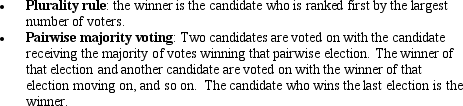
Consider the following voting rules:
 Assume the following voter preferences for a voting district:
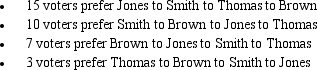 -Refer to Scenario 22-4.Which candidate wins under pairwise majority voting if first Brown is put up against Jones,then the winner takes on Smith,and finally the winner of that election takes on Thomas?
Assume the following voter preferences for a voting district:
-Refer to Scenario 22-4.Which candidate wins under pairwise majority voting if first Brown is put up against Jones,then the winner takes on Smith,and finally the winner of that election takes on Thomas? (Multiple Choice)
4.9/5 (88)
(88) Under majority rule,the order in which items are voted on is
(Multiple Choice)
5.0/5 (66)
(66) An insurance company that writes automobile policies tries to separate safe drivers from risky drivers by offering policies that feature different deductibles and different premiums.This practice is best described as an example of
(Multiple Choice)
4.8/5 (87)
(87) 
Filters
- Essay(0)
- Multiple Choice(0)
- Short Answer(0)
- True False(0)
- Matching(0)