



 Chat with AI
Exam 19: Earnings and Discrimination

Exam 1: Ten Principles of Economics237 Questions
Exam 2: Thinking Like an Economist267 Questions
Exam 3: Interdependence and the Gains From Trade217 Questions
Exam 4: The Market Forces of Supply and Demand303 Questions
Exam 5: Elasticity and Its Applications282 Questions
Exam 6: Supply, demand, and Government Policies252 Questions
Exam 7: Consumers, producers, and the Efficiency of Markets248 Questions
Exam 8: Application: the Costs of Taxation245 Questions
Exam 9: Application: International Trade245 Questions
Exam 10: Externalities288 Questions
Exam 11: Public Goods and Common Resources258 Questions
Exam 12: The Design of the Tax System328 Questions
Exam 13: The Costs of Production303 Questions
Exam 14: Firms in Competitive Markets271 Questions
Exam 15: Monopoly306 Questions
Exam 16: Oligopoly291 Questions
Exam 17: Monopolistic Competition257 Questions
Exam 18: The Markets for the Factors of Production284 Questions
Exam 19: Earnings and Discrimination286 Questions
Exam 20: Income Inequality and Poverty247 Questions
Exam 21: The Theory of Consumer Choice238 Questions
Exam 22: Frontiers of Microeconomics199 Questions
Exam 23: Measuring a Nations Income215 Questions
Exam 24: Measuring the Cost of Living208 Questions
Exam 25: Production and Growth240 Questions
Exam 26: Saving, investment, and the Financial System282 Questions
Exam 27: The Basic Tools of Finance249 Questions
Exam 28: Unemployment242 Questions
Exam 29: The Monetary System277 Questions
Exam 30: Money Growth and Inflation224 Questions
Exam 31: Open-Economy Macroeconomics: Basic Concepts256 Questions
Exam 32: A Macroeconomic Theory of the Open Economy217 Questions
Exam 33: Aggregate Demand and Aggregate Supply302 Questions
Exam 34: The Influence of Monetary and Fiscal Policy on Aggregate Demand249 Questions
Exam 35: The Short Run Trade Off Between Inflation and Unemployment246 Questions
Exam 36: Five Debates Over Macroeconomic Policy140 Questions
Select questions type


Suppose that a college student receives an offer for a summer internship with a stock brokerage firm.Unfortunately for the student,the internship is unpaid.Is it ever economically beneficial to accept an unpaid job?
(Multiple Choice)
4.9/5  (82)
(82) A competitive market may be consistent with a discriminatory wage differential if
(Multiple Choice)
4.8/5 (83)
(83) The organized withdrawal of labor from a firm by a union is called
(Multiple Choice)
4.8/5 (84)
(84) Discrimination is an emotionally charged issue that is impossible to study objectively.
(True/False)
4.8/5 (78)
(78) Scenario 19-4
Assume that the labor market for barbers is competitive and that it is differentiated into two groups: barbers who are bald (or going bald) and those who have a full head of hair. Assume that the barbers in this market have identical hair-cutting ability, regardless of whether they are bald or not. Currently the equilibrium wage in the bald barber market is lower than that in the nonbald market. Further assume that the market for haircuts is competitive.
-Refer to Scenario 19-4.If consumers do not discriminate between bald barbers and barbers with hair,then
(Multiple Choice)
4.9/5 (85)
(85) As a result of an increase in the earnings gap between skilled and unskilled jobs,the incentive to get a college education has been declining.
(True/False)
4.7/5 (82)
(82) Figure 19-3
The manufacturing labor market.
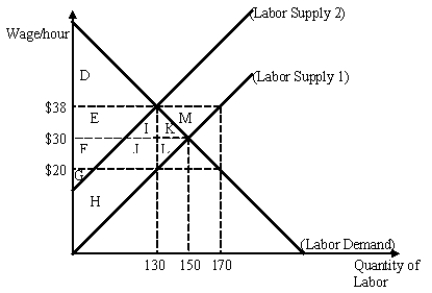 -Refer to Figure 19-3.Suppose the manufacturing labor market,which is non-unionized,is in equilibrium at a wage equal to $30.Suppose now that the AFL-CIO (a labor organization)organizes the workers in the manufacturing market and negotiates a wage of $38 per hour.Because of the union,
 (Multiple Choice)
4.9/5 (74)
(74) Explain the theory that education acts as a signaling device.How does this contrast with the theory of education as an investment in human capital?
(Essay)
4.8/5 (93)
(93) As more companies rely on computer databases and less on filing cabinets,the (i) demand for computer programmers will rise.
(ii) wage paid to filing clerks will rise.
(iii) wage paid to computer programmers will rise.
(Multiple Choice)
4.9/5 (79)
(79) Patrick is considering two different jobs in the same city - one as a bicycle courier and the other as a mail room clerk.Both require equivalent training.He finds neither job very appealing,but,if they pay the same wage rate,Patrick would prefer to work as a mail room clerk.In order for Patrick to find the two jobs equally attractive,the
(Multiple Choice)
4.9/5 (79)
(79) Philip is the best contractor in town,and he earns $400,000 a year.Billy is an average contractor in town,and he earns $80,000 a year.Philip's contracting services
(Multiple Choice)
4.8/5 (78)
(78) Which of the following theories explains why increased education translates into higher wages? (i) human-capital theory
(ii) the theory of compensating differentials
(iii) signaling theory
(Multiple Choice)
4.8/5 (78)
(78) Offering different opportunities to similar individuals who differ only by race,ethnic group,sex,age,or other personal characteristics is called
(Multiple Choice)
4.9/5 (61)
(61) A plumber who specializes in cleaning plugged sewer lines is typically paid a higher wage than a plumber who works on installing water systems in new residential housing.This can be partially explained by the fact that
(Multiple Choice)
4.8/5 (84)
(84) Coal mining is a dangerous and dirty job.Suppose someone developed new machinery that made coal mining safer and cleaner;at the same time,it made coal miners more productive.We would expect that the wages of coal miners would
(Multiple Choice)
4.7/5 (79)
(79) Which of the following statements is correct? (i) Since the 1940s,the number of American workers employed in the manufacturing sector has declined from 30 percent to 10 percent.
(ii) Since 1910,the number of Americans working as farmers has declined from 33 percent to 3 percent.
(iii) Since 1995,global industrial output has fallen by more than 30 percent.
(iv) Productivity increases are one reason for the declining number of manufacturing jobs.
(Multiple Choice)
4.8/5 (86)
(86) Which of the following is not a consequence of above-equilibrium wages in a labor market?
(Multiple Choice)
4.8/5 (93)
(93) When two workers work for the same company but get paid different wages,there is likely to be a
(Multiple Choice)
4.8/5 (66)
(66) 
Filters
- Essay(0)
- Multiple Choice(0)
- Short Answer(0)
- True False(0)
- Matching(0)