



 Chat with AI
Exam 19: Earnings and Discrimination

Exam 1: Ten Principles of Economics237 Questions
Exam 2: Thinking Like an Economist267 Questions
Exam 3: Interdependence and the Gains From Trade217 Questions
Exam 4: The Market Forces of Supply and Demand303 Questions
Exam 5: Elasticity and Its Applications282 Questions
Exam 6: Supply, demand, and Government Policies252 Questions
Exam 7: Consumers, producers, and the Efficiency of Markets248 Questions
Exam 8: Application: the Costs of Taxation245 Questions
Exam 9: Application: International Trade245 Questions
Exam 10: Externalities288 Questions
Exam 11: Public Goods and Common Resources258 Questions
Exam 12: The Design of the Tax System328 Questions
Exam 13: The Costs of Production303 Questions
Exam 14: Firms in Competitive Markets271 Questions
Exam 15: Monopoly306 Questions
Exam 16: Oligopoly291 Questions
Exam 17: Monopolistic Competition257 Questions
Exam 18: The Markets for the Factors of Production284 Questions
Exam 19: Earnings and Discrimination286 Questions
Exam 20: Income Inequality and Poverty247 Questions
Exam 21: The Theory of Consumer Choice238 Questions
Exam 22: Frontiers of Microeconomics199 Questions
Exam 23: Measuring a Nations Income215 Questions
Exam 24: Measuring the Cost of Living208 Questions
Exam 25: Production and Growth240 Questions
Exam 26: Saving, investment, and the Financial System282 Questions
Exam 27: The Basic Tools of Finance249 Questions
Exam 28: Unemployment242 Questions
Exam 29: The Monetary System277 Questions
Exam 30: Money Growth and Inflation224 Questions
Exam 31: Open-Economy Macroeconomics: Basic Concepts256 Questions
Exam 32: A Macroeconomic Theory of the Open Economy217 Questions
Exam 33: Aggregate Demand and Aggregate Supply302 Questions
Exam 34: The Influence of Monetary and Fiscal Policy on Aggregate Demand249 Questions
Exam 35: The Short Run Trade Off Between Inflation and Unemployment246 Questions
Exam 36: Five Debates Over Macroeconomic Policy140 Questions
Select questions type


The statement that "coal miners are paid more than workers with similar levels of education" is likely to reflect the fact that
(Multiple Choice)
4.9/5  (99)
(99) In the signaling theory of education, (i) schooling itself does not lead to more productive workers.
(ii) the worker signals to the employer that he is a valuable employee because he was willing to spend time to get an education.
(iii) schooling enhances worker productivity.
(Multiple Choice)
4.9/5 (80)
(80) Which theory explains the fact that some firms may choose to pay their employees more then they would earn as determined by equilibrium in the labor market?
(Multiple Choice)
4.8/5 (80)
(80) Which of the following scenarios would serve to decrease the demand for unskilled labor in our country?
(Multiple Choice)
4.8/5 (74)
(74) Which of the following sets of circumstances is likely to provide the best evidence in support of the theory of efficiency wages?
(Multiple Choice)
4.8/5 (86)
(86) Workers whose skills become obsolete as a result of technological change are often paid a lower wage as a result of
(Multiple Choice)
4.8/5 (72)
(72) Which of the following represents an example of labor-market discrimination?
(Multiple Choice)
4.9/5 (84)
(84) Scenario 19-5
Billy works for the local piano moving company part-time after school. Billy has worked for the company for two years but still hasn't received a wage increase, even though newer employees have received raises. Billy has threatened his employer with a lawsuit if he doesn't get a raise in the next few weeks. Billy believes he is a victim of labor-market discrimination.
-Refer to Scenario 19-5.In a competitive market for piano movers,why might Billy's wage differential persist?
(Multiple Choice)
4.9/5 (78)
(78) Why do major-league baseball players get paid more than minor-league players?
(Multiple Choice)
4.7/5 (89)
(89) The case study of segregated street cars in southern cities illustrates which of the following?
(Multiple Choice)
4.8/5 (69)
(69) Politicians often point to wage differentials as evidence of labor-market discrimination against ethnic minorities and women;however,economists argue against this approach because people differ in the kinds of work they are willing and able to do.
(True/False)
4.7/5 (73)
(73) Above-equilibrium wages caused by efficiency wages will most likely result in (i) an increase in the quantity of labor supplied.
(ii) a surplus of labor.
(iii) increased unemployment.
(Multiple Choice)
4.8/5 (81)
(81) When discrimination occurs as a result of prejudice,firms do not maximize profits.
(True/False)
4.7/5 (90)
(90) Empirical evidence suggests that ability,effort,and chance are not likely to be significant contributors to wage differences.
(True/False)
4.8/5 (70)
(70) Economists who attempt to explain the increasing earnings gap between skilled and unskilled workers offer two main hypotheses:
(Multiple Choice)
4.8/5 (93)
(93) Figure 19-2
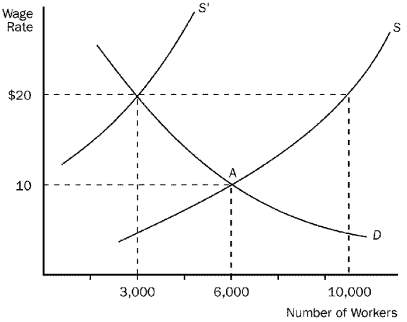 -Refer to Figure 19-2.This figure depicts labor demand and supply in a nonunionized labor market.The original equilibrium is at point A.If a labor union subsequently establishes a union shop and negotiates an hourly wage of $20,then the employment level
 (Multiple Choice)
4.9/5 (99)
(99) Women are clearly underrepresented in the economics profession.This is possibly evidence of (i) self-selection of females into other occupations.
(ii) cultural bias in primary and secondary education.
(iii) labor market discrimination.
(Multiple Choice)
4.8/5 (84)
(84) An effective minimum wage law will increase the quantity of labor demanded.
(True/False)
4.9/5 (85)
(85) Evaluate the following statement: "The gender pay gap provides evidence of widespread,severe,ongoing discrimination by employers and fellow workers."
(Essay)
4.8/5 (89)
(89) In the signaling theory of education, (i) schooling makes workers more productive in the short-run.
(ii) schooling makes workers more productive in the long-run.
(iii) the worker signals to the employer that he is a valuable employee because he was willing to spend time to get an education.
(Multiple Choice)
4.9/5 (69)
(69) 
Filters
- Essay(0)
- Multiple Choice(0)
- Short Answer(0)
- True False(0)
- Matching(0)