



 Chat with AI
Exam 19: Earnings and Discrimination

Exam 1: Ten Principles of Economics237 Questions
Exam 2: Thinking Like an Economist267 Questions
Exam 3: Interdependence and the Gains From Trade217 Questions
Exam 4: The Market Forces of Supply and Demand303 Questions
Exam 5: Elasticity and Its Applications282 Questions
Exam 6: Supply, demand, and Government Policies252 Questions
Exam 7: Consumers, producers, and the Efficiency of Markets248 Questions
Exam 8: Application: the Costs of Taxation245 Questions
Exam 9: Application: International Trade245 Questions
Exam 10: Externalities288 Questions
Exam 11: Public Goods and Common Resources258 Questions
Exam 12: The Design of the Tax System328 Questions
Exam 13: The Costs of Production303 Questions
Exam 14: Firms in Competitive Markets271 Questions
Exam 15: Monopoly306 Questions
Exam 16: Oligopoly291 Questions
Exam 17: Monopolistic Competition257 Questions
Exam 18: The Markets for the Factors of Production284 Questions
Exam 19: Earnings and Discrimination286 Questions
Exam 20: Income Inequality and Poverty247 Questions
Exam 21: The Theory of Consumer Choice238 Questions
Exam 22: Frontiers of Microeconomics199 Questions
Exam 23: Measuring a Nations Income215 Questions
Exam 24: Measuring the Cost of Living208 Questions
Exam 25: Production and Growth240 Questions
Exam 26: Saving, investment, and the Financial System282 Questions
Exam 27: The Basic Tools of Finance249 Questions
Exam 28: Unemployment242 Questions
Exam 29: The Monetary System277 Questions
Exam 30: Money Growth and Inflation224 Questions
Exam 31: Open-Economy Macroeconomics: Basic Concepts256 Questions
Exam 32: A Macroeconomic Theory of the Open Economy217 Questions
Exam 33: Aggregate Demand and Aggregate Supply302 Questions
Exam 34: The Influence of Monetary and Fiscal Policy on Aggregate Demand249 Questions
Exam 35: The Short Run Trade Off Between Inflation and Unemployment246 Questions
Exam 36: Five Debates Over Macroeconomic Policy140 Questions
Select questions type


In recent years,the amount of international trade in which the United States engages has
(Multiple Choice)
4.9/5  (74)
(74) Figure 19-3
The manufacturing labor market.
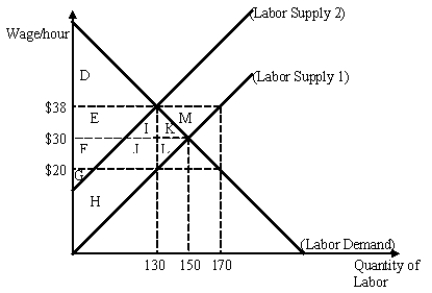 -Refer to Figure 19-3.Suppose the manufacturing labor market,which is non-unionized,is in equilibrium at a wage equal to $30.Suppose now that the AFL-CIO (a labor organization)organizes the workers in the manufacturing market and negotiates a wage of $38 per hour.After the workers become unionized,how many workers do manufacturing firms collectively hire?
 (Multiple Choice)
4.9/5 (88)
(88) Which of the following can be used to help explain wage differences among different groups of workers?
(Multiple Choice)
4.9/5 (81)
(81) Regarding the possibility of labor-market discrimination,a consensus view among economists is that
(Multiple Choice)
4.8/5 (84)
(84) All differences in wages that are not accounted for by differences in human-capital investment are likely to be a result of discrimination.
(True/False)
4.8/5 (84)
(84) Which of the following affects a worker's wage? (i) worker characteristics such as years of experience and education
(ii) job attributes such as the unpleasantness of the work
(iii) discrimination based on the age,race,or gender of the worker
(Multiple Choice)
4.9/5 (94)
(94) In the country of Amazonia,men and women have the same level of education and choose different forms of work in the same proportions.The only real difference is that men typically stay home to raise young children,returning to the work force after their children enter elementary school.If no discrimination exists,then we would expect that,on average,
(Multiple Choice)
4.9/5 (71)
(71) The statement that "the rich get richer,and the poor get poorer" is supported by evidence of an expanding wage gap between high-skill and low-skill workers.
(True/False)
4.8/5 (84)
(84) Which of the following explains the "beauty premium" differences in wages?
(Multiple Choice)
4.9/5 (80)
(80) Bob and Rob are identical twins who attended grammar school through college together.Bob took a job as an engineer who must travel out of state once a week.Rob took a job as an engineer who does not have to travel out of the state.Bob earns $100,000 a year,and Rob earns $85,000 a year.Select the best explanation for this wage difference.
(Multiple Choice)
4.7/5 (79)
(79) Store clerks are known to have low wages.This is likely to be reflect the fact that
(Multiple Choice)
4.8/5 (71)
(71) By definition,there is discrimination when the marketplace offers different opportunities to similar individuals who differ only by
(Multiple Choice)
4.8/5 (85)
(85) How does the theory of efficiency wages explain above-equilibrium wages?
(Multiple Choice)
4.9/5 (73)
(73) Scenario 19-4
Assume that the labor market for barbers is competitive and that it is differentiated into two groups: barbers who are bald (or going bald) and those who have a full head of hair. Assume that the barbers in this market have identical hair-cutting ability, regardless of whether they are bald or not. Currently the equilibrium wage in the bald barber market is lower than that in the nonbald market. Further assume that the market for haircuts is competitive.
-Refer to Scenario 19-4.If some consumers in the market for haircuts have a strong preference for having their hair cut by a barber who is not going bald,then
(Multiple Choice)
4.8/5 (82)
(82) When economists study wages,they relate a worker's wage to those variables that are most subject to measurement.Which of the following are most likely to be unmeasurable?
(Multiple Choice)
4.9/5 (72)
(72) Suppose that the country of Libraria made a concerted effort to increase the educational level of its people.If this effort had no effect on the wages of its workers,one might consider this as evidence in support of
(Multiple Choice)
4.8/5 (73)
(73) 
Filters
- Essay(0)
- Multiple Choice(0)
- Short Answer(0)
- True False(0)
- Matching(0)