



 Chat with AI
Exam 6: Sellers and Incentives

Exam 1: The Principles and Practice of Economics103 Questions
Exam 2: Economic Methods and Economic Questions94 Questions
Exam 3: Optimization: Doing the Best You Can94 Questions
Exam 4: Demand, supply, and Equilibrium185 Questions
Exam 5: Consumers and Incentives187 Questions
Exam 6: Sellers and Incentives261 Questions
Exam 7: Perfect Competition and the Invisible Hand251 Questions
Exam 8: Trade264 Questions
Exam 9: Externalities and Public Goods223 Questions
Exam 10: The Government in the Economy: Taxation and Regulation244 Questions
Exam 11: Markets for Factors of Production237 Questions
Exam 12: Monopoly295 Questions
Exam 13: Game Theory and Strategic Play199 Questions
Exam 14: Oligopoly and Monopolistic Competition264 Questions
Exam 15: Trade-Offs Involving Time and Risk147 Questions
Exam 16: The Economics of Information119 Questions
Exam 17: Auctions and Bargaining123 Questions
Exam 18: Social Economics111 Questions
Select questions type


Scenario: Selma runs a pastry shop. The following table shows the total number of cupcakes produced as a function of the number of hours of labor put into making them.
 -Refer to the scenario above.The "diminishing marginal returns" in this production process is observed when the ________ hour of labor is employed.
 (Multiple Choice)
5.0/5  (93)
(93) The following graph represents the total production of a firm on the y-axis, and the number of employees on the x-axis.
 -Refer to the figure above.Specialization begins to occur when the ________.
 (Multiple Choice)
4.8/5 (87)
(87) Is it true that in the long run it is impossible for firms functioning in a perfectly competitive market to earn positive economic profits? Explain your answer.
(Essay)
4.9/5 (81)
(81) Define the terms "economies of scale," "constant returns to scale," and "diseconomies of scale." Among these three situations,operating in which stage is likely to be the most profitable for a firm?
(Essay)
4.7/5 (61)
(61) If the percentage change in the quantity supplied of a good is less than the percentage change in the price of the good,the price elasticity of the good is likely to be ________.
(Multiple Choice)
4.9/5 (75)
(75) As the amount of inventory maintained by a firm increases,________.
(Multiple Choice)
4.8/5 (72)
(72) In a perfectly competitive market,firms earn zero economic profits in the long run.Why?
(Essay)
4.7/5 (75)
(75) A production function establishes the relationship between ________.
(Multiple Choice)
4.8/5 (79)
(79) The following graph shows the supply curve of a product.What is the arc price elasticity of supply of this product when its price changes from $12 to $8?
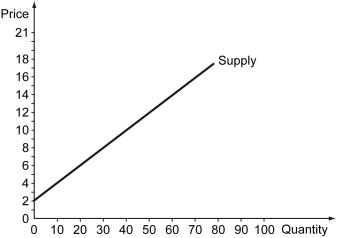
(Multiple Choice)
4.9/5 (75)
(75) The figure below shows the supply and the demand for a good (left) and the cost curves of an individual firm in this market (right). Assume that all firms in this market, including the potential entrants, have identical cost curves. Initially, the market is in equilibrium at point A.
 -Refer to the figure above.At the equilibrium A,each firm in the market earns ________ and there will be ________.
 (Multiple Choice)
4.9/5 (81)
(81) The following table shows the total output, number of workers employed, variable costs, and fixed costs of a firm.
 -Refer to the table above.What is the total cost of producing 145 units of the good?
 (Multiple Choice)
4.9/5 (77)
(77) Calculate the price elasticity of supply for the following goods.Also comment on the elasticity in each case.
a)When the price of a good is $100,200 units are supplied.But when the price increases to $300,220 units are supplied.
b)When the price of a good is $50,50 units are supplied.But when the price decreases to $30,10 units are supplied.
(Essay)
4.9/5 (81)
(81) If firms in a perfectly competitive market are realizing economic losses in the short run,________.
(Multiple Choice)
4.9/5 (92)
(92) A firm producing 10 units of output incurs a total cost of $800.When it produces 11 units,the total cost increases to $890.What is the marginal cost of producing the eleventh unit?
(Multiple Choice)
4.9/5 (67)
(67) Are the terms "shutdown" and "exit" synonymous? What is the optimal shutdown rule for a firm?
(Essay)
4.9/5 (94)
(94) Why would a firm decide to produce a positive quantity of a output even though it makes negative profits by doing so?
(Multiple Choice)
4.9/5 (80)
(80) 
Filters
- Essay(0)
- Multiple Choice(0)
- Short Answer(0)
- True False(0)
- Matching(0)