



 Chat with AI
Exam 20: The Evolutionary History of Life

Exam 1: The Nature of Science and the Characteristics of Life82 Questions
Exam 2: Biological Diversity, Bacteria, and Archaea101 Questions
Exam 3: Protista, Plantae, and Fungi83 Questions
Exam 4: Animalia81 Questions
Exam 5: The Chemistry of Life92 Questions
Exam 6: Cell Structure and Internal Compartments87 Questions
Exam 7: Cell Membranes, Transport, and Communication85 Questions
Exam 8: Energy, Metabolism, and Enzymes81 Questions
Exam 9: Photosynthesis and Cellular Respiration84 Questions
Exam 10: Cell Division89 Questions
Exam 11: Stem Cells, Cancer, and Human Health93 Questions
Exam 12: Patterns of Inheritance75 Questions
Exam 13: Chromosomes and Human Genetics75 Questions
Exam 14: Dna and Genes105 Questions
Exam 15: From Gene to Protein80 Questions
Exam 16: Dna Technology80 Questions
Exam 17: How Evolution Works80 Questions
Exam 18: Evolution of Populations80 Questions
Exam 19: Speciation and the Origins of Biological Diversity80 Questions
Exam 20: The Evolutionary History of Life100 Questions
Exam 21: The Biosphere89 Questions
Exam 22: Growth of Populations69 Questions
Exam 23: Ecological Communities133 Questions
Exam 24: Ecosystems75 Questions
Exam 25: Global Change70 Questions
Exam 26: Internal Organization and Homeostasis79 Questions
Exam 27: Nutrition and Digestion80 Questions
Exam 28: Circulation and Gas Exchange77 Questions
Exam 29: Animal Hormones78 Questions
Exam 30: Nervous and Sensory Systems78 Questions
Exam 31: Skeletons, Muscles, and Movement78 Questions
Exam 32: Defenses Against Disease78 Questions
Exam 33: Reproduction and Development76 Questions
Exam 34: Animal Behavior76 Questions
Exam 35: Plant Structure, Nutrition, and Transport80 Questions
Exam 36: Plant Growth and Reproduction80 Questions
Select questions type


Which kind of organism makes up the oldest fossil found on Earth?
(Multiple Choice)
4.8/5  (80)
(80) Descendants of ____________________ were among the first organisms to colonize land.
(Short Answer)
4.9/5 (76)
(76) The first single-celled prokaryotes evolved 3 billion years after the first eukaryotes.
(True/False)
4.9/5 (80)
(80) Many organisms decompose rapidly after death; some organisms have had soft bodies and some areas where organisms died have undergone massive geologic changes. For these reasons, the ____________________ record is incomplete.
(Short Answer)
4.7/5 (79)
(79) An archaeologist discovers several skeletons and a collection of stone tools of the same age in a cave. The individuals were clearly bipedal. The skull shows that the individual had a small brain (compared to modern humans)and apelike teeth. Which of the following did the archaeologist most likely discover?
(Multiple Choice)
4.9/5 (67)
(67) Which of the following does not lead to adaptive radiation?
(Multiple Choice)
4.9/5 (75)
(75) The extinction of dinosaurs caused an end to the ____________________ between dinosaurs and mammals, thus allowing mammals to evolve to fill some ecological roles the dinosaurs had previously filled.
(Short Answer)
4.8/5 (75)
(75) Which of the following statements about the fossil record is true?
(Multiple Choice)
4.9/5 (80)
(80) Which word could not be included in a description of humans?
(Multiple Choice)
4.9/5 (68)
(68) Which of the following is not documented by the fossil record?
(Multiple Choice)
4.9/5 (66)
(66) The first group of vertebrates that could complete their life cycle without returning to water was
(Multiple Choice)
4.8/5 (95)
(95) Hominids adapted to life on the ground approximately _____ years ago.
(Multiple Choice)
4.8/5 (84)
(84) During the time of Pangaea, an ancestor of modern crocodiles inhabited the region marked by the star in this map (left in the figure below). 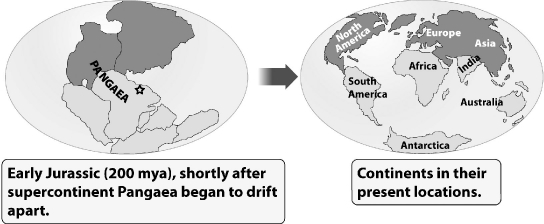 Where would you expect to find fossils of this animal today (the map on the right)?
 (Multiple Choice)
4.8/5 (91)
(91) Which of the following groups of animals evolved the most recently?
(Multiple Choice)
4.8/5 (67)
(67) Which of the following methods would give the most accurate estimate of the age of a fossil?
(Multiple Choice)
4.8/5 (75)
(75) The leg bones of the first tetrapod (shown in the diagram below)are hypothesized to have evolved from bones in the 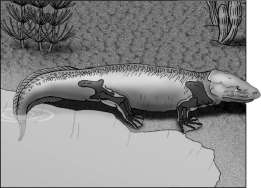
(Multiple Choice)
4.8/5 (68)
(68) 
Filters
- Essay(0)
- Multiple Choice(0)
- Short Answer(0)
- True False(0)
- Matching(0)