



 Chat with AI
Exam 20: The Evolutionary History of Life

Exam 1: The Nature of Science and the Characteristics of Life82 Questions
Exam 2: Biological Diversity, Bacteria, and Archaea101 Questions
Exam 3: Protista, Plantae, and Fungi83 Questions
Exam 4: Animalia81 Questions
Exam 5: The Chemistry of Life92 Questions
Exam 6: Cell Structure and Internal Compartments87 Questions
Exam 7: Cell Membranes, Transport, and Communication85 Questions
Exam 8: Energy, Metabolism, and Enzymes81 Questions
Exam 9: Photosynthesis and Cellular Respiration84 Questions
Exam 10: Cell Division89 Questions
Exam 11: Stem Cells, Cancer, and Human Health93 Questions
Exam 12: Patterns of Inheritance75 Questions
Exam 13: Chromosomes and Human Genetics75 Questions
Exam 14: Dna and Genes105 Questions
Exam 15: From Gene to Protein80 Questions
Exam 16: Dna Technology80 Questions
Exam 17: How Evolution Works80 Questions
Exam 18: Evolution of Populations80 Questions
Exam 19: Speciation and the Origins of Biological Diversity80 Questions
Exam 20: The Evolutionary History of Life100 Questions
Exam 21: The Biosphere89 Questions
Exam 22: Growth of Populations69 Questions
Exam 23: Ecological Communities133 Questions
Exam 24: Ecosystems75 Questions
Exam 25: Global Change70 Questions
Exam 26: Internal Organization and Homeostasis79 Questions
Exam 27: Nutrition and Digestion80 Questions
Exam 28: Circulation and Gas Exchange77 Questions
Exam 29: Animal Hormones78 Questions
Exam 30: Nervous and Sensory Systems78 Questions
Exam 31: Skeletons, Muscles, and Movement78 Questions
Exam 32: Defenses Against Disease78 Questions
Exam 33: Reproduction and Development76 Questions
Exam 34: Animal Behavior76 Questions
Exam 35: Plant Structure, Nutrition, and Transport80 Questions
Exam 36: Plant Growth and Reproduction80 Questions
Select questions type


The term that describes the upright walking of humans on two legs is ____________________.
(Short Answer)
4.9/5  (77)
(77) Following each of Earth's five mass extinction, the diversity of life on Earth has ____________________ [increased or decreased] over time.
(Short Answer)
4.8/5 (81)
(81) The most recent mass extinction, which occurred during the Cretaceous period, may have been caused by
(Multiple Choice)
4.8/5 (72)
(72) The genes that once encoded the development of the human tail may still be present in the human genome.
(True/False)
4.9/5 (78)
(78) Oxygen was one of the original gases abundant in Earth's atmosphere before the evolution of life.
(True/False)
4.9/5 (84)
(84) 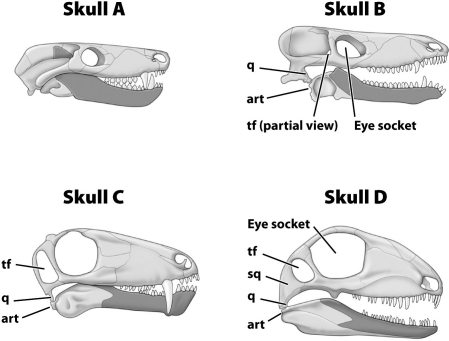
The evidence of a partially opposable big toe in early hominid foot-bone fossils suggests that early hominids
(Multiple Choice)
4.8/5 (86)
(86) Living humans evolved from ape ancestors without intermediate steps.
(True/False)
4.9/5 (75)
(75) For insects, could there be a connection between being the first organism to fly and being the most diverse terrestrial organism today?
(Multiple Choice)
4.8/5 (72)
(72) Scientists use existing fossils to predict what the transitional forms between organisms might look like. Why is it so hard for scientists to find fossils of these transitional forms?
(Multiple Choice)
4.9/5 (89)
(89) The Permian explosion gave rise to all the modern animal phyla (and many that no longer exist).
(True/False)
4.9/5 (91)
(91) What does the positioning of the toe indicated by the arrow in this figure suggest about the owner of this fossil hominid foot? 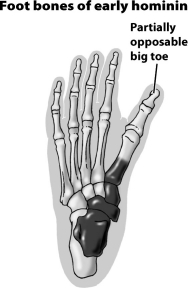
(Multiple Choice)
4.8/5 (89)
(89) The first members of the genus Homo originated on the continent of ____________________.
(Short Answer)
4.8/5 (61)
(61) You are looking at the side of a cliff with many clearly visible layers of rock. In the top layer you find the fossil of a mouse. In the next layer down you find the fossil of a frog. Two layers down from that you find the fossil of a beetle, and in the deepest layer the fossil of a millipede. This is evidence that
(Multiple Choice)
4.8/5 (79)
(79) Mammals branched out to evolve many new species after the extinction of the ____________________.
(Short Answer)
5.0/5 (85)
(85) Mammals evolved from ____________________ about 220 million years ago.
(Short Answer)
4.8/5 (69)
(69) Using Uranium-235, a ____________________ with a half-life of 700 million years, allows scientists to determine the approximate age of a fossil.
(Short Answer)
4.9/5 (96)
(96) 
Filters
- Essay(0)
- Multiple Choice(0)
- Short Answer(0)
- True False(0)
- Matching(0)