



 Chat with AI
Exam 20: The Evolutionary History of Life

Exam 1: The Nature of Science and the Characteristics of Life82 Questions
Exam 2: Biological Diversity, Bacteria, and Archaea101 Questions
Exam 3: Protista, Plantae, and Fungi83 Questions
Exam 4: Animalia81 Questions
Exam 5: The Chemistry of Life92 Questions
Exam 6: Cell Structure and Internal Compartments87 Questions
Exam 7: Cell Membranes, Transport, and Communication85 Questions
Exam 8: Energy, Metabolism, and Enzymes81 Questions
Exam 9: Photosynthesis and Cellular Respiration84 Questions
Exam 10: Cell Division89 Questions
Exam 11: Stem Cells, Cancer, and Human Health93 Questions
Exam 12: Patterns of Inheritance75 Questions
Exam 13: Chromosomes and Human Genetics75 Questions
Exam 14: Dna and Genes105 Questions
Exam 15: From Gene to Protein80 Questions
Exam 16: Dna Technology80 Questions
Exam 17: How Evolution Works80 Questions
Exam 18: Evolution of Populations80 Questions
Exam 19: Speciation and the Origins of Biological Diversity80 Questions
Exam 20: The Evolutionary History of Life100 Questions
Exam 21: The Biosphere89 Questions
Exam 22: Growth of Populations69 Questions
Exam 23: Ecological Communities133 Questions
Exam 24: Ecosystems75 Questions
Exam 25: Global Change70 Questions
Exam 26: Internal Organization and Homeostasis79 Questions
Exam 27: Nutrition and Digestion80 Questions
Exam 28: Circulation and Gas Exchange77 Questions
Exam 29: Animal Hormones78 Questions
Exam 30: Nervous and Sensory Systems78 Questions
Exam 31: Skeletons, Muscles, and Movement78 Questions
Exam 32: Defenses Against Disease78 Questions
Exam 33: Reproduction and Development76 Questions
Exam 34: Animal Behavior76 Questions
Exam 35: Plant Structure, Nutrition, and Transport80 Questions
Exam 36: Plant Growth and Reproduction80 Questions
Select questions type


The development of an upright stance in human ancestors is thought to be linked to
(Multiple Choice)
4.8/5  (78)
(78) Which of the following is not a difference between living mammals and living reptiles?
(Multiple Choice)
4.9/5 (87)
(87) Recent evidence contradicts ____________________ law, which states that once a trait is lost in a species, it never comes back.
(Short Answer)
4.9/5 (85)
(85) The Cambrian explosion resulted in the evolution of more than 17,000 species of an animal known as the trilobite. The shear number of trilobite fossils found in modern times suggests that trilobites were very abundant, perhaps the rulers of the seas. Today, no living descendants of this group exist. What happened?
(Multiple Choice)
4.8/5 (76)
(76) Ninety-five percent of marine invertebrate species went extinct during the ____________________ mass extinction
(Short Answer)
4.8/5 (80)
(80) The oxygen necessary to support much of life on Earth is a waste product of an important adaptation, the process of ____________________.
(Short Answer)
4.9/5 (80)
(80) Based on the evolutionary tree in the figure below, Homo sapiens sapiens and Homo erectus both evolved from Homo habilis.
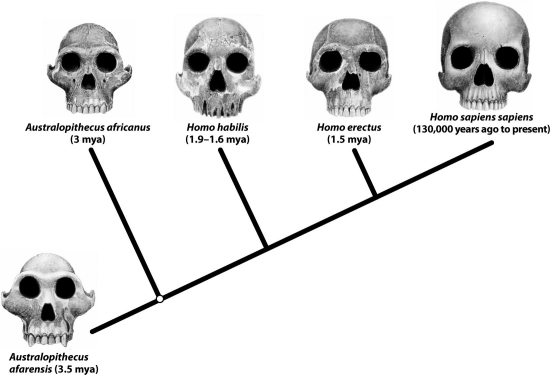
(True/False)
4.9/5 (68)
(68) The appearance of eukaryotes may have been delayed until more _____ accumulated in Earth's atmosphere.
(Multiple Choice)
4.8/5 (77)
(77) The first single-celled organisms arose 3.5 ____________________ years ago.
(Short Answer)
4.7/5 (79)
(79) Why might many new species form in the aftermath of a mass extinction?
(Multiple Choice)
4.9/5 (81)
(81) In the figure below, the arrows on the map indicate a hypothesis regarding the movement of modern human populations throughout the world.  In 2004, a set of human tools dated to 50,000 years old was found at the location of the star on the map (the southeast United States). If the age of these tools is correct, which of the following is true?
 (Multiple Choice)
4.9/5 (60)
(60) Adaptive ____________________ is the diversification of groups of organisms to form new species and higher taxonomic groups. It can occur after a mass extinction or at other times.
(Short Answer)
4.7/5 (75)
(75) The first eukaryotes evolved approximately _____ years ago.
(Multiple Choice)
4.9/5 (72)
(72) Examine the diagrammatic representation below of the multiregional hypothesis for the origin of modern humans. If this hypothesis is valid, what allowed all three hominid groups to develop into one species despite their different geographical locations? 
(Multiple Choice)
4.7/5 (72)
(72) Measuring the amount of the radioisotope ¹⁴C in a fossil that is assumed to be over 70,000 years is a good way to determine the age of the fossil.
(True/False)
4.8/5 (90)
(90) Which of the following is a characteristic of hominids but not of other primates?
(Multiple Choice)
5.0/5 (73)
(73) 
Filters
- Essay(0)
- Multiple Choice(0)
- Short Answer(0)
- True False(0)
- Matching(0)