



 Chat with AI
Exam 20: The Evolutionary History of Life

Exam 1: The Nature of Science and the Characteristics of Life82 Questions
Exam 2: Biological Diversity, Bacteria, and Archaea101 Questions
Exam 3: Protista, Plantae, and Fungi83 Questions
Exam 4: Animalia81 Questions
Exam 5: The Chemistry of Life92 Questions
Exam 6: Cell Structure and Internal Compartments87 Questions
Exam 7: Cell Membranes, Transport, and Communication85 Questions
Exam 8: Energy, Metabolism, and Enzymes81 Questions
Exam 9: Photosynthesis and Cellular Respiration84 Questions
Exam 10: Cell Division89 Questions
Exam 11: Stem Cells, Cancer, and Human Health93 Questions
Exam 12: Patterns of Inheritance75 Questions
Exam 13: Chromosomes and Human Genetics75 Questions
Exam 14: Dna and Genes105 Questions
Exam 15: From Gene to Protein80 Questions
Exam 16: Dna Technology80 Questions
Exam 17: How Evolution Works80 Questions
Exam 18: Evolution of Populations80 Questions
Exam 19: Speciation and the Origins of Biological Diversity80 Questions
Exam 20: The Evolutionary History of Life100 Questions
Exam 21: The Biosphere89 Questions
Exam 22: Growth of Populations69 Questions
Exam 23: Ecological Communities133 Questions
Exam 24: Ecosystems75 Questions
Exam 25: Global Change70 Questions
Exam 26: Internal Organization and Homeostasis79 Questions
Exam 27: Nutrition and Digestion80 Questions
Exam 28: Circulation and Gas Exchange77 Questions
Exam 29: Animal Hormones78 Questions
Exam 30: Nervous and Sensory Systems78 Questions
Exam 31: Skeletons, Muscles, and Movement78 Questions
Exam 32: Defenses Against Disease78 Questions
Exam 33: Reproduction and Development76 Questions
Exam 34: Animal Behavior76 Questions
Exam 35: Plant Structure, Nutrition, and Transport80 Questions
Exam 36: Plant Growth and Reproduction80 Questions
Select questions type


Which of the following was not necessary for plants to develop in order to adapt to life on land?
(Multiple Choice)
4.9/5  (84)
(84) The organism below is the evolutionary ancestor of the modern whale.
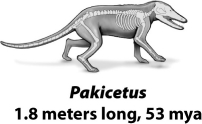
(True/False)
4.8/5 (86)
(86) Based on the "out-of-Africa" hypothesis, which of the following is the most likely reason why species like Neandertals and Homo floresiensis do not exist today?
(Multiple Choice)
4.8/5 (86)
(86) Why did it take so long for eukaryotes to evolve after photosynthetic prokaryotes began releasing O₂ into the atmosphere?
(Multiple Choice)
4.9/5 (70)
(70) After the extinction of the dinosaurs the adaptive radiation of ____________________ set the stage for the eventual evolution of humans.
(Short Answer)
4.8/5 (97)
(97) Fossil anklebones from the ancestors of whales and the anklebones of hippopotamuses have the same shape, which is an adaptation for running on land. This suggests that
(Multiple Choice)
4.9/5 (94)
(94) Continental drift has played a role in which of the following?
(Multiple Choice)
4.8/5 (62)
(62) Which of the following is not an advantage of being bipedal?
(Multiple Choice)
4.8/5 (66)
(66) Life evolved in the oceans long before it evolved on land. Which of the following had to occur before organisms were able to live on land?
(Multiple Choice)
4.7/5 (81)
(81) ____________________ have flexible arm joints, short snouts, opposable thumbs, and big toes.
(Short Answer)
4.8/5 (83)
(83) Which of the following is not true about archaic Homo sapiens species?
(Multiple Choice)
4.9/5 (68)
(68) The figure below shows the number of living taxonomic families that existed on Earth during the last 540 million years. The sudden decreases in family numbers at 445, 360, 250, 200, and 65 million years ago represent Earth's five mass extinction events. Based on this data, which mass extinction had the biggest impact on the overall diversity of life on Earth? 
(Multiple Choice)
4.8/5 (78)
(78) A certain species of tree frog was able to "re-evolve" teeth on their lower jaws because
(Multiple Choice)
4.8/5 (78)
(78) By about a half million years ago, our human ancestors were probably hunting large game and using fire.
(True/False)
4.7/5 (75)
(75) The earliest forms of life evolved and lived in ____________________.
(Short Answer)
4.9/5 (75)
(75) Which of the following is not a key step in the evolutionary transition from reptiles to mammals?
(Multiple Choice)
4.8/5 (85)
(85) 
Filters
- Essay(0)
- Multiple Choice(0)
- Short Answer(0)
- True False(0)
- Matching(0)