



 Chat with AI
Exam 5: The Chemistry of Life

Exam 1: The Nature of Science and the Characteristics of Life82 Questions
Exam 2: Biological Diversity, Bacteria, and Archaea101 Questions
Exam 3: Protista, Plantae, and Fungi83 Questions
Exam 4: Animalia81 Questions
Exam 5: The Chemistry of Life92 Questions
Exam 6: Cell Structure and Internal Compartments87 Questions
Exam 7: Cell Membranes, Transport, and Communication85 Questions
Exam 8: Energy, Metabolism, and Enzymes81 Questions
Exam 9: Photosynthesis and Cellular Respiration84 Questions
Exam 10: Cell Division89 Questions
Exam 11: Stem Cells, Cancer, and Human Health93 Questions
Exam 12: Patterns of Inheritance75 Questions
Exam 13: Chromosomes and Human Genetics75 Questions
Exam 14: Dna and Genes105 Questions
Exam 15: From Gene to Protein80 Questions
Exam 16: Dna Technology80 Questions
Exam 17: How Evolution Works80 Questions
Exam 18: Evolution of Populations80 Questions
Exam 19: Speciation and the Origins of Biological Diversity80 Questions
Exam 20: The Evolutionary History of Life100 Questions
Exam 21: The Biosphere89 Questions
Exam 22: Growth of Populations69 Questions
Exam 23: Ecological Communities133 Questions
Exam 24: Ecosystems75 Questions
Exam 25: Global Change70 Questions
Exam 26: Internal Organization and Homeostasis79 Questions
Exam 27: Nutrition and Digestion80 Questions
Exam 28: Circulation and Gas Exchange77 Questions
Exam 29: Animal Hormones78 Questions
Exam 30: Nervous and Sensory Systems78 Questions
Exam 31: Skeletons, Muscles, and Movement78 Questions
Exam 32: Defenses Against Disease78 Questions
Exam 33: Reproduction and Development76 Questions
Exam 34: Animal Behavior76 Questions
Exam 35: Plant Structure, Nutrition, and Transport80 Questions
Exam 36: Plant Growth and Reproduction80 Questions
Select questions type


You are given an unknown substance and asked to determine whether it is polar or nonpolar. The easiest way to do this would be to
(Multiple Choice)
4.8/5  (77)
(77) ____________________ are a type of organic compound that plays roles in both heredity and the energy delivery in cells.
(Short Answer)
4.7/5 (87)
(87) Most living organisms consist of more than 70 percent ____________________ by weight.
(Short Answer)
4.9/5 (68)
(68) Individual water molecules orient toward each other because of the _____ bonds that form between them.
(Multiple Choice)
4.7/5 (92)
(92) When you place a piece of red meat on a hot barbeque, it slowly changes from soft to firm. Meat is primarily made of proteins. Which of the following might account for the change in texture during cooking?
(Multiple Choice)
4.8/5 (79)
(79) Fevers in young children are a particular concern because oxygen is less effectively transported by hemoglobin at high temperature. How might this be explained?
(Multiple Choice)
4.8/5 (94)
(94) Chemical reactions rearrange atoms but do not create or destroy them.
(True/False)
4.9/5 (79)
(79) The process of partial hydrogenation turns liquid plant lipids into semisolid lipids by
(Multiple Choice)
4.8/5 (78)
(78) A group of monomers bonded together form a ____________________.
(Short Answer)
4.8/5 (64)
(64) A monosaccharide is made up of several sugar molecules strung together.
(True/False)
4.9/5 (84)
(84) A solution with a pH of _____ is _____ times more acidic than a solution with a pH of _____.
(Multiple Choice)
4.8/5 (93)
(93) The uncharged component in the core of an atom is a(n)____________________.
(Short Answer)
4.8/5 (92)
(92) A scientist observed a chemical that changes to bright red in the presence of organic compounds containing nitrogen and phosphorus. To test this chemical, a set of test tubes each containing a purified sample of one of the following organic compounds is prepared. The chemical is then added to each tube. Which test tube will always turn bright red?
(Multiple Choice)
4.9/5 (87)
(87) Examine the illustration below, a representation of a sodium ion with a charge of +1. Based on the information provided determine the proton number for this atom. 
(Multiple Choice)
4.7/5 (83)
(83) The figure below shows the chemical structure and space-filling models for stearic acid and oleic acid.
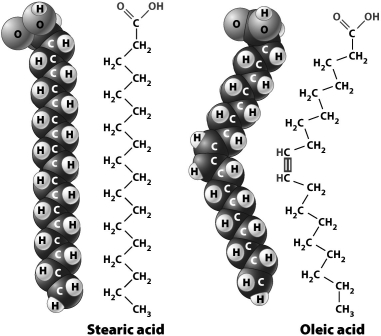 The reason oleic acid is slightly bent (as compared to stearic acid)is that it contains a ____________________ between two of its carbon atoms.
 (Short Answer)
4.8/5 (84)
(84) Trans fats have been linked to a variety of undesirable health complications that have historically been associated with saturated fats; what do the two types of molecules share in common that may account for their health impacts?
(Multiple Choice)
4.8/5 (85)
(85) 
Filters
- Essay(0)
- Multiple Choice(0)
- Short Answer(0)
- True False(0)
- Matching(0)