



 Chat with AI
Exam 5: The Chemistry of Life

Exam 1: The Nature of Science and the Characteristics of Life82 Questions
Exam 2: Biological Diversity, Bacteria, and Archaea101 Questions
Exam 3: Protista, Plantae, and Fungi83 Questions
Exam 4: Animalia81 Questions
Exam 5: The Chemistry of Life92 Questions
Exam 6: Cell Structure and Internal Compartments87 Questions
Exam 7: Cell Membranes, Transport, and Communication85 Questions
Exam 8: Energy, Metabolism, and Enzymes81 Questions
Exam 9: Photosynthesis and Cellular Respiration84 Questions
Exam 10: Cell Division89 Questions
Exam 11: Stem Cells, Cancer, and Human Health93 Questions
Exam 12: Patterns of Inheritance75 Questions
Exam 13: Chromosomes and Human Genetics75 Questions
Exam 14: Dna and Genes105 Questions
Exam 15: From Gene to Protein80 Questions
Exam 16: Dna Technology80 Questions
Exam 17: How Evolution Works80 Questions
Exam 18: Evolution of Populations80 Questions
Exam 19: Speciation and the Origins of Biological Diversity80 Questions
Exam 20: The Evolutionary History of Life100 Questions
Exam 21: The Biosphere89 Questions
Exam 22: Growth of Populations69 Questions
Exam 23: Ecological Communities133 Questions
Exam 24: Ecosystems75 Questions
Exam 25: Global Change70 Questions
Exam 26: Internal Organization and Homeostasis79 Questions
Exam 27: Nutrition and Digestion80 Questions
Exam 28: Circulation and Gas Exchange77 Questions
Exam 29: Animal Hormones78 Questions
Exam 30: Nervous and Sensory Systems78 Questions
Exam 31: Skeletons, Muscles, and Movement78 Questions
Exam 32: Defenses Against Disease78 Questions
Exam 33: Reproduction and Development76 Questions
Exam 34: Animal Behavior76 Questions
Exam 35: Plant Structure, Nutrition, and Transport80 Questions
Exam 36: Plant Growth and Reproduction80 Questions
Select questions type


Most lipids contain one or more of the long, hydrophobic hydrocarbon chains known as ____________________.
(Short Answer)
4.7/5  (87)
(87) We use soap to clean ourselves better than we could with water alone. Soaps contain phospholipids that are responsible for the cleansing action. Which of the following statements is the most likely explanation for how soaps work?
(Multiple Choice)
4.9/5 (68)
(68) An atom of the element with the atomic number of 11 (which can form an ion)always contains 11 _____.
(Multiple Choice)
4.9/5 (80)
(80) In the equation, 2 H₂O₂ → 2 H₂O + O₂, the H₂O₂ molecules are the _____ and the H₂O + O₂ molecules are the _____.
(Multiple Choice)
4.9/5 (90)
(90) After adding a small amount of Solution A to Solution B, the pH of Solution B declines from 8 to 3. Solution A must contain
(Multiple Choice)
4.9/5 (81)
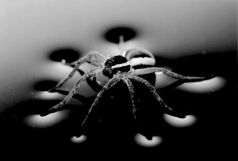
(81) Because both the wood in a tree branch and the spider's exoskeleton are composed of
low-density cellulose each floats when placed in water.
(True/False)
4.7/5 (72)
(72) ____________________ are the most hydrophobic of the four classes of organic compounds because they are made of hydrocarbon chains that repel water.
(Short Answer)
4.9/5 (87)
(87) Chemists often represent the structure of atoms using p, n, and e to indicate the numbers of protons, neutrons, and electrons; which atom would have an atomic weight of 30?
(Multiple Choice)
4.9/5 (90)
(90) Lipids with a four-ring structure are called ____________________.
(Short Answer)
4.7/5 (90)
(90) The primary structure of a protein consists of its amino acid sequence.
(True/False)
4.7/5 (79)
(79) The carbon dioxide you breathe out is carried to the lungs in the blood. Carbon dioxide, when dissolved in water, is an acid. How does the body prevent your blood from becoming too acidic on the way to your lungs?
(Multiple Choice)
4.7/5 (79)
(79) The figure below shows the structural and space-filling models for stearic acid and oleic acid. 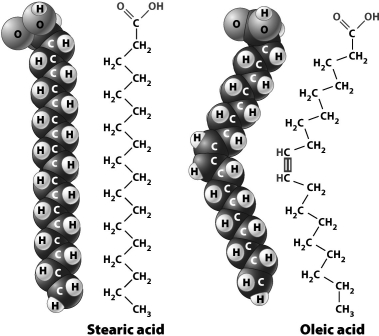 Although the two fatty acids have the same number of carbon atoms, they have different three-dimensional configurations; oleic acid has a slight bend near the middle. As a result,
 (Multiple Choice)
4.9/5 (86)
(86) Oxygen has six electrons in its outer shell that can hold up to eight electrons. As a result, oxygen will commonly form ____________________ covalent bonds.
(Short Answer)
4.7/5 (81)
(81) ____________________ molecules are nonpolar molecules that are repelled by water.
(Short Answer)
4.8/5 (93)
(93) An atom is in its most stable state when all its electron shells are filled to capacity.
(True/False)
4.9/5 (77)
(77) An atom that becomes charged due to the gain or loss of an electron is called a(n)____________________.
(Short Answer)
4.9/5 (82)
(82) 
Filters
- Essay(0)
- Multiple Choice(0)
- Short Answer(0)
- True False(0)
- Matching(0)