



 Chat with AI
Exam 6: The Behavior of Proteins: Enzymes

Exam 1: Biochemistry and the Organization of Cells73 Questions
Exam 2: Water: the Solvent for Biochemical Reactions85 Questions
Exam 3: Amino Acids and Peptides75 Questions
Exam 4: The Three-Dimensional Structure of Proteins82 Questions
Exam 5: Protein Purification and Characterization Techniques67 Questions
Exam 6: The Behavior of Proteins: Enzymes83 Questions
Exam 7: The Behavior of Proteins: Enzymes, Mechanisms, and Control81 Questions
Exam 8: Lipids and Proteins Are Associated in Biological Membranes90 Questions
Exam 9: Nucleic Acids: How Structure Conveys Information66 Questions
Exam 10: Biosynthesis of Nucleic Acids: Replication86 Questions
Exam 11: Transcription of the Genetic Code: Biosynthesis of RNA98 Questions
Exam 12: Protein Synthesis: Translation of the Genetic Message85 Questions
Exam 13: Nucleic Acid Biotechnology Techniques94 Questions
Exam 14: Viruses, Cancer, and Immunology42 Questions
Exam 15: The Importance of Energy Changes and Electron Transfer in Metabolism60 Questions
Exam 16: Carbohydrates92 Questions
Exam 17: Glycolysis67 Questions
Exam 18: Storage Mechanisms and Control in Carbohydrate Metabolism82 Questions
Exam 19: The Citric Acid Cycle80 Questions
Exam 20: Electron Transport and Oxidative Phosphorylation66 Questions
Exam 21: Lipid Metabolism95 Questions
Exam 22: Photosynthesis74 Questions
Exam 23: The Metabolism of Nitrogen78 Questions
Exam 24: Integration of Metabolism: Cellular Signaling68 Questions
Select questions type


Which of the following is true concerning a ping-pong mechanism?
(Multiple Choice)
4.9/5  (75)
(75) Which of the following is true about lactate dehydrogenase (LDH)?
(Multiple Choice)
4.9/5 (73)
(73) Exhibit 6A This is a reaction going on in your muscle cells right this very minute: The enzyme triose phosphate isomerase catalyzes this reaction in the forward direction as part of the glycolytic pathway. It follows simple Michaelis-Menten kinetics: Typical cellular concentrations: triose phosphate isomerase = 0.1 nM?dihydroxyacetone phosphate = 5 µM glyceraldehyde-3-phosphate = 2 µM

 -Refer to Exhibit 6A. What is the equilibrium constant for the uncatalyzed reaction?
 (Multiple Choice)
5.0/5 (74)
(74) Which of the following diseases has not been successfully treated using the principles of enzyme inhibition?
(Multiple Choice)
4.9/5 (85)
(85) The fundamental difference between competitive and noncompetitive inhibition is
(Multiple Choice)
4.8/5 (72)
(72) Generally speaking, a competitive inhibitor and the substrate cannot both bind to the enzyme at the same time.
(True/False)
4.8/5 (67)
(67) Exhibit 6A This is a reaction going on in your muscle cells right this very minute: The enzyme triose phosphate isomerase catalyzes this reaction in the forward direction as part of the glycolytic pathway. It follows simple Michaelis-Menten kinetics: Typical cellular concentrations: triose phosphate isomerase = 0.1 nM?dihydroxyacetone phosphate = 5 µM glyceraldehyde-3-phosphate = 2 µM
-Refer to Exhibit 6A. What is the actual velocity of the forward reaction under physiologic conditions?
-Refer to Exhibit 6A. What is the actual velocity of the forward reaction under physiologic conditions? (Multiple Choice)
4.9/5 (88)
(88) The initial rate of an enzymatic reaction is usually determined in order to assure that
(Multiple Choice)
4.9/5 (88)
(88) The E-S complex often shows as a slight depression in the energy profile for the reaction.
(True/False)
4.8/5 (89)
(89) The substrate will only bind to the enzyme when the shapes fit together rigidly.
(True/False)
4.8/5 (67)
(67) Exhibit 6A This is a reaction going on in your muscle cells right this very minute: The enzyme triose phosphate isomerase catalyzes this reaction in the forward direction as part of the glycolytic pathway. It follows simple Michaelis-Menten kinetics: Typical cellular concentrations: triose phosphate isomerase = 0.1 nM?dihydroxyacetone phosphate = 5 µM glyceraldehyde-3-phosphate = 2 µM
-Refer to Exhibit 6A. What is the KM of the enzyme?
-Refer to Exhibit 6A. What is the KM of the enzyme? (Multiple Choice)
4.9/5 (82)
(82) Which of the following is true about a mixed type inhibition?
(Multiple Choice)
4.9/5 (94)
(94) Exhibit 6A This is a reaction going on in your muscle cells right this very minute: The enzyme triose phosphate isomerase catalyzes this reaction in the forward direction as part of the glycolytic pathway. It follows simple Michaelis-Menten kinetics: Typical cellular concentrations: triose phosphate isomerase = 0.1 nM?dihydroxyacetone phosphate = 5 µM glyceraldehyde-3-phosphate = 2 µM
-Refer to Exhibit 6A. "Hindrate" is an inhibitor of triose phosphate isomerase. When it is added to cells at a concentration of 0.1 nM, the enzyme's KM for the substrate is unchanged, but the apparent Vmax is altered to 50 nM/sec. In the following graph, which line best represents the Lineweaver-Burk plot obtained in the presence of hindrate? 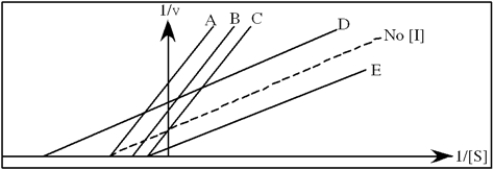
-Refer to Exhibit 6A. "Hindrate" is an inhibitor of triose phosphate isomerase. When it is added to cells at a concentration of 0.1 nM, the enzyme's KM for the substrate is unchanged, but the apparent Vmax is altered to 50 nM/sec. In the following graph, which line best represents the Lineweaver-Burk plot obtained in the presence of hindrate? (Multiple Choice)
4.8/5 (87)
(87) 
Filters
- Essay(0)
- Multiple Choice(0)
- Short Answer(0)
- True False(0)
- Matching(0)